Before proceeding to the pressure test
ensure the battery is fully charged. Battery
voltage must be over 12 volts.
Ensure there is enough gas in fuel tank.
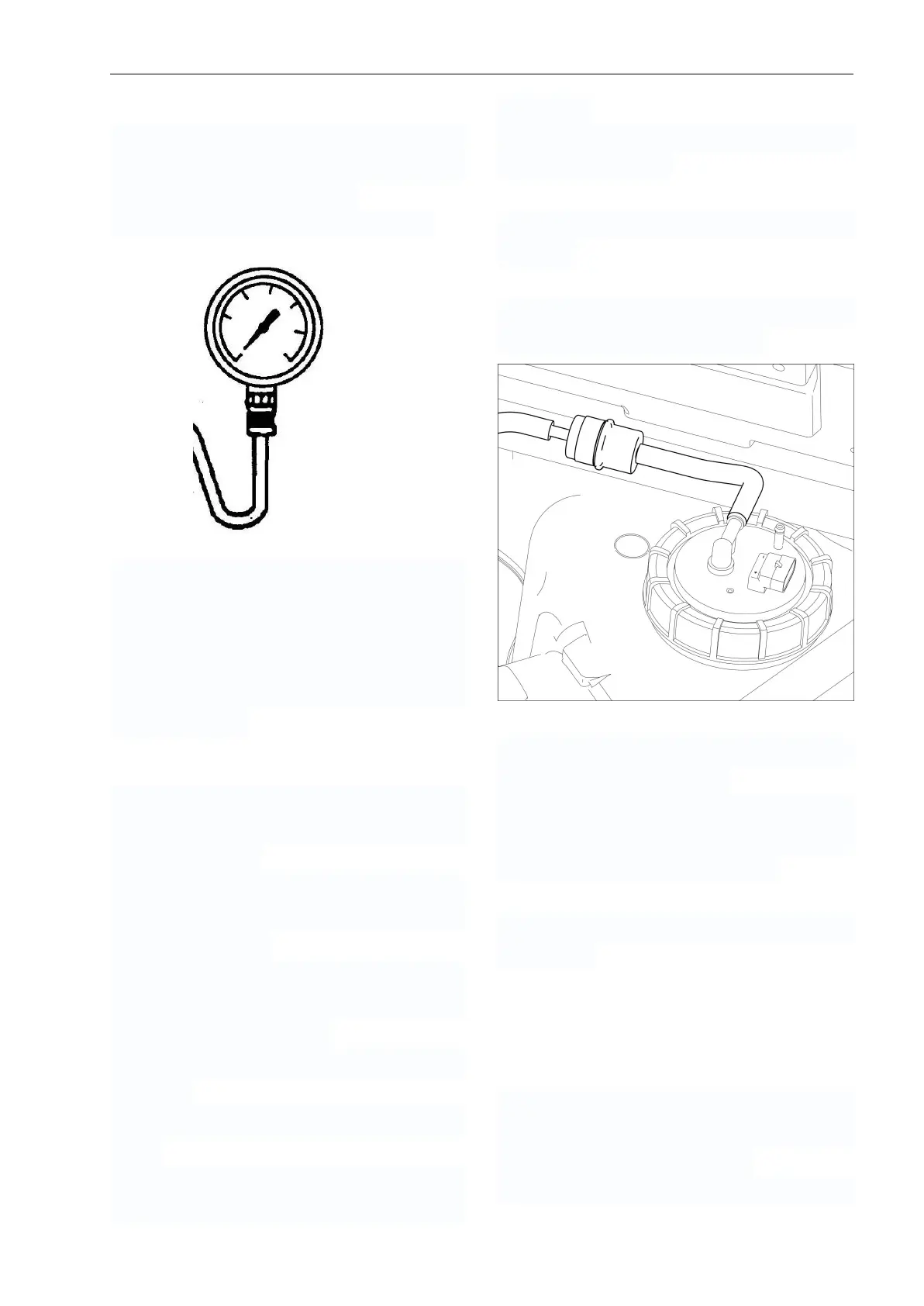
Disconnect outlet hose. Install fuel pressure
gauge and T-fitting between disconnected
hoses. Turn ignition key ON and set engine
stop switch to RUN and observe fuel
pressure. Turn ignition key off then back on.
Repeat the test.
Standard fuel pressure: 350kpa.
A rapid pressure drop indicates leakage is
from the fuel rail, If there is not leaking then
replace fuel pump.
A slow pressure drop indicates leakage
either from the fuel injector or from the fuel
pressure regulator.
Check fuel injector and the fuel pressure
regulator for leaks. If it is not leaking then
replace fuel pump module.
If no leakage, start engine and observe fuel
pressure.
The fuel pressure should be the same as
above.
If pressure is within limits, fuel pump and
the fuel pressure regulator are working
adequately.
Remove pressure gauge from inlet hose.
Reconnect inlet hose.
FUEL FILTER
Replace fuel filter as per amintenance
schedule.
Filter Removal
Remove the clamp and pull down the hose.
Remove the filter from the body.
Filter inspection
If fuel filter is suspected to be clogged, it
may be checked as follows:
Using low compressed air, check if fuel filter
is clogged. Air should flow easily through
filter. In doubt, install a new filter.
Filter installation
Use arrow on filter to position it according
to fuel flow.
FUEL PUMP
Fuel pump electrical test.
When turning ignition key ON, the fuel
pump should run for 5 seconds to build up
the fuel pressure in the system.
If the pump does not work, disconnect the



 To Next Page