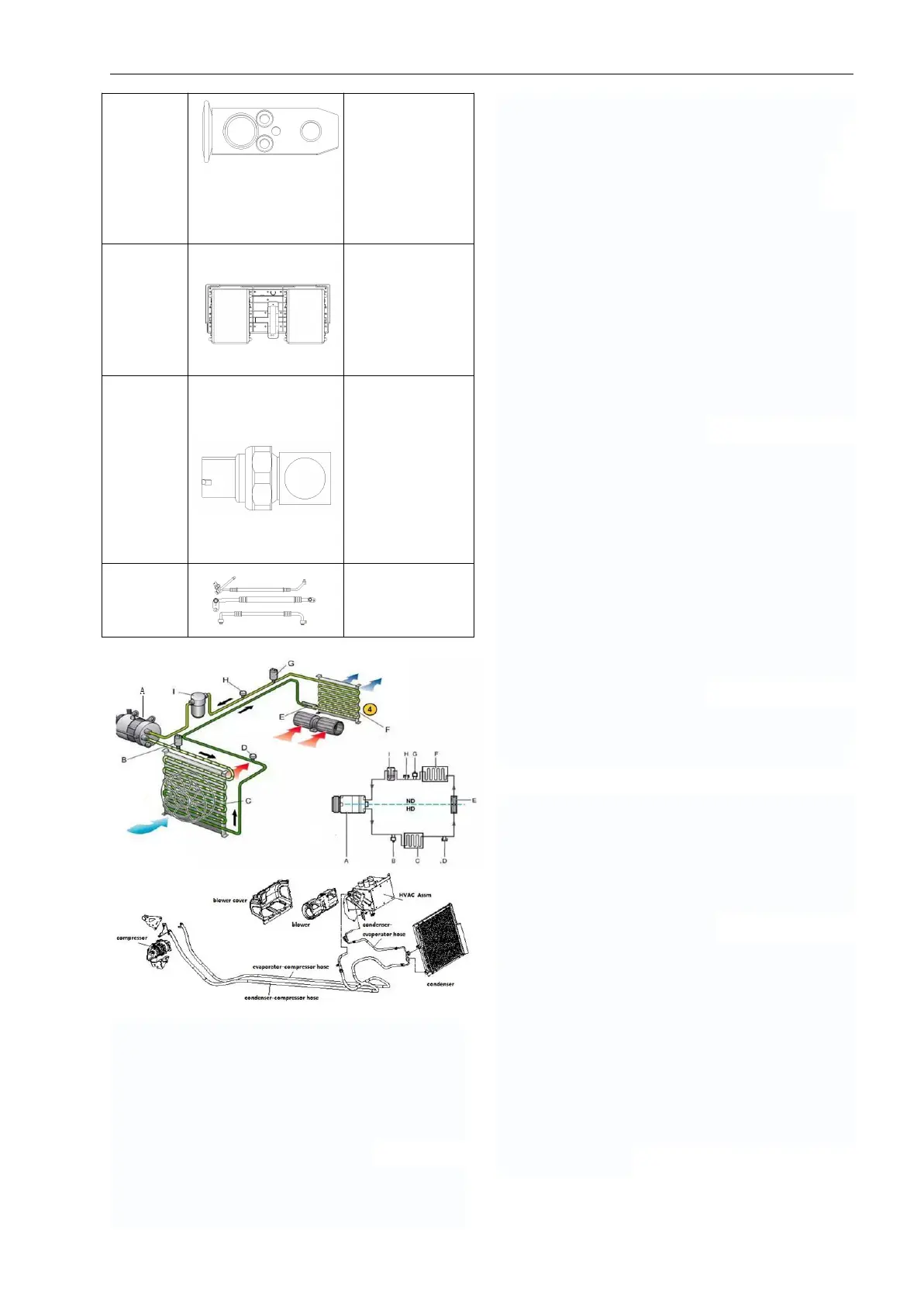
The compressor is driven by the engine,
and the refrigerant is sucked in from the
evaporator and compressed to increase its
pressure, and then sent to the condenser
through the high-pressure hose.
The condenser is installed in front of the
radiator. The refrigerant is cooled by the
cooling fan of the engine and the
ventilation of the car, and becomes liquid.
After the refrigerant gives off heat, it is
filtered and drained by the drying filter.
The liquid refrigerant is pressed to the
expansion valve under high pressure. Due
to the limited flow function of the
expansion valve, the refrigerant flow can be
automatically adjusted according to the
heat load in the vehicle compartment, so
that the liquid refrigerant enters the
evaporator after the limit.
When the refrigerant suddenly enters the
evaporator with large capacity, the pressure
drops due to the volume increasing, and
then changes from liquid state to gas state.
At the same time, it absorbs a large amount
of heat to cool the air flowing through the
evaporator, and then the air is sent into the
cabin by the blower to reduce the
temperature in the cabin.
The gaseous refrigerant with heat is sucked
into the compressor to start the next cycle.
COMPONENTS
Compressor: The compressor is the pump
that circulates the refrigerant throughout
the system. It raises the pressure of the
refrigerant for heat transfer through the
condenser and evaporator.
NOTE: when maintaining the compressor,
please maintain the installation angle of the
compressor and never invert the
compressor. Because inversion may cause a
large amount of refrigerant oil from the
compressor to flow into the air conditioning
pipeline, causing the air conditioning to
lose its function.



 To Next Page