16
Publication No: US-ODY-TM-001 - April 2011
www.odysseybattery.com
Another class of chargers is designed specifically to
maintain a battery in a high SOC. These chargers, normally
in the
3
/4 amp to 1
1
/2 amp range, are not big enough to
charge a deeply discharged ODYSSEY
®
battery. They must
only be used either to continuously compensate for parasitic
losses or to maintain a trickle charge on a stored battery, as
long as the correct voltages are applied. It is very important,
therefore, to ensure that the ODYSSEY battery is fully
charged before this type of charger is connected to it.
Effect of undercharge in cycling applications
Proper and adequate charging is necessary to ensure that
ODYSSEY batteries deliver their full design life. Generally
speaking, a full recharge requires about 5% more amp-
hours (Ah) must be put back in than was taken out. In other
words, for each amp-hour extracted from the battery, about
1.05Ah must be put back to complete the recharge.
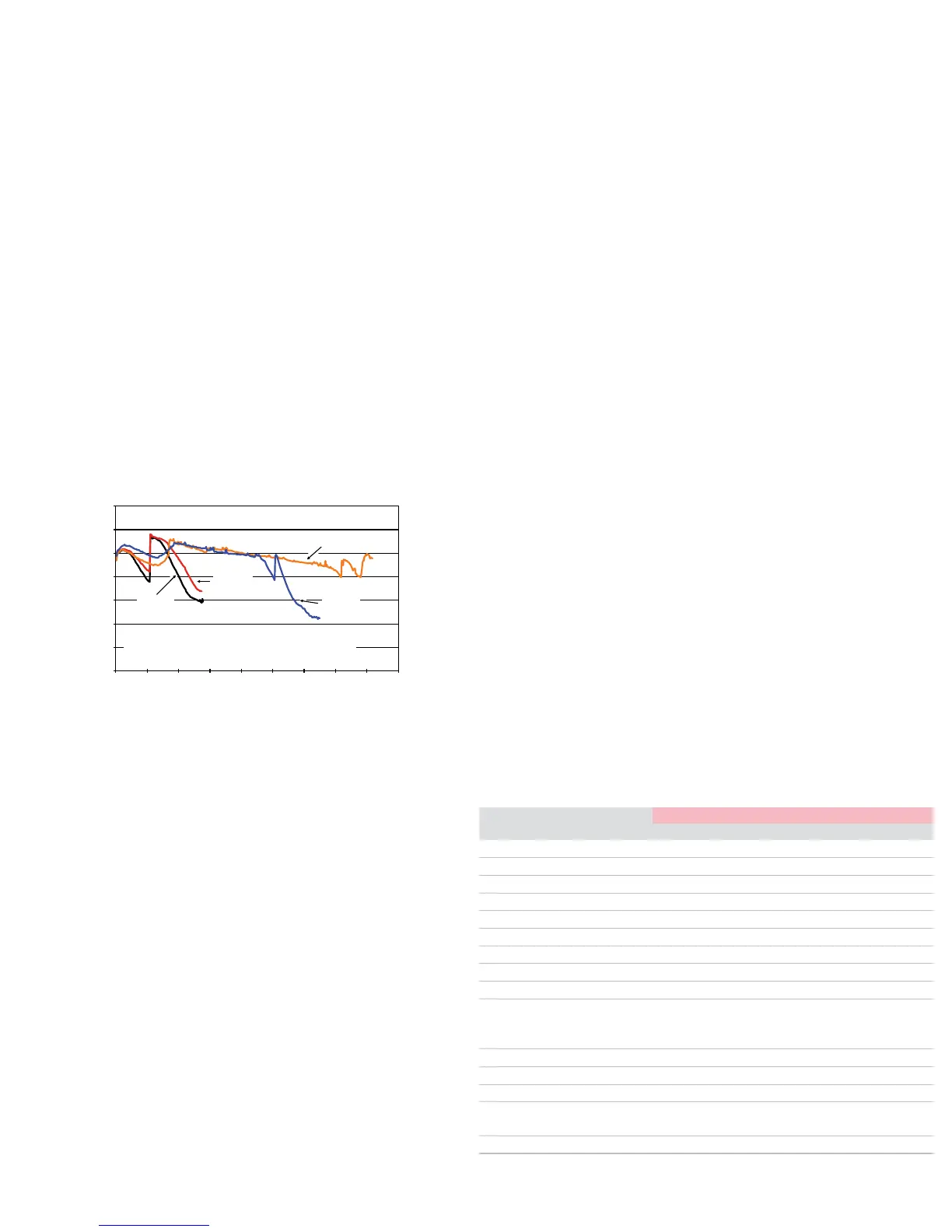
Cycling tests conducted on an ODYSSEY PC545 battery
demonstrated the impact raising the charge voltage from
14.2V to 14.7V has on the cycle life of the battery. The
results are shown in the graph below.
Samples 1 and 2 were charged at 14.2V while Samples 3
and 4 were charged at 14.7V. All batteries were discharged
at 2.3A until the terminal voltage dropped to 10.02V and
charged for 16 hours. In this particular test, a capacity of
11.5Ah corresponds to 100% capacity and 9.2Ah is 80%
of rated capacity and the battery is considered to have
reached end of life at that point.
The message to be taken from this graph is clear – in deep
cycling applications it is important to have the charge
voltage set at 14.4 – 15.0V. A nominal setting of 14.7V is a
good choice, as shown by the test results.
(A) Selecting the right charger for your battery
Qualifying portable automotive and powersport chargers for
your ODYSSEY battery is a simple two-step process.
Step 1 Charger output voltage
Determining the charger output voltage is the most important
step in the charger qualification process.
If the voltage output from the charger is less than 14.2V or
more than 15V for a 12V battery, then do not use the charger.
For 24V battery systems, the charger output voltage should
be between 28.4V and 30V. If the charger output voltage falls
within these voltage limits when the battery approaches a
fully charged state, proceed to Step 2, otherwise pick another
charger.
Step 2 Charger type - automatic or manual
The two broad types of small, portable chargers available
today are classified as either automatic or manual. Automatic
chargers can be further classified as those that charge the
battery up to a certain voltage and then shut off and those
that charge the battery up to a certain voltage and then switch
to a lower float (trickle) voltage.
An example of the first type of automatic charger is one that
charges a battery up to 14.7V, then immediately shuts off.
An example of the second type of automatic charger would
bring the battery up to 14.7V, then switches to a float (trickle)
voltage of 13.6V; it will stay at that level indefinitely. The
second type of automatic charger is preferred, because the
first type of charger will undercharge the battery.
A manual charger typically puts out either a single voltage or
single current level continuously and must be switched off
manually to prevent battery overcharge. Should you choose
to use a manual charger with your ODYSSEY battery, do
not exceed charge times suggested in Table 5 below. It is
extremely important to ensure the charge voltage does not
exceed 15V.
(B) Selecting battery type on your charger
Although it is not possible to cover every type of battery
charger available today, this section gives the ODYSSEY
battery user some general charger usage guidelines to
follow, after the charger has been qualified for use with this
battery.
In general, do not use either the gel cell or maintenance free
setting, if provided on your charger. Choose the deep cycle
or AGM option, should there be one on your charger. Table
5 below gives suggested charge times based on charger
currents. To achieve maximum life from your ODYSSEY
battery after completing the charge time in Table 5, we
recommend that you switch your charger to the 2A trickle
charge position and leave the battery connected to the charger
for an additional 6-8 hours. The trickle charge voltage should
be 13.5V to 13.8V.
Table 5: Suggested charge times
0
2.3
4.6
6.9
9.2
11.5
13.8
16.1
0 50 100 150 200 250 300 350 400 450
Amp-hrs out
Cycle
Samples 1 & 2: Given a 24hr CC charge @ 650mA prior to cycle 55, then resumed cycling
Sample 3: Given a 24-hr CC charge @ 650mA at cycle 359, then resumed cycling
Sample 4: Given a 24-hr CC charge @ 650mA at cycle 254, then resumed cycling
Sample 3
Sample 4
Sample 1
Sample 2
ODYSSEY
®
Charge time for 100% discharged battery
Battery Model 10-amp charger 20-amp charger
PC310 1.28 hours 40 minutes
PC535 2.25 hours 1.25 hours
PC545 2 hours 1 hour
PC625 3 hours 1.5 hours
PC680 2.7 hours 1.5 hours
PC925 4.5 hours 2.25 hours
PC1200 6.75 hours 3.5 hours
75-PC1230 & 75/86-PC1230 9 hours 4.5 hours
25-PC1400 & 35-PC1400 10.5 hours 5.25 hours
34-PC1500, 34R-PC1500,
34M-PC1500, 34/78-PC1500
& 78-PC1500
11 hours 5.5 hours
PC1700 11 hours 5.5 hours
PC1220 & 65-PC1750 11 hours 5.5 hours
PC1800-FT Not Recommended 17 hours
PC1350, 31-PC2150
& 31M-PC2150
16 hours 8 hours
PC2250 20 hours 10 hours


 To Next Page