18
Publication No: US-ODY-TM-001 - April 2011
www.odysseybattery.com
4. Long Test: Discharge the battery using a resistor or other
suitable load until the voltage drops to 10.00V and record the
time taken to reach this voltage. Let the battery rest for an
hour and repeat Steps 1 through 4. If the time taken by the
battery to drop to 10.00V is longer in the second discharge
than in the first discharge, the battery may be returned to
service after a full recharge; if not the battery should be
rejected as having reached end of life.
5. ½CCA Test: Battery OCV must be at least 12.60V to proceed
with this test. Connect the load tester cables and the voltage
leads of a separate digital voltmeter (if the tester does not
have a built-in digital voltmeter) to the battery terminals.
6. Adjust the tester load current to lad the battery to half its
rated CCA and apply the load for 15 seconds. Table 7 shows
the ½CCA values for all ODYSSEY
®
battery models. Use
Table 8 to adjust the battery end of test voltage temperature.
Table 7
ODYSSEY
®
Battery
Model
½CCA
Test
Value (A)
ODYSSEY
®
Battery
Model
½CCA
Test
Value (A)
ODYSSEY
®
Battery
Model
½CCA
Test
Value (A)
PC310 155 PC1200 275 PC1700 438
PC535 100 PC1220 340 PC1750 465
PC545 93 PC1230 365 PC1800 650
PC625 133 PC1350 480 PC2150 575
PC680 110 PC1400 410 PC2250 613
PC925 190 PC1500 440
Table 8
Temperature End of Test Voltage
70°F 9.60V
60°F 9.50V
50°F 9.40V
40°F 9.30V
30°F 9.10V
20°F 8.90V
10°F 8.70V
0°F 8.50V
7. At the end of 15 seconds note the battery voltage on the
voltmeter and discontinue the test. If the temperature is
70°F or warmer the battery voltage should be at or above
9.60V. If so the battery can be returned to service; if below
9.60V the battery should be rejected.
ODYSSEY
®
BATTERIES IN NO-IDLE
APPLICATIONS
Since these batteries are dual purpose in nature they can be
used for both engine starting and deep cycling applications.
This makes them particularly well suited for fleets such as
police vehicles that would like to power their computers
and communications equipment without having to idle their
engines. Auxiliary power units (APU) on trucks provide
another example of a no-idling application. All of these
require energy sources to power loads such as computers
and refrigerators with the engines shut off to reduce their
carbon footprints and lower gas consumption.
As discussed in a previous section, properly charged
ODYSSEY batteries are capable of delivering as many as 400
cycles to an 80% depth of discharge (DOD) at the 5-hour rate
of discharge. A shallower discharge will yield higher cycles,
as noted in the cycle life vs. DOD graph shown earlier.
This is the reason why ODYSSEY batteries are becoming
increasingly popular in APU and police fleet applications
that require batteries to have both high cycling and excellent
engine cranking capabilities in the same package.
ODYSSEY
®
PORTALYZER
TM
TESTER
The ODYSSEY battery PortAlyzer™ Tester (PAT) is designed
to quickly assess the condition of ODYSSEY batteries
without applying a heavy load on them. It is portable and
shows test results in a matter of a few seconds.
The tester applies a series of micro loads and determines the
condition of the battery based on how its voltage rebounds
– the weaker the battery the more sluggish the voltage rise
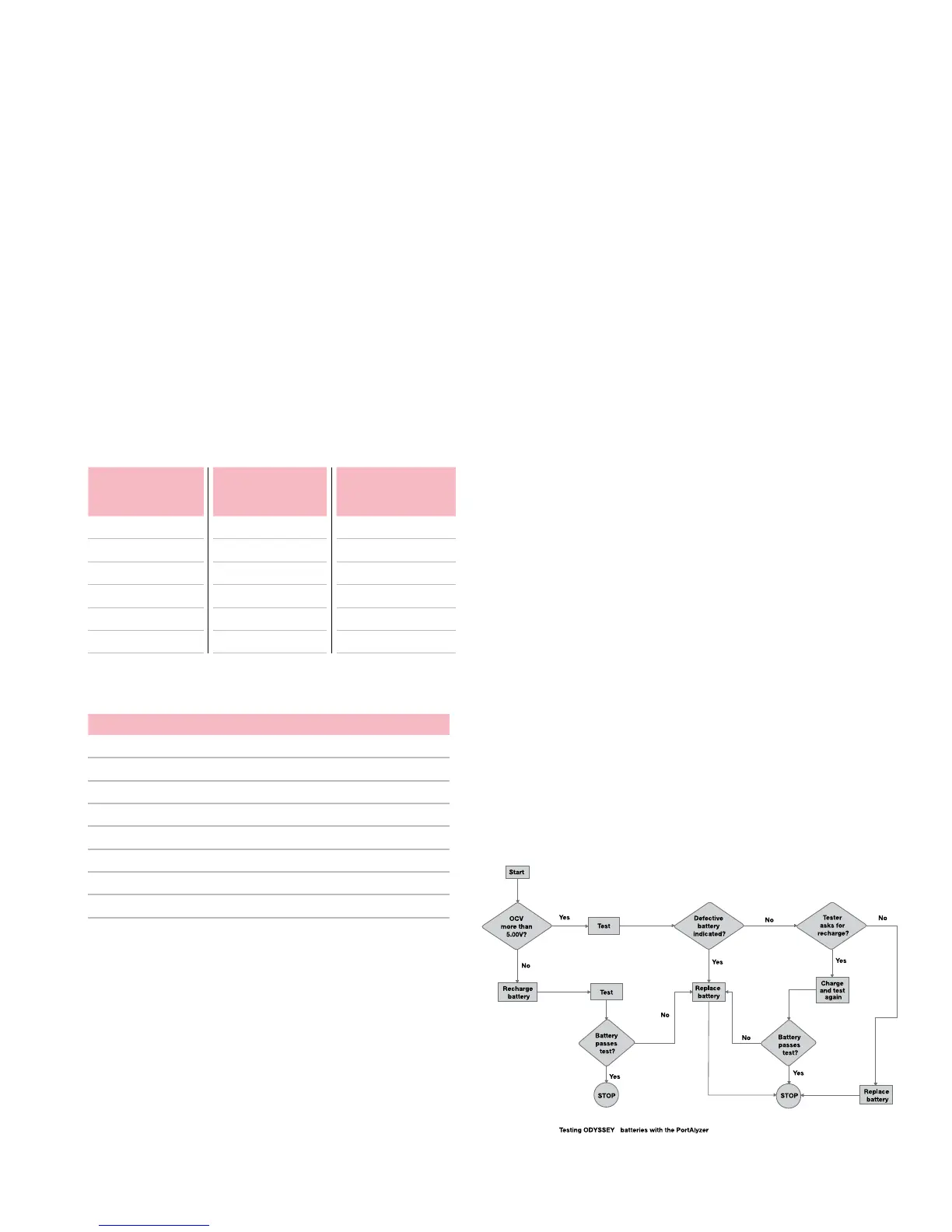
when the load is removed. The test procedure using a PAT is
shown in the flowchart below.
Although the tester displays a cold cranking amp
(CCA) rating for the tested battery, it should be treated
with circumspection as the value is calculated using a
mathematical relationship and not based on a load test.
A true CCA test involves a 30-second load applied to the
battery at 0°F (-18°C), so a result based on a mathematical
formula is inherently not very accurate.


 To Next Page