5
1 DESIGN
Inside the TTX GP
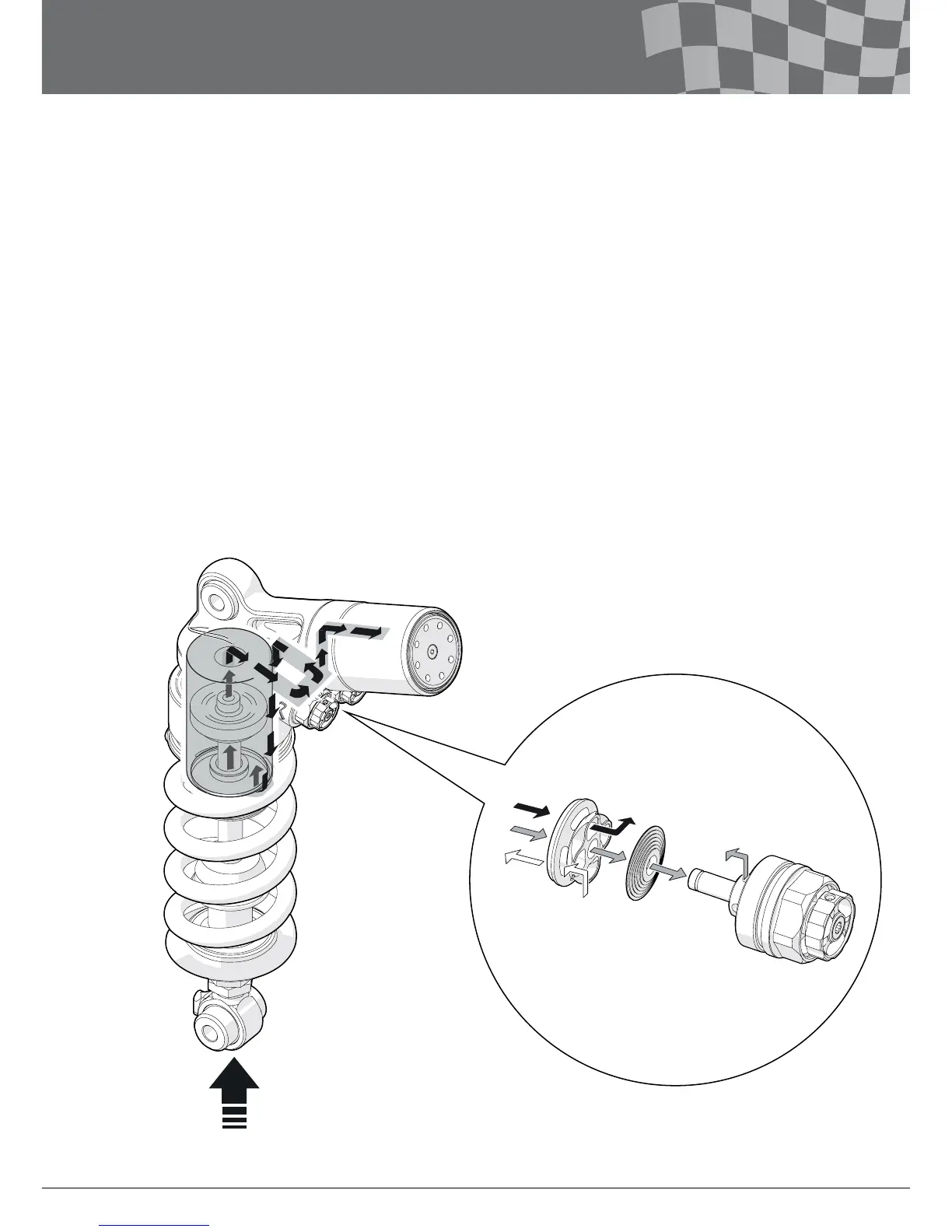
When the shock absorber moves
When the shock absorber moves, the uid inside
is forced to ow through the compression valve
or the rebound valve, depending on the direction
of the movement, followed by going through
either the rebound check valve or compression
check valve and to the other side of the main
piston (gure 2 and 3). The piston rod displaces
the uid into or out of the reservoir.
The reservoir
The reservoir is connected to the damping
system in a way that regardless of the direction
of the movement the reservoir will be connected
to the low pressure side of the main piston.
The compression and rebound valves
The compression and rebound valves have
three ow paths for the uid, the bleed valve,
shim valve and the check valve.
The bleed valve (gure 1 center grey arrows)
is a small orice giving a ow restriction by its
small size. In the shim valve (gure 1 black
arrows) the uid pressure must deect the thin
steel washers to open up the valve to allow uid
to ow through. The check valve (gure 1 outer
white arrows) contains a spring preloaded shim
that opens easily for return ow of uid when the
movement direction changes.
The bleed valve and the shim valve build up
the damping force. At slow stroke speeds the
amount of uid going through the bleed valve
is higher. At a fast stroke the shim valve takes
care of most of the uid ow. The check valve,
together with the bleed valve (since it can ow
both directions), handle return ow.
1
Basic ow during
compression stroke.


 To Next Page