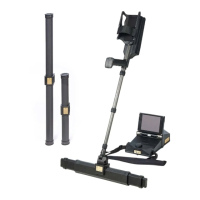
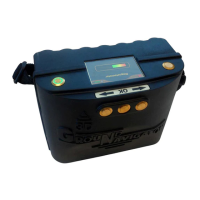
Need help?
Do you have a question about the OKM eXp 4000 and is the answer not in the manual?
Introduction to the eXp 4000 detector and its capabilities.
Crucial safety and operational information before using the eXp 4000.
Basic care and handling instructions for the electronic device.
Information on potential health risks associated with device usage.
Precautions regarding environmental factors like condensation and magnetic fields.
Guidelines for power supply and battery usage.
Factors that can cause data errors and how to prevent them.
Recommendations for maintaining the instrument and accessories.
Warnings about potential explosive relics found during excavation.
Instructions for installing USB drivers on Windows XP.
Step-by-step guide for installing USB drivers for the device on Windows XP.
Procedure to remove previously installed USB drivers from Windows XP.
Instructions for installing USB drivers on Windows Vista.
Step-by-step guide for installing USB drivers for the device on Windows Vista.
Procedure to update existing USB drivers on Windows Vista.
Procedure to remove previously installed USB drivers from Windows Vista.
Instructions for installing USB drivers on Windows 7.
Step-by-step guide for installing USB drivers for the device on Windows 7.
Procedure to remove previously installed USB drivers from Windows 7.
Detailed technical specifications for the device's control unit.
Technical details regarding data transfer capabilities.
Minimum computer specifications for using the device software.
Overview of the control unit's functions and processing capabilities.
Detailed description of the control unit's front panel and its components.
Detailed description of the control unit's rear panel and its connections.
Mode for scanning sub-surface for ferromagnetic targets and iron-rich soil.
Mode for graphical measurement and data storage for analysis.
Setup and recording of new graphical measurements.
Function to view, delete, or manage stored scan graphics.
Mode using DDV system to find small, near-surface objects.
Mode to identify metals and cavities, often used with Super Sensor.
Mode to delete all data stored in the device's internal memory.
Mode to properly shut down and power off the device.
Operating mode visible only when FS-Thermoscan is connected.
Operating mode visible only when FS-Thermoscan is connected.
Guidelines for systematic scanning of an area.
Explanation of Zig-Zag and Parallel scanning techniques.
Adjusting scan resolution and data points per scan line.
Expert tips and considerations for effective field scanning.
Correct positioning and movement of the sensor probe during scans.
Guidance on choosing between Parallel and Zig-Zag scan modes.
Choosing between manual and automatic impulse recording.
Practical advice from experienced users for better results.
Details and usage of the high-resolution Super Sensor antenna.
How to use the Super Sensor in different operating modes.
Information about the DDV system for metal detection.
Manual calibration procedure for the DDV system.
How to adjust the discriminator for material filtering.
Necessary soil reconciliation procedure for correct operation.
Displays common error messages related to memory, battery, and hardware.
 General
| Detection Depth | Up to 25 meters (depending on soil conditions and target size) |
|---|---|
| Power Supply | Rechargeable battery |
| Display | LCD |
| Data Storage | Internal memory |
| Interface | USB |
| Accessories | Headphones |
| Operating Temperature | 0°C - 50°C |
| Storage Temperature | -20°C - 60°C |
| Data Transmission | USB |

 To Next Page