Battery disposal .
I s not allowed to discard batteries in to common trash bins, they must be discarded only
Warnings.
1. Service and maintence activities should be done only when the device is disconneted from the
mains power supply and the battery.
2. During the installation the connections to the mains power supply and the battery must be
done after all other connections are finished.
3. The panel connection with the mains supply must be done via a10A external fuse or an
automatic circuit breaker rated at 10A.This fuse has to be a separate, labeled fuse.
4. Always use cables with double insulation.
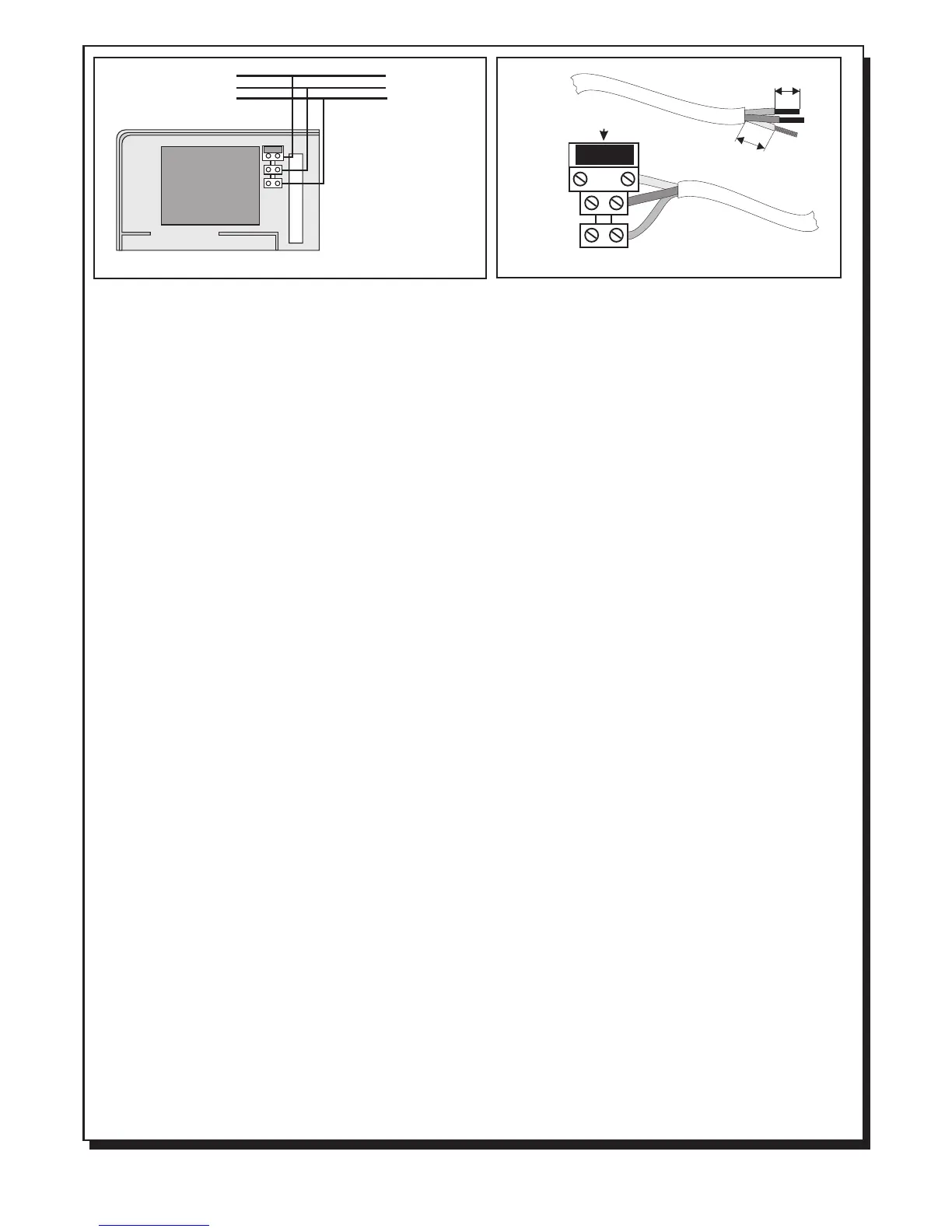
5. The diameter of the cable must be at least 1mm.(Figure 9)
6. The inner insulation of each cable must not be cut more than 1cm (Figure 9)
7. The outer insulation must not be cut more than 1cm away from the internal insulation.
8. The panel's internal fuse is T250mAL250V with 5x20 dimensions.
9. The batery fuse is a resetable fuse 3A inside the panel.
When the connections to zones, sirens and other required outputs are finished then we must connect the mains
power supply. In order to aid the installer during the initial installation, the panel offers a special configuration. This
configuration is entered by setting MODE switch 1 to the ON position. After entering this mode the panel conducts
an auto reset and the 'Power', 'Zone disable' and 'General disable' LEDs blink. The special functions that aid in
working out various problems that might arise are :
If all the problems are corrected and the installation is operating normally then the MODE switch 1 must be placed in
the OFF position. The panel conducts a auto-reset and is ready for operation.
By using a special operation mode we can conduct a walk test of the system. To enter walk-test mode set the MODE switch 1
to the ON position. The 'Power', 'Zone disable' and 'General disable' LEDs blink. If an alarm is manually given by either
activating a BS-536 call point or by activating a smoke detector with smoke or simulated smoke particles the corresponding
Alarm LED of the zone will light and the siren will sound for 2 seconds. Using this method we can test the operation of the
zones.
In this state if we press the number keys 1, 2, 3, 4, 5 and 6 then the corresponding zone relay will be activated. All
devices that are connected to these relays will also be activated indicating that they are operating properly. After
finishing the walk test set the MODE switch 1 to the OFF position. The panel conducts an automatic reset and enters
normal operation mode.
The optional function which is provided by the panel is the fire alarm devices paragraph 7.8 of 54-2.
t i in battery
recycling points.
Initial Installation
When a zone has an open circuit then the internal buzzer sounds and the corresponding LED lights. If the
problem is corrected then the buzzer is deactivated and the LED is extinguished.
When a zone has a short circuit then the internal buzzer sounds and the corresponding LED blinks. If the problem
is corrected then the buzzer is deactivated and the LED is extinguished.
When a siren output has an open circuit then the internal buzzer is activated and the corresponding fault LED
lights. If the problem is corrected then the buzzer is deactivated and the LED is extinguished.
When a siren output has a short circuit then the internal buzzer sounds and the corresponding LED blinks. If the
problem is corrected then the buzzer is deactivated and the LED goes Off.
When a battery fault exists then the 'Batt fault' LED lights and the 'Power fault' LED blinks. If the problem is
corrected then the LEDs are deactivated.
Walk - Testing
Optional Function of EN 54-2.
Figure 8. Panels connection with 220-240V AC.
220-240V AC
L
N
1 cm
Fuse: T250mAL250V (5x20)
1 cm
Figure 9. Panels connection with 220-240V AC
PE
Page 7 from 9 921636000_09_023



 To Next Page
 Loading...