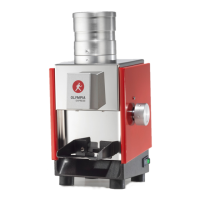
The Olympia Express Moca SD is a high-quality, single-dosing coffee grinder designed for enthusiasts seeking a premium espresso experience. This owner's book emphasizes the importance of a first-class coffee blend, good water, and a precision-made grinder, but ultimately highlights the "Barista" as the most crucial element in achieving an exceptional espresso. The Moca SD is presented as a handmade, compact, and elegant machine built from premium materials like steel and aluminum, reflecting typical Swiss design and quality.
Function Description
The primary function of the Moca SD is to grind whole coffee beans into espresso powder. It features extra-large 64 mm grinding burrs made of hardened special steel, powered by a 300-watt DC motor. This design ensures quick and continuous grinding without heating up the beans, which is crucial for preserving the coffee's aroma and flavor. The grinder is specifically intended for household use to grind portions of coffee up to 25g.
Usage Features
To begin using the Moca SD, users must first remove all transport fixtures and place the grinder on a flat, sturdy, and easy-to-clean surface. The main power switch should be in the "O" (off) position before plugging in the power cord. The bean hopper is inserted into the top opening and turned clockwise until fully locked; the grinder will only operate when the hopper is correctly inserted. A catch tray is placed between the two front feet to collect ground coffee. Pre-dosed coffee beans are then filled into the hopper, and the lid is closed. The grinder is activated by turning the main power switch to "I" (on) and turned off once the portion is ground.
A key feature is the grind coarseness dial, located on the right side of the grinder, which allows for precise adjustment of the grind setting. Big dots on the dial indicate a coarse grind, while small dots signify a fine grind. This adjustment can be made at any time, as the grinder empties itself after each portion. The optimal dose depends on the espresso machine's filter basket, with a double basket typically accommodating 14g to 16g. To reduce static, a small amount of water can be applied to the beans using the included spray bottle.
The manual also provides detailed instructions for readjusting the grind coarseness range, which is described as an intervention for skilled personnel. This process involves pulling off the aluminum cap, unscrewing the M3x20 screw, and then pulling the adjustment knob from the axis. The knob is turned counter-clockwise for a finer range or clockwise for a coarser range before being reattached and secured. It is crucial to ensure the motor runs freely and is not blocked after this procedure.
Maintenance Features
Regular cleaning and maintenance are essential for the Moca SD's longevity and performance. Coffee beans contain oils, fats, and waxes, which necessitate cleaning the bean hopper and grinding burrs periodically with a damp cloth. Failure to do so can lead to a bitter and rancid smell, and the grinding burrs may clog or stick. It is recommended to clean the grinder once or twice a month, paying special attention to the output area to remove coffee residue.
The grinding burrs should also be cleaned regularly with specialized cleaning products (e.g., Grindz™) or dry rice, processed at different grind settings. The body of the machine, with its high-gloss surfaces, should be cleaned with a dry microfiber cloth to prevent scratches. The lid of the bean hopper should be washed manually with mild soap. Importantly, neither the lid nor the bean hopper should be washed in a dishwasher, as aluminum can change color and darken due to aggressive cleaning agents.
Beyond routine cleaning, the grinding burrs require replacement at regular intervals, typically after grinding approximately 550 to 660 lb. (250 to 300 kg) of coffee. This task should be performed by a professional. Indicators that burrs need replacement include freshly ground powder being more than lukewarm, oily bubbles appearing on freshly brewed espresso (due to squashed or not thoroughly ground beans), or an espresso grind that is too fine (dust-like).
The manual also emphasizes safety precautions, such as reading all instructions, keeping the manual accessible, and understanding all safety information before first use. It states that the machine should only be used for its intended purpose and with the correct local line voltage. It also warns against operating the appliance with a damaged cord or plug and advises unplugging the machine before cleaning or when not in use. The body of the machine should never be opened. For disposal, packaging materials are environmentally friendly and recyclable, and the machine itself should be taken to a recycling center for electric and electronic devices, not disposed of with normal household waste.


 To Next Page
 General