Need help?
Do you have a question about the OLYS MPPT5012A-DUO-BT and is the answer not in the manual?
Enhanced charging current and compatibility with multiple battery types.
Supports charging of main and starter batteries with protection.
Includes unattended charging, overcharge protection, and temp. sensor adaptation.
Defines compatible batteries, panels, and cable requirements.
Covers installation, fuse usage, and general safety advice.
Diagram illustrating the connection of solar panels, batteries, and accessories.
Guide to selecting the correct battery type using DIP switches and the provided table.
Instructions on proper cable connections, polarity, and safety for installation.
Instructions for connecting the primary 12V main battery, including polarity and fuse.
Guidelines for connecting solar panels, emphasizing polarity and cable specifications.
Details on connecting the optional starter battery for auxiliary charging.
Instructions for connecting the temperature sensor for voltage compensation.
Explanation of green lamps indicating battery charge level and completion.
Details on green lamps for charging, MPP mode, and system readiness.
Description of yellow lamps for low voltage and flashing indicators for errors.
Guidance on recharging discharged batteries to prevent sulphation.
Table detailing boost and float charging voltages for different battery types.
Graphical representation of the charging voltage and current over time.
Recommended and maximum solar panel capacity, current, and voltage.
Details on charging current, voltage limits, and protection features for the main battery.
Specifications for the starter battery port, including charging current and protection.
Lists optional accessories such as temperature sensors and LCD meters.
Instructions for downloading the OLYS APP for Android and iOS devices.
Steps for connecting the controller via Bluetooth and operating it through the APP.
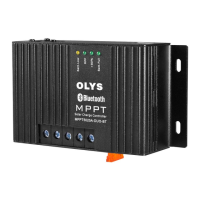
This document describes the OLYS MPPT Bluetooth Dual Battery Solar Controller, available in models MPPT5012A-DUO-BT and MPPT5025A-DUO-BT. This device is designed to efficiently manage solar charging for dual battery systems, offering advanced features and protection mechanisms.
The OLYS MPPT Bluetooth Dual Battery Solar Controller is a sophisticated device that utilizes ultramodern controller technology (microprocessor) to achieve an increased Maximum Power Point (MPP) charging current, offering 10% to 30% higher efficiency (over 95%) compared to conventional controllers. Its primary function is to charge two batteries simultaneously from a solar panel array.
A key feature is its ability to adapt to various battery types. Users can select switchable characteristic lines of charging for optimal performance with Gel, dryfit, AGM, fleece, acid/lead-acid, and LiFePO4 batteries. This versatility ensures that each battery type receives the most appropriate charging profile, maximizing its lifespan and performance.
The controller boasts two battery charging ports. The main port (Board I) is dedicated to automatic charging of the primary battery, while a secondary port (Start II) supports trickle charging for a vehicle's starter battery, with a maximum current of 1A and built-in overcharge protection. This dual-port design is particularly useful for recreational vehicles or boats where both a house battery and a starter battery need to be maintained.
For unattended operation, the controller incorporates standard protection features against overload, overheating, reverse battery connection, and back discharge. Back discharge protection is crucial in situations of insufficient solar power, such as at twilight or during the night, preventing the batteries from discharging back into the solar panels.
Overcharge protection is also integrated, reducing the charging current when excessive solar power is available or when the battery is full. It intelligently initiates recharging when power is consumed, ensuring the battery always remains in the best possible charging state.
The controller supports an optional temperature sensor connection, which allows for automatic adaptation of the charging voltage to the battery temperature. This feature is highly recommended for batteries exposed to significant temperature variations, such as those in a motor compartment. In colder temperatures, the charging voltage is increased to improve and accelerate full charging of a weaker battery, while in warmer temperatures, unnecessary battery gassing is avoided, prolonging battery life.
An optional LCD meter can be connected to display various values, including battery voltage, charging current, charging capacity, stored capacity, and energy (V, A, W, Ah, Wh), providing comprehensive monitoring capabilities.
The device also includes a "Safety Mode" that automatically detects missing sensors, cable breaks, short-circuits in sensor lines, or unreasonable measurement values. In such cases, it defaults to standard charging voltage rates (20°C / 25°C) recommended by battery manufacturers, ensuring safe operation even with sensor issues.
The controller is designed for fixed installations and is suitable for charging lead-gel, lead-AGM, lead-acid, or LiFePO4 batteries (with integrated BMS) of the indicated nominal voltage, while simultaneously supplying connected consumers. It can handle solar panels up to its maximum power rating.
Installation requires observing specific cable cross-sections at the charging ports and panel input, as well as using fuses of the indicated capacity near the battery to protect the cabling. The unit should be installed in a well-ventilated room, protected from rain, humidity, dust, aggressive battery gas, and free from condensation water.
Connecting the main battery ("MAIN I") is mandatory. The controller will not deliver a defined output voltage if this battery is not connected. Correct polarity must be observed, and in case of wrong polarity, an internal safety fuse will release, requiring replacement with a car fuse of the same capacity. Parallel charging of two or more 12V batteries is permissible.
When connecting solar panels, it's advised to shade them to minimize sparking and prevent damage from incorrect polarity. If multiple small solar panels are used, they should be connected in parallel. Partial shading of panels can lead to higher average capacity.
The starter battery connection ("START II") is optional. If used, it provides reduced voltage and charging current, prioritizing solar power for the main battery while ensuring the starter battery remains in a condition to always allow starting, even after long downtimes or during winter.
The temperature sensor, if used, should be mounted to ensure good thermal contact with the main battery, ideally screwed to the negative or positive pole, or at the sidewall center of the casing. It's crucial to ensure the installation location is not influenced by heat sources like the motor block or heater. The sensor connects via a 2-pole cable, and its polarity and cable length are not critical as the controller automatically recognizes it.
The device features pilot lamps to indicate various states:
If all five pilot lamps flash, it indicates incorrect positions of the selector switches for "MAIN Battery," and the controller will switch off for safety. Users must adjust the battery type according to the provided table.
The controller also offers an APP operation feature. Users can download the APP (available for Android and iOS), connect the battery and solar panel, enable Bluetooth on their mobile phone, and then run the APP to connect to the controller. The APP allows users to view parameters within 3-5 seconds. The Bluetooth range is approximately 10 meters; if no signal, reconnection is advised.
The controller is designed for user-friendliness, with most parts not user-replaceable, except for the fuse. Only replacement car fuses of the indicated capacity should be used.
For optimal battery lifespan, it is crucial to recharge totally discharged batteries immediately. Sulphation of lead battery plates due to total discharge should be prevented by prompt charging, especially in high ambient temperatures. If sulphation is not too severe, the battery may recover some capacity after several charging/discharging cycles.
Lead batteries should always be stored fully charged and recharged periodically, particularly older batteries and those in higher temperatures. Keeping batteries cool and dry in an appropriate installation location is also recommended.
In situations of insufficient solar power or high current consumption, the battery should be occasionally fully charged using a mains supply charger.
The controller includes overvoltage protection, switching off if excessive battery voltage rates are detected (switching threshold 15.0-16.0 V) or in case of defective additional charging systems. It also limits charging voltage to a maximum of 15.0 V to protect sensitive consumers.
Overload and overheating protection are built-in, featuring double electronic protection against overload and automatic reduction of charging capacity under adverse installation conditions (e.g., insufficient ventilation, excessive ambient temperatures).
Voltage measurement should always be performed at the battery terminals, not at the solar controller, to account for any loss in the charging cable.
Children should be kept away from the solar controller and batteries for safety.
 General
| Model | MPPT5012A-DUO-BT |
|---|---|
| Type | MPPT Solar Charge Controller |
| Max. PV Input Voltage | 50V |
| Maximum PV Input Voltage | 50V |
| Efficiency | 98% |
| Communication | Bluetooth |
| DUO | Yes |
| Battery Voltage | 12/24V |
| Rated Battery Voltage | 12V/24V |
| Protection Features | Overload, Short Circuit, Reverse Polarity, Over Temperature |
| Operating Temperature | -20°C to +50°C |
| Cooling | Natural |

 To Next Page