Need help?
Do you have a question about the OMEGA AIR A-DRY 60 and is the answer not in the manual?
Details about the adsorption dryer model, serial number, production year, and commissioning.
Contact details for the supplier, including name, address, and communication methods.
Explanation of compressed air contaminants and dew point measurement standards.
Typical applications and types of adsorption dryers, focusing on heatless regeneration.
Description of the adsorption process using porous solid adsorbents.
Specifies the intended use of DRY series desiccant dryers and restrictions for fluid types.
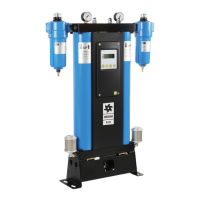
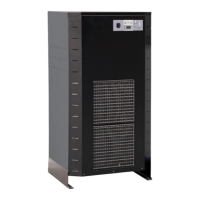
Identification of key parts of the A-DRY adsorption dryer with a numbered diagram.
Table detailing model specifications, flow capacity, dimensions, weight, and operating parameters.
Information regarding compliance with PED 2014/68/EU for fluid group 2.
Specifications for supply voltage, frequency, power consumption, and interface details.
Explains the display of dryer status, adsorption, and regeneration times in the operation menu.
Procedure for shortening adsorption and regeneration cycles for testing and maintenance.
Details on connecting and using a dew point sensor with the controller.
Guide to setting the dew point sensor range and parameters via the controller menu.
Explanation of switch point settings for fixed or variable cycle modes.
Menu option to select dew point threshold and cycle mode.
Settings for triggering alarms based on dew point thresholds.
Configuration of relay outputs for signaling dryer condition like 'Dryer Active' or 'Dew Point OK'.
Description of the automatic timer drain feature for condensate discharge.
Procedure for setting ON and OFF periods for the timer drain.
Menu to view the status of dryer inputs and outputs, useful for troubleshooting.
How to configure the dryer to enter standby mode and its implications.
Information about dryer operation cycles, hours, and other statistics.
Check for any visible damage to the adsorption dryer after transportation.
Conditions for installation location and compressed air quality standards.
Examples of common installation layouts for adsorption dryers.
Instructions for mounting, connecting air supply, electric power, and checking for leaks.
Step-by-step guide for slowly pressurizing the adsorption dryer.
Instructions for slowly opening the outlet valve after pressurization.
Final steps to initiate the adsorption dryer's operation after installation and pressurization.
Detailed steps for replacing the molecular sieve in the dryer towers.
Procedure for replacing the normally open inlet and normally closed purge control valves.
Instructions for safely replacing the non-return valves in the system.
Steps for unscrewing and replacing the purge exhaust silencers.
Procedure for replacing the nozzles, with recommendations for changed operating conditions.
Guidance for troubleshooting controller-related malfunctions.
Diagnosing issues with control valves, including activation and membrane problems.
Procedures for identifying and fixing leaks between blocks, towers, and valves.
Identifying reasons for high pressure drop, such as undersized components or system errors.
Troubleshooting high outlet dew point due to dryer sizing, contamination, or operating conditions.
 General
| Refrigerant | R134a |
|---|---|
| Maximum Operating Pressure | 16 bar |
| Dew Point | 3 °C |
| Power Supply | 230V/50Hz |
| Capacity | 60 m3/h |
| Voltage | 230V/50Hz |
| Type | Refrigerated air dryer |


 To Next Page