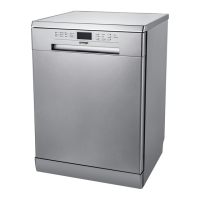
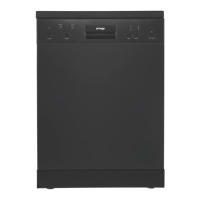
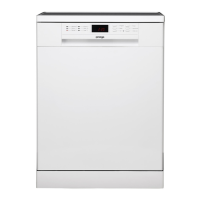
This document describes the Omega ODW600S/ODW600W dishwasher, a household appliance designed for efficient dishwashing with 12 place settings. The manual provides comprehensive instructions for its operation, maintenance, and installation, ensuring optimal performance and longevity.
Function Description
The Omega dishwasher is designed to clean and dry dishes, utensils, and cookware automatically. It offers various wash cycles tailored to different levels of soiling and types of items, from heavily soiled pots and pans to delicate glassware. The appliance utilizes a combination of water, detergent, and rinse aid to achieve thorough cleaning and streak-free drying.
Key functional components include:
- Detergent Dispenser: This compartment holds the detergent required for each wash cycle. It has separate sections for main wash and pre-wash detergents, allowing for precise dosing based on the selected program and soil level.
- Rinse Aid Dispenser: Located next to the detergent dispenser, this unit automatically releases rinse aid during the final rinse. Rinse aid prevents water from forming droplets, which can leave spots and streaks, and improves drying performance by allowing water to roll off the dishes. The dispenser has an optical level indicator to show when a refill is needed.
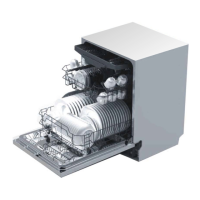
- Baskets: The dishwasher features an upper and a lower basket for loading dishes. The upper basket is designed for more delicate and lighter items like glasses, cups, and small bowls, while the lower basket accommodates larger and more heavily soiled items such as pots, pans, and serving dishes. Both baskets are designed to ensure proper water spray coverage and secure placement of items. The lower basket includes folding spikes for accommodating larger items.
- Cutlery Basket: This dedicated basket is for silverware and small utensils, ensuring they are properly cleaned and do not obstruct the spray arms. Sharp items should be placed with points down for safety.
- Filtering System: Comprising a coarse filter, a flat (main) filter, and a microfilter (fine filter), this system prevents larger food remnants and other objects from entering the pump, ensuring efficient water recycling and preventing blockages.
- Spray Arms: These arms rotate during a wash cycle, spraying water onto the dishes to remove food particles. The design ensures comprehensive coverage of all items in the baskets.
- Control Panel: The user interface includes an On/Off button, Delay button, Extra Drying button, Half Load button, Program button, and Start/Pause button. Indicators show power status, delay time, extra drying, rinse aid level, and program completion.
Usage Features
The dishwasher offers several features to enhance convenience and cleaning performance:
- Multiple Wash Cycles: The appliance provides a range of programs, including Intensive, Heavy, Normal, Glass, 90 min, and Rapid, to suit various cleaning needs. Each program specifies the pre-wash and main wash temperatures, rinse cycles, and estimated duration, energy, and water consumption.
- Delay Start Function: Users can set a delay time for the wash cycle to start, allowing for flexible scheduling, such as running the dishwasher during off-peak electricity hours.
- Extra Drying Function: Available with specific programs (Intensive, Heavy, Normal, Glass, and 90 min), this feature enhances drying performance, particularly for plastic items.
- Half Load Function: This option is ideal when washing a smaller load (6 place settings or less), reducing water and energy consumption. It can be used with Intensive, Heavy, Normal, Glass, and 90 min programs.
- Program Modification: A running cycle can be modified if it has been active for a short time. If detergent has already been released or water drained, the detergent dispenser may need to be refilled.
- Adding Forgotten Dishes: Dishes can be added to a running cycle before the detergent cup opens. The process involves pausing the machine, opening the door slightly, waiting for spray arms to stop, adding dishes, closing the door, and resuming the cycle.
- Troubleshooting Tips: The manual includes a comprehensive troubleshooting guide to help users diagnose and resolve common issues such as the dishwasher not starting, water not pumping out, suds in the tub, or unsatisfactory cleaning/drying results. Error codes are also explained to assist in identifying specific malfunctions.
Maintenance Features
Regular maintenance is crucial for the dishwasher's performance and longevity. The manual outlines several maintenance procedures:
- Filter Cleaning: The filtering system, consisting of coarse, main, and fine filters, should be inspected and cleaned regularly, ideally after each wash cycle for larger food particles, and once a week for the entire assembly. This involves turning the filter in an anti-clockwise direction, lifting it out, rinsing it under running water, and using a cleaning brush for thorough cleaning.
- Caring for the Dishwasher Exterior: The control panel can be cleaned with a lightly dampened cloth and dried thoroughly. For the exterior, an appliance polish wax can be used. Abrasive cleaners or sharp objects should be avoided.
- Cleaning the Door: The edge around the door should be cleaned with a soft, warm, damp cloth. Spray cleaners should not be used near the door lock and electrical components to prevent water penetration. Abrasive agents or paper towels should be avoided to prevent scratching the stainless steel surface.
- Protecting Against Freezing: In winter, specific measures should be taken to protect the dishwasher from frost. This includes cutting off electrical power, turning off and disconnecting the water supply, draining water from the inlet pipe and valve, and soaking up water from the sump using a sponge.
- Cleaning the Spray Arms: The spray arms should be cleaned regularly to prevent hard water chemicals from clogging the jets and bearings. The upper spray arm can be removed by rotating it clockwise, and the lower spray arm by pulling it upward. They should be washed in soapy, warm water and cleaned with a soft brush before being reinstalled.
- General Care After Every Wash: After each wash, the water supply should be turned off, and the door left slightly ajar to prevent moisture and odors from being trapped.
- Long-Term Storage: If the appliance will not be used for an extended period, it is recommended to run an empty wash cycle, remove the plug, turn off the water supply, and leave the door slightly open to prolong the life of door seals and prevent odors.
- Seals Cleaning: Periodic cleaning of the door seals with a damp sponge helps prevent food particles from getting trapped, which can cause odors.

 Need help?
 General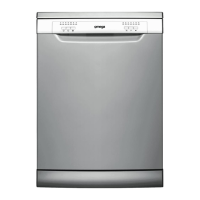

 To Next Page