Need help?
Do you have a question about the Omron H3DE-S1 and is the answer not in the manual?
Covers operating modes, terminal block, screw torque, input/output types, mounting, and approvals.
Details the available time scale displays and units for setting time on the timer.
Specifies rated supply voltage, operating range, power reset, consumption, and control output capabilities.
Illustrates the functional blocks and signal flow within the H3DE-M and H3DE-S timer models.
Explains the timer's input signal handling and control output behavior for different modes.
Provides visual timing charts for various operating modes, showing signal sequences.
Displays the terminal layout and wiring connections for all H3DE timer models.
Defines the specific voltage levels required for 'ON' and 'OFF' states in transistor and contact inputs.
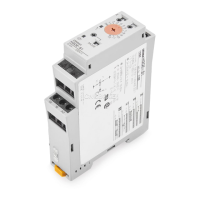
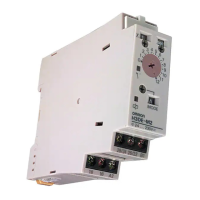
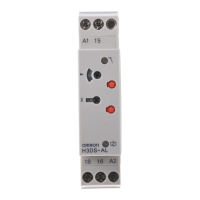
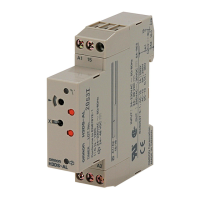
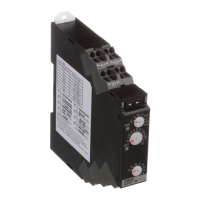
The OMRON H3DE is a series of analog set multifunction timers designed in a slim 22.5 mm form factor for track mounting. These timers offer a wide range of functionalities and are suitable for diverse industrial applications.
The H3DE series provides precise timing control with various operating modes. The H3DE-M models offer eight operating modes, while the H3DE-S models provide four, ensuring broad application flexibility. Key features include:
General:
Operating Modes:
Time Ranges:
Ratings:
Characteristics:
Selector Setting: The H3DE timers feature selectors for time unit, time scale, and operating mode. These selectors can be turned clockwise or counterclockwise and have a snap mechanism to secure them in position. It is crucial to ensure selectors are firmly secured to prevent malfunction.
Time Unit and Time Scale Selection: The desired time unit (sec, min, hrs, or 10h) is displayed in the time unit display window. The time scale (0.1 or 1) is selected via a dedicated selector and appears in the scale range display window.
Operating Mode Selection: Operating modes (A to J for H3DE-M, A, B2, E, or J for H3DE-S) are selected using a screwdriver, and the chosen mode is displayed in the operating mode display window.
Input Connections: The H3DE-M1/-M2 models support voltage inputs (voltage imposition or open). This includes connections to PNP output sensors, NPN output sensors, and contact inputs (e.g., relays). It is important to note that the input circuit and power supply circuit are configured independently. When connecting external signal input devices like relays or transistors, care must be taken to prevent short-circuiting due to sneak currents in the transformerless power supply system. Input terminals of multiple timers must be wired correctly to avoid phase differences or short circuits.
Output Type Selector Switch: H3DE-M2 and -S2 models include an output type selector switch on the bottom of the timer. This switch allows selection between time-limit output (default setting, using terminal numbers 25, 26, and 28) and instantaneous output (using terminal numbers 21, 22, and 24). When set to instantaneous, the relay R2 contacts turn ON/OFF synchronously with power supply changes.
Mounting: The H3DE should be mounted horizontally. For track mounting, hook portion (A) of the timer to an edge of the track, then depress the timer in direction (B). For removal, pull out portion (C) with a flat-blade screwdriver. A minimum clearance of 30 mm (1.18 in) between the H3DE and other equipment is recommended for ease of mounting and removal.
Power Supply: The H3DE Series uses a transformerless power supply system. Both AC and DC power supplies can be connected to the power input terminals without polarity considerations, except for the H3DE-M2 DC12 model, which requires designated polarity. DC power supplies must have a ripple factor of 20% or less and a mean voltage within the rated operating range. It is crucial to connect the power supply voltage through a relay or switch to ensure the voltage reaches a fixed value at once, preventing timer reset or errors. For input device power supply, an isolating transformer with mutually isolated and ungrounded primary and secondary windings is recommended.
Mounting Clearance: To ensure the longevity of internal components, especially when the load current is continuously supplied for extended periods, it is essential to provide adequate mounting clearance. The manual specifies mounting clearances (e.g., 50 mm min., 10 mm, 5 mm, 0 mm) and their impact on the maximum operating ambient temperature when mounting two or more H3DE units side-by-side. For example, with 0 mm clearance, the maximum operating ambient temperature is significantly reduced compared to 50 mm clearance.
Environment:
Input Wires: Input wires should be as short as possible. If the floating capacity of wires exceeds 2,000 pF (approx. 17 m for cables with 120 pF/m), operation may be affected. Shielded cables should be used with particular attention.
VDE Conformance: The H3DE conforms to VDE 0435/P2021 under specific conditions. The output section provides basic isolation; supplementary basic isolation on the load side is required for reinforced isolation. The H3DE itself is designed for Overvoltage category III and Pollution degree 2. It features reinforced isolation with clearance of 5.5 mm and creepage distance of 5.5 mm at 230 VAC for front and bottom parts, and basic isolation with clearance of 3 mm and creepage distance of 3 mm at 230 VAC for the output.
Relay Life Expectancy: The built-in relay (G6RN) has a life expectancy of 50,000 operations min. (8 A at 250 VAC, resistive load at 360 operations/h). For reference, a maximum current of 0.15 A can be switched at 125 VDC (cosφ=1), and 0.1 A if L/R is 7 ms, with an expected life of 100,000 operations. The minimum applicable load is 10 mA at 5 VDC.
 General
| Type | Digital Timer |
|---|---|
| Power Supply | AC/DC |
| Output | SPDT Relay |
| Output Type | Relay |
| Operating Voltage | 100-240V AC |
| Mounting | DIN Rail |
| Display Type | LED |
| Contact Rating | 5 A at 250 VAC |
| Operating Temperature | -10 to 55°C |
| Storage Temperature | -25 to 65°C |
| Operating Mode | On Delay, Off Delay |


 To Next Page