EasyManua.ls Logo

Optimum OP-DFST - User Manual

Optimum OP-DFST
8 pages
Print Icon
To Next Page IconTo Next Page
Loading...
7. Specification
Supply: 220-240V AC 50Hz
Temperature rating T45 Fuse:
BS1362, 13A Isolation: double
pole switch
Switch type: mains, normally open
Rating:
13A resistive / 8A inductive
Not suitable for direct switching of lighting
types: HID, SON, LED—use a contactor
Class II control / Protection class IP20
Complies with European Norm
EN 60730-1: 2011Automatic Electrical Con-
trols for Household and similar use,
and European Directives:
LVD; EMC; RoHS
www.tfc-group.co.uk
TFC Group LLP Tonbridge TN9 1TB
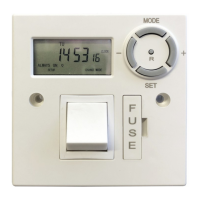
Digital fused spur timer
OP-DFST
User instructions
1. Set the timer
2. Setting a program
3. Check program settings
4. Manual override
5. Installation instructions
6. Wiring diagram
7. Specification
5. Installation instructions.
Please read these instructions fully before commenc-
ing work. The OP-DFST must be installed by a qual-
ified person, in accordance with best practise and
current IEE wiring regulations. Do not install the
timer onto a flammable surface, or keep stored mate-
rials too close. The installed timer should have clear-
ance of at least 150mm in all directions.
Ensure the supply is switched off. In addition, re- move
any fuse protection or turn off the circuit break- er. The
OP-DFST is designed to be installed onto a flush or
surface-mounted electrical back-box of mini- mum
16mm depth. A BS1362 13 Amp cartridge fuse is
pre-installed as circuit protection for the radial, or spur
connection.
Make sure that the total load on the circuit - with the
additional < 13A load connected to the fused spur
timer - does not exceed the capacity of the circuit
cable, fuse or circuit breaker.
Installation:
Connect the incoming supply, and the outgoing load
with the wiring diagram (Figure 1.). Use the earth
continuity terminal which will be provided in a metal
patress box, or the supplied screw terminal connect-
or if using a moulded surface mounted box. Bare earth
conductors must be sleeved. A flexible cable outlet,
with cable restraint is provided. If the flexible cable
outlet is required, remove the blanking cover and route
the flexible load cable via the cable re- straint and the
outlet hole. Check that all conductors are correctly
connected, and terminals are fully tight- ened.
Secure the connected timer to the back-box with the
25mm machine screws provided. Make sure that
cables are carefully routed and stowed to avoid
pinching, stress or damage.
6. Wiring diagram:
N
Mains
supply
L
N
Load
L
E
E
Figure 1.
F
U
S
E
+
R
-
S E T
M O D E
Question and Answer IconNeed help?

Do you have a question about the Optimum OP-DFST and is the answer not in the manual?

Summary

Set the Timer

Setting a program

Check program settings

Manual override

Installation instructions

Wiring diagram

Specification

Summary

Set the Timer

Setting a program

Check program settings

Manual override

Installation instructions

Wiring diagram

Specification

Overview

The Optimum Digital Fused Spur Timer, model OP-DFST, is a sophisticated electrical control device designed to manage the power supply to an appliance or circuit with precision. It functions as a digital timer, allowing users to program specific ON/OFF times for connected loads, thereby automating their operation. The device is equipped with a clear digital display that shows the current time and program status, along with intuitive buttons for setup and control. A key safety feature is the integrated fuse, providing essential circuit protection for the connected load.

Function Description:

The primary function of the OP-DFST is to provide timed control over an electrical circuit. It allows users to set up to 24 individual ON/OFF programs, enabling precise scheduling of when power is supplied to a connected appliance. This makes it ideal for managing devices that need to operate at specific times, such as water heaters, towel rails, or other fixed appliances. The timer operates on a 220-240V AC 50Hz supply and is designed for permanent installation as a fused spur.

The device features a real-time clock that can be set to the current hour, minute, and day. This clock forms the basis for all programmed operations. Users can define specific ON and OFF times for each of the 24 available programs. These programs can be set for individual days of the week or for various combinations of days, offering significant flexibility in scheduling. For example, a program can be set to run every weekday, only on weekends, or on specific non-consecutive days like Monday, Wednesday, and Friday.

In addition to programmed operation, the OP-DFST offers manual override options. This allows users to temporarily or permanently switch the connected load ON or OFF, irrespective of the programmed schedule. The manual override modes include "ALWAYS ON" (timer is permanently ON), "PROG ON" (timer is in program mode ON), "PROG OFF" (timer is in program mode OFF), and "ALWAYS OFF" (timer is permanently OFF). This flexibility ensures that users can adapt the device's operation to immediate needs without having to reprogram the entire schedule.

The integrated BS1362 13 Amp cartridge fuse provides crucial overcurrent protection for the connected radial or spur connection. This ensures the safety of the appliance and the electrical circuit by preventing damage from excessive current flow. The device also features a double pole isolation switch, enhancing safety during maintenance or when the connected appliance needs to be completely de-energized.

Usage Features:

Setting up and using the OP-DFST involves a series of straightforward steps, guided by the device's buttons and digital display.

Setting the Timer (Current Time):

To begin, the timer's internal clock needs to be set to the correct current time and day.

  • Reset: The 'R' button (activated with a pen or similar instrument) resets the timer to its default settings and deletes all stored programs. This is useful for starting fresh or troubleshooting.
  • Enter Setup: Pressing the 'Set' button enters the function setup mode. If no further buttons are pressed within 10 seconds, the display reverts to the normal screen.
  • Navigate to Clock Icon: Use the '+' or '-' buttons to scroll through the menu until the clock icon is flashing.
  • Enter Time Setting: Press 'Set' to enter the current time setting mode, where the hours will begin flashing.
  • Adjust Hours: Use the '+' or '-' buttons to adjust the hour. Holding these buttons for more than 3 seconds enables a fast scroll mode. Press 'Set' to confirm the hour, and the minutes will then flash.
  • Adjust Minutes: Use the '+' or '-' buttons to adjust the minutes. Press 'Set' to confirm, and the day will flash.
  • Adjust Day: Use the '+' or '-' buttons to adjust the current day. Press 'Mode' to exit the time setting.

Setting a Program:

The OP-DFST supports up to 24 ON/OFF programs.

  • Enter Programming Mode: Press the 'Set' button twice to enter the program setting mode. The display will typically show "01 ON" as the default program.
  • Select Program Number: If needed, use the '+' or '-' buttons to scroll through the 24 available ON/OFF programs. Press 'Set' to confirm the desired program number (e.g., "01 ON"). The hours will then flash.
  • Adjust Program ON Time (Hours): Use the '+' or '-' buttons to set the desired hour for the program to turn ON. Press 'Set' to confirm, and the minutes will flash.
  • Adjust Program ON Time (Minutes): Use the '+' or '-' buttons to set the desired minute for the program to turn ON. Press 'Set' to confirm, and the day will flash.
  • Select Program ON Day(s): Use the '+' or '-' buttons to select the day or combination of days for the program to be active. The device offers various day blocks:
    • Monday to Sunday
    • Monday to Friday
    • Saturday to Sunday
    • Monday to Saturday
    • Monday + Wednesday + Friday
    • Tuesday + Thursday + Saturday
    • Monday + Tuesday + Wednesday
    • Thursday + Friday + Saturday Press 'Set' to confirm the day selection.
  • Set Program OFF Time: After setting the ON program, press the '+' button. This will typically select "01 OFF" (or the corresponding OFF program for the selected ON program). Press 'Set' to confirm.
  • Adjust Program OFF Time (Hours, Minutes, Days): Follow the same steps as for setting the ON time (adjusting hours, minutes, and days). It's crucial that the day or day block for the OFF program matches the ON program.
  • Exit Programming: If no more programs are needed, press the 'Mode' button to exit. If more programs are required, repeat the program setting steps starting from selecting a new program number.

Checking Program Settings:

Users can review all programmed settings.

  • Enter Program Mode: Press the 'Set' button twice to enter program mode.
  • Scroll Through Programs: Use the '+' or '-' buttons to scroll through the 24 ON/OFF programs and check their settings.
  • Exit: Press the 'Mode' button to exit and return to the normal clock mode.

Manual Override:

The manual override feature allows for immediate control over the connected load.

  • Access Override Options: When in normal clock mode, repeatedly pressing the 'Mode' button will cycle through the following switching options, which are displayed on the screen:
    • ALWAYS ON: The timer is permanently ON, overriding any programmed OFF times.
    • PROG ON: The timer operates according to the programmed schedule, and the current status is ON.
    • PROG OFF: The timer operates according to the programmed schedule, and the current status is OFF.
    • ALWAYS OFF: The timer is permanently OFF, overriding any programmed ON times. This feature is useful for temporary changes in operation without altering the stored programs.

Cancelling a Program:

Individual programs can be deleted if no longer needed.

  • Select Program to Cancel: Enter program mode (press 'Set' twice) and use the '+' or '-' buttons to navigate to the desired program number (e.g., "01 ON") until it is flashing.
  • Delete Program: Press the 'Set' button twice, then press and hold the 'Mode' button for more than 3 seconds. This will delete the selected ON program.
  • Delete Corresponding OFF Program: Press the '+' button again to select the corresponding OFF program (e.g., "01 OFF") and repeat the deletion process (press 'Set' twice, then press and hold 'Mode' for >3 seconds). This procedure can be repeated for any of the 24 programs.

Maintenance Features:

The OP-DFST is designed for minimal user maintenance after installation.

  • Fuse Replacement: The device includes a pre-installed BS1362 13 Amp cartridge fuse. If the fuse blows due to an overcurrent event, it can be replaced. Access to the fuse is typically straightforward, often requiring the removal of a cover or specific part of the unit. Always ensure the power supply to the unit is switched off before attempting to replace the fuse. Use only a fuse of the correct type and rating (BS1362, 13A).
  • Cleaning: The exterior of the device can be wiped clean with a soft, dry cloth. Avoid using abrasive cleaners or solvents, as these could damage the plastic housing or display.
  • Battery Backup (Implied): While not explicitly stated as a user-serviceable feature, digital timers typically incorporate an internal battery to maintain time and program settings during power outages. This ensures that once programmed, the settings are retained even if the main power supply is interrupted. There is no indication that this battery is user-replaceable.

Installation Considerations:

Installation of the OP-DFST must be carried out by a qualified person in accordance with current IEE wiring regulations. Safety precautions are paramount:

  • Power Disconnection: Always ensure the main electrical supply is switched off at the consumer unit (fuse box/circuit breaker) before commencing any installation work.
  • Mounting: The timer is designed to be installed onto a flush or surface-mounted electrical back-box with a minimum depth of 16mm.
  • Clearance: Maintain a minimum clearance of 150mm in all directions around the installed timer to ensure proper ventilation and prevent overheating. Avoid installing it on flammable surfaces or near stored flammable materials.
  • Wiring: Connect the incoming mains supply and the outgoing load according to the provided wiring diagram (Figure 1). Ensure all conductors are correctly connected and terminals are fully tightened. Bare earth conductors must be sleeved.
  • Earth Continuity: Utilize the earth continuity terminal, which will be provided either in a metal patress box or via the supplied screw terminal connector if using a moulded surface-mounted box.
  • Cable Management: If using the flexible cable outlet, remove the blanking cover and route the flexible load cable through the cable restraint and outlet hole. Carefully route and stow all cables to prevent pinching, stress, or damage when securing the timer to the back-box.
  • Load Capacity: Ensure that the total load connected to the fused spur timer (including the additional load, which must be less than 13A) does not exceed the capacity of the circuit cable, the internal fuse, or the circuit breaker protecting the circuit.

By following these instructions, users can effectively utilize the Optimum Digital Fused Spur Timer to automate and manage their electrical appliances safely and efficiently.

Optimum OP-DFST Specifications

General IconGeneral
TypeDigital Timer
Mounting TypeDIN Rail
Current Rating5A
Contact ConfigurationSPDT
Operating ModesOn-Delay, Off-Delay, Interval
Timer Settings0.1s to 9999h
MountingDIN Rail
Number of ChannelsSingle Channel

Related product manuals