EasyManua.ls Logo

OrienTek TFI-40 - User Manual

OrienTek TFI-40
2 pages
Print Icon
To Next Page IconTo Next Page
Loading...
TFI-40 Fiber Identifier User Manual
Products introduction
Panel features open
Fiber signal recognition
The fiber identification instrument is an essential tool for
fiber maintenance. It is used for non-destructive fiber
identification. It can be detected at any position of
single-mode and multi-mode fiber. During maintenance,
installation, wiring and recovery, it is often necessary to
continue without interruption. In the case of business, find
and separate a specific optical fiber, by injecting a
1310nm or 1550nm band modulation (270Hz, 1KHz, 2KHz)
signal into the optical fiber at one end, and use the
recognizer to identify it on the line, and it can also indi-
cate the signal direction. This product integrates VFL red
light function and LED lighting function. The VFL uses a
2.5mm universal interface with an output power of up to
1mW, which can detect fiber breaks or corners within
5KM. The VFL red light source supports pulse and contin-
uous wave operation. Equipped with LED lighting function,
convenient for construction in the dark.
1
2
3
5
2
4
dB
Hz
5.9
270
Fixture cover
Plunger detachable, use on the
front and back, choose the cor-
responding surface according to
the thickness of the fiber
Optical components
Fiber groove
battery cover
6 Fixing screws
7 2*1.5V alkaline battery
8 Dust cover: built-in VFL interface
(2.5mm universal interface) and
LED lighting
9 Lock button
dB
Hz
5.9
270
Note: This product does not specify power accuracy
and should not be used to determine the actual signal
strength in the fiber.
2.If there is a signal in the optical fiber, the left and
right direction lights show the signal direction.
3.If there is no signal in the optical fiber, the LCD
display shows LO, and the direction indicator light
may flicker left and right. When the fiber is not
clamped, the direction light may also flicker left and
right
4.When the signal frequency is 2KHz, 1KHz, 270Hz,
the corresponding indicator light is on, accompanied
by a buzzing sound (when the signal is too weak, it
will not be correctly identified).
1.Put the fiber to be tested into the groove of the
fixture, push the button to lock the fixture, and
install the fixture cover .
dB
Hz
5.9
270
2mm/3mm
250/900μm
1
2
3
4
5
6
7
5
8
6
9
4
front
back
1
2
3
4
5
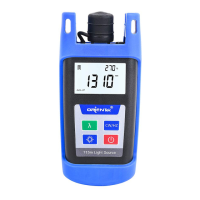
1 LCD display-display power value, frequency.
2 Direction indicator-indicating the direction
of the optical fiber light source under test.
3 Power-power on/off.
4 Backlight-Switch the backlight function [On] or [Off].
5 VFL key-- turn on/off the VFL function.
Question and Answer IconNeed help?

Do you have a question about the OrienTek TFI-40 and is the answer not in the manual?

Summary

Products Introduction

Panel Features Overview

Details the controls and display elements of the fiber identifier, including LCD, direction indicator, and power buttons.

Fiber Signal Recognition

Explains how to test and recognize signals in an optical fiber, including indications for signal presence and frequency.

Device Operation and Features

VFL Red Light Test

Instructions for using the Visual Fault Locator (VFL) for continuous wave and pulsed light output.

LED Lighting Function

Details on how to activate and use the integrated LED flashlight for dark environments.

Key Product Features

Highlights the universal fixture design, signal recognition, online testing, and integrated VFL function.

Specifications and Safety

Product Specifications

Lists technical details including wavelength range, signal types, adapter compatibility, and VFL performance.

Usage Environment and Tips

Provides guidelines on operating environment, safety warnings, and proper handling to prevent damage or injury.

Overview

The TFI-40 Fiber Identifier is an essential tool designed for non-destructive fiber identification in both single-mode and multi-mode fibers. It is primarily used during fiber maintenance, installation, wiring, and recovery processes where continuous operation is crucial. The device helps identify and separate specific optical fibers by detecting a 1310nm or 1550nm band modulation signal (270Hz, 1KHz, 2KHz) injected at one end of the fiber. Beyond identification, it also indicates the signal direction, streamlining troubleshooting and setup.

A key feature of the TFI-40 is its integration of a Visual Fault Locator (VFL) red light function and an LED lighting function. The VFL utilizes a 2.5mm universal interface, offering an output power of up to 1mW. This allows for the detection of fiber breaks or sharp bends within a range of up to 5KM. The VFL supports both pulse and continuous wave operation, providing flexibility for various fault-finding scenarios. The integrated LED lighting function is particularly useful for construction and maintenance work in dark environments, enhancing user convenience.

Technical Specifications:

  • Wavelength Recognition Range: 800nm to 1700nm
  • Signal Recognition Type: CW, 270 Hz ± 5%, 1 kHz ± 5%, 2 kHz ± 5%
  • Detector Type: Ø1mm InGaAs 2 pcs
  • Adapter Fiber Type: Universal Ø0.25mm (fiber), Ø0.9mm, Ø2.0mm, Ø3.0mm optical fiber sheath
  • Optical Power Reading Range: -40 dBm to 10 dBm
  • Signal Frequency Range: 270Hz, 1kHz, 2kHz
  • Power Type: AA*2 batteries
  • Operating Temperature Range: -10°C to 60°C
  • Storage Temperature Range: -25°C to 70°C
  • Product Size/Weight: 219mm x 45mm x 28mm / 235g
  • VFL Power Range: 1mW
  • VFL Test Distance: 3-5km
  • VFL Wavelength Range: 650nm
  • VFL Laser Type: LD
  • LED Flashlight: Supported

Usage Features:

The TFI-40 is designed for ease of use with several intuitive features:

  • LCD Display: Clearly shows power values and detected frequencies.
  • Direction Indicator: Visually indicates the direction of the optical fiber light source under test.
  • Power Button: Simple on/off control for the device.
  • Backlight Function: Allows users to switch the backlight on or off for improved visibility in varying light conditions.
  • VFL Key: Dedicated button to turn the VFL function on or off.
  • Fiber Signal Recognition: To use, the fiber is placed into the fixture's groove, the button is pushed to lock it, and the fixture cover is installed. If a signal is present, left and right direction lights will indicate the signal direction. If no signal is detected, the LCD will display "LO," and the direction indicator light may flicker. When the fiber is not properly clamped, the direction light may also flicker.
  • Frequency Indication: When a signal frequency of 2KHz, 1KHz, or 270Hz is detected, the corresponding indicator light illuminates, accompanied by an audible buzzing sound. Note that if the signal is too weak, it may not be correctly identified.
  • VFL Red Light Test: After powering on and opening the dust cover, insert the fiber interface into the laser connector. Pressing the VFL button once activates continuous wave output; pressing it again activates pulse output; a third press turns the VFL function off.
  • LED Lighting: With the device powered on and the dust cover open, a short press of the "--" button turns the flashlight on, providing illumination for dark environments. Another short press turns it off.
  • Three-in-One Universal Fixture Design: Accommodates a variety of optical fibers, ensuring compatibility and secure clamping.
  • Mechanical Damping Design: Engineered to prevent harm to the optical fiber during use.
  • LED Backlight Display: Suitable for various environments without requiring auxiliary lighting.
  • Modulation Signal Recognition: Capable of recognizing 270Hz, 1KHz, and 2KHz modulation signals.
  • Online Testing: Facilitates non-disruptive online testing, eliminating the need to interrupt business operations.
  • One-Touch Operation: Simple and convenient for efficient workflow.
  • Integrated VFL Function: Features a 2.5mm universal interface for versatile fault location.

Maintenance Features and Tips:

To ensure the longevity and proper functioning of the TFI-40, users should adhere to the following guidelines:

  • Cleanliness: Keep the equipment free of dirt and other contaminants.
  • Storage Conditions: Avoid storing the product in high-temperature, strong light, or strong magnetic fields. Do not place it in harsh environments such as near fire sources.
  • Proper Fiber Placement: Users must carefully place the optical fiber into the provided slot. Incorrectly pressing the optical fiber into the head assembly or misalignment with the fiber groove can deform the optical assembly.
  • Eye Safety: Never directly look at the optical output of fiber optic network equipment, test equipment, jumpers, or test jumpers to prevent serious eye injury.
  • Physical Handling: Avoid strong physical impacts, including knocking, throwing, trampling, or squeezing the device.
  • Disassembly: Non-professionals are strictly prohibited from disassembling this product.
  • Operating Environment: The device is designed for use in operating environments at altitudes below 2000m above sea level.
  • Disclaimer: This product does not specify power accuracy and should not be used to determine the actual signal strength in the fiber. The company is not responsible for personal and property damage caused by improper use of the product in violation of the manual.

The TFI-40 Fiber Identifier is a robust and versatile tool, combining essential fiber identification capabilities with practical features like VFL and LED lighting, making it an indispensable asset for fiber optic professionals.

OrienTek TFI-40 Specifications

General IconGeneral
BrandOrienTek
ModelTFI-40
CategoryMeasuring Instruments
LanguageEnglish

Related product manuals