Input/Comp Control
The Cali76 features a very nice studio-grade input
preamplifier. This works as an interface between the guitar
and the compressor section. In exactly the same way a studio-
engineer will first amplify a dry guitar signal before applying
additional processing.
The "INPUT/COMP" control allows the user to vary the gain of
this preamplifier. Turning this control clockwise increases the
overall gain of the pedal. This also inc r eas es the amoun t of
compression. The guitar will become increasingly more touch-
sensitive. Too much gain and the preamplifier will clip and
distort.
Compression is greatly reduced at lower gain settings as much
of the signal entering the compressor section falls below the
compressor's internal threshold. Signal level must exceed this
threshold in order to initiate gain-reduction. In this scenario
only the signal-peaks are compressed.
Output
The Output c ont rol simply varies the level of signal pr es ent at
the pedal's output jack. This can be set in order to keep the
overall effected-level close to the, dry (bypass) signal.
Alternatively, the level can be increased to help project a
guitar solo.
Attack & Release
Attack & Release controls are all too often misunderstood,
which is unfortunate as they are instrumental in achieving a
usable sound. In most cases Attack & Release parameters
should be adjusted to optimise the compressor's dynamic
response to that of a particular instrument. However, they can
also be adjusted to create strong dynamic effects.
The Attack control determines the time taken for the
compressor to react to the presence of a signal, i.e. the delay
from the instant when you pl ay the note, to the moment the
compressor actually reduces the gain. The long er the Attack-
time/delay, the more pronounced the beginning of each note
will sound.
In the context of the guitar - you may make the following
observations when adjusting Attack settings:
Increasing Attack-time highl i gh ts the percussive "snap" of
strongly picked notes.
Reducing Attack-time may impart a "spongy" feel to the
character of the compressor - esp ec ia l ly when "digging-in" to
single notes!
Reducing the Attack-time to a very short time will result in
undesirable distortion being generated - this will be heard to a
greater extent when playing bass notes.
The Release control determines the duration of any gain
reduction. This would be measured from the time that
compression is triggered to th e point that the compressor has
returned to its idle state. For maximum effect when processing
guitar, the Release must be set so that the compressor
responds fully to every note played. If so, the release time
must be short enough for the compressor to fully recover in the
short time between one note ending and the next note
beginning.
Ratio
The Ratio control allows the user to adjust the amount of g ai n
reduction applied for a ny given increase in guitar signal. At
the lowest ratio-setting, doubling the input signal (an increase
of 100%) will result i n the output increasing by 19%. At the
highest ratio-settin g, the output would rise by only 3. 5%, for
the same increase in input signal. The latter case represents
"Limiting".
As was the case in the Urei 1176, changing the ratio setting
also varies the threshold level of the unit. This h el ps to keep
the output at a consistent level, regardless of settings.
Example Settings
Figure 1 presents some useful starting points, intended for use
with guitar. Figure 4 consists of some more examples for use
in processing various recorded instruments.
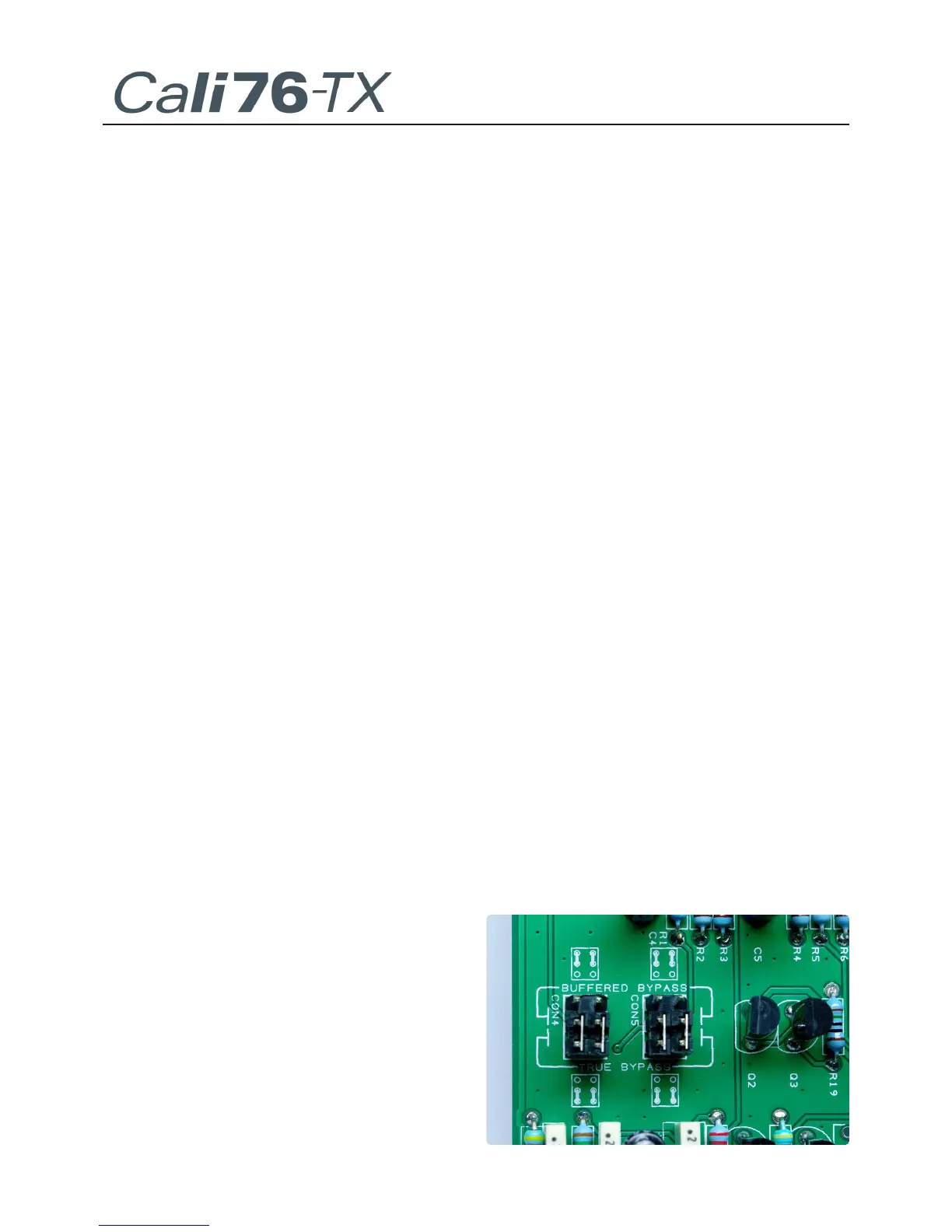
Bypass Mode (Internal Selection)
In non-transformer mode, i.e. when powerin g from a battery or
9V supply, the bypass mode can be selected internally by
changing the positions of four internal jumper-
connectors."True-Bypass" can be obtained with all four
jumpers in the lower-position. A low impedance, or buffered-
bypass, mode can be selected by moving all four jumpers to the
upper-position. In buffered-bypas s , the pedal w i l l ensure that
signal integrity is preserved even when driving long cable
runs.
Jumpers can be simply pulled away and pushed back into
place. Spare jumpers can be easily obtained if required.
When actively engaged, through the use of an 18V supply, the
transformer-board effectively buffers the signal at all times,
even when the unit is bypassed. For an optimum input
impedance of 1.1MOhms, pl ea se get the jumpers to the
buffered position.
Please note that any saturation/overdrive experienced with
the "GAIN" switch set in the "HIGH" position, will also be
audible with the unit set to bypass - just like driving a Urei
1176 with the compression bypas sed / defeated. If this proves to
be a problem, you may want to consider purchasing an
external bypass-looper in order to fully bypass the Cali76.
Using an external bypass-looper would give you three us efu l
pre-sets: dry signal; transformer-coloured dry signal; and
lastly, compressed signal also with transformer colouration.
Figure 2: J4, J5, J6, J7: Bypass Jumper-Connectors.


 To Next Page
 Loading...