Need help?
Do you have a question about the Orion EQ-2 and is the answer not in the manual?
Lists all components included with the Orion EQ-2 Equatorial Mount for verification.
Process to align the mount's R.A. axis with Earth's rotational axis for accurate tracking.
Instructions on utilizing fine adjustment cables for precise object centering and tracking.
Method for maintaining celestial objects in the telescope's field of view during observation.
Information on adding motor drives for automated, hands-free celestial object tracking.
Explanation of how to read and use R.A. and Dec. setting circles for object location.
Steps to calibrate the R.A. setting circle for accurate celestial coordinate alignment.
Guide on using calibrated setting circles to locate specific astronomical targets in the sky.
Tips and explanations for correctly aiming the telescope in different sky directions.
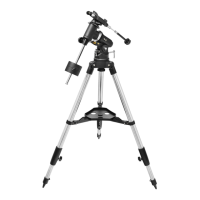
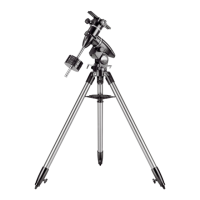
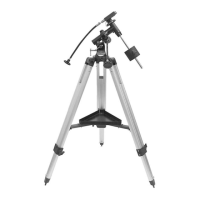
The Orion EQ-2 Equatorial Mount, model #9828, is a precision astronomical mount designed for manual tracking of celestial objects. It is suitable for use with various small to mid-size telescope optical tubes, accommodating refractors, Newtonian reflectors, and catadioptric telescopes weighing up to approximately 10 lbs. The mount's primary function is to compensate for the Earth's rotation, allowing observers to keep celestial objects within their eyepiece's field of view without constant manual repositioning. This is achieved by slowly rotating the telescope on its right ascension (R.A.) axis after proper polar alignment.
The EQ-2 Equatorial Mount is a German-type equatorial mount that facilitates the observation of celestial objects by allowing manual "tracking" along the right ascension axis. This tracking capability ensures that objects, which appear to move slowly across the sky due to Earth's rotation, remain centered in the telescope's field of view. The mount features setting circles for both right ascension (R.A.) and declination (Dec.), which assist in locating hundreds of celestial objects—including galaxies, nebulas, and star clusters—from their catalogued coordinates. The R.A. setting circle is scaled in hours (1-24) with 10-minute increments, while the Dec. setting circle is scaled in degrees with 1° increments, ranging from +90° to -90°.
The mount's design includes a counterweight system to balance the telescope, ensuring smooth movement and stability. This balance is crucial for precise tracking and comfortable observation. The counterweight slides along a shaft, allowing for fine adjustment to counterbalance the telescope's weight.
For enhanced tracking, the EQ-2 mount can be outfitted with an optional DC motor drive on its R.A. axis. This accessory provides hands-free automatic tracking, eliminating the need for manual adjustments via the R.A. slow-motion control cable and allowing objects to remain stationary in the field of view for extended periods.
Setting up the EQ-2 Equatorial Mount involves several key steps to ensure optimal performance. Assembly typically takes about 20 minutes and requires no special tools beyond those provided. The tripod legs attach to the mount, and an accessory tray bracket connects to the legs, providing stability and a convenient place for accessories. The tripod legs are adjustable in length, allowing the observer to set a comfortable viewing height and level the mount.
Polar alignment is a critical initial step for effective use of the equatorial mount. For Northern Hemisphere observers, this involves pointing the mount's R.A. axis towards Polaris, the North Star, which is approximately 1° from the north celestial pole (NCP). The latitude adjustment t-bolt allows the user to set the mount's latitude to match their observing site's geographical latitude. Once polar aligned, the mount should only be moved on its R.A. and Dec. axes to maintain alignment.
The mount is equipped with slow-motion control cables for both R.A. and Dec. axes. These cables enable fine adjustments to the telescope's position, allowing for precise centering of objects within the field of view. The Dec. slow-motion control cable has a limited range of mechanical travel (25°), requiring occasional resetting by rotating the cable in the opposite direction and manually slewing the telescope closer to the target. The R.A. slow-motion mechanism, however, has no limit to its amount of travel.
Balancing the telescope on the mount is essential for smooth operation. This involves two main steps: balancing on the R.A. axis and then on the Dec. axis. For R.A. balance, the counterweight is slid along its shaft until it precisely counterbalances the telescope tube, ensuring the shaft remains horizontal when released. For Dec. balance, the telescope tube is slid within its tube rings until it remains horizontal when released. Proper balance ensures that the telescope moves without resistance and does not drift when lock knobs are loosened.
Using the setting circles requires calibration. The Dec. setting circle is factory-calibrated to read 90° when the telescope optical tube is parallel to the R.A. axis. The R.A. setting circle, however, needs to be calibrated by pointing the telescope at a bright star with known coordinates, centering it, and then rotating the R.A. setting circle until its indicator arrow matches the star's R.A. coordinate. Once calibrated, the setting circles can be used to locate objects by matching their celestial coordinates. While not always precise enough to place an object dead-center in the eyepiece, they should place it within the finder scope's field of view, allowing for fine adjustments with the slow-motion controls.
Pointing the telescope to various parts of the sky, such as overhead (zenith) or directly south, involves rotating the telescope on its R.A. and Dec. axes while maintaining polar alignment. The counterweight shaft's orientation will vary depending on the target's altitude and direction, but the key is to move only along the R.A. and Dec. axes, avoiding adjustments to the azimuth or latitude settings once polar aligned.
The EQ-2 Equatorial Mount is designed for durability and ease of maintenance. All bolts should be tightened securely to prevent flexing and wobbling, but care should be taken not to over-tighten, which could strip the threads. The counterweight shaft includes a retaining screw and washer at the bottom to prevent the counterweight from falling off if its lock knob becomes loose.
The mount comes with a one-year limited warranty covering defects in materials or workmanship from the date of purchase. For warranty service, the product should be returned postage paid to Orion Warranty Repair. The warranty does not cover abuse, mishandling, modification, or normal wear and tear. Keeping the original packaging and internal shipping containers is recommended for safe transport if the mount needs to be shipped for service or relocation. Orion provides customer support via phone and email for any missing or broken parts, or for general assistance with setup and usage.
 Mount and Adjustment
| mount type | German-type equatorial |
|---|---|
| slow-motion adjustment | on both RA and Dec axes |
| setting circles | RA scaled in 10 min. increments, Dec scaled in 1° increments |
| polar axis latitude adjustment | 5° to 75° |
 Weight and Dimensions
| height | 38” to 58” |
|---|---|
| weight | 17 lbs |
| counterweight | 5 lb. |
| maximum loading weight | About 10 lbs |

 To Next Page