13
Eyepiece Selection
By using eyepieces of different focal lengths, it is possible
to attain many magnifications or powers with the Observer
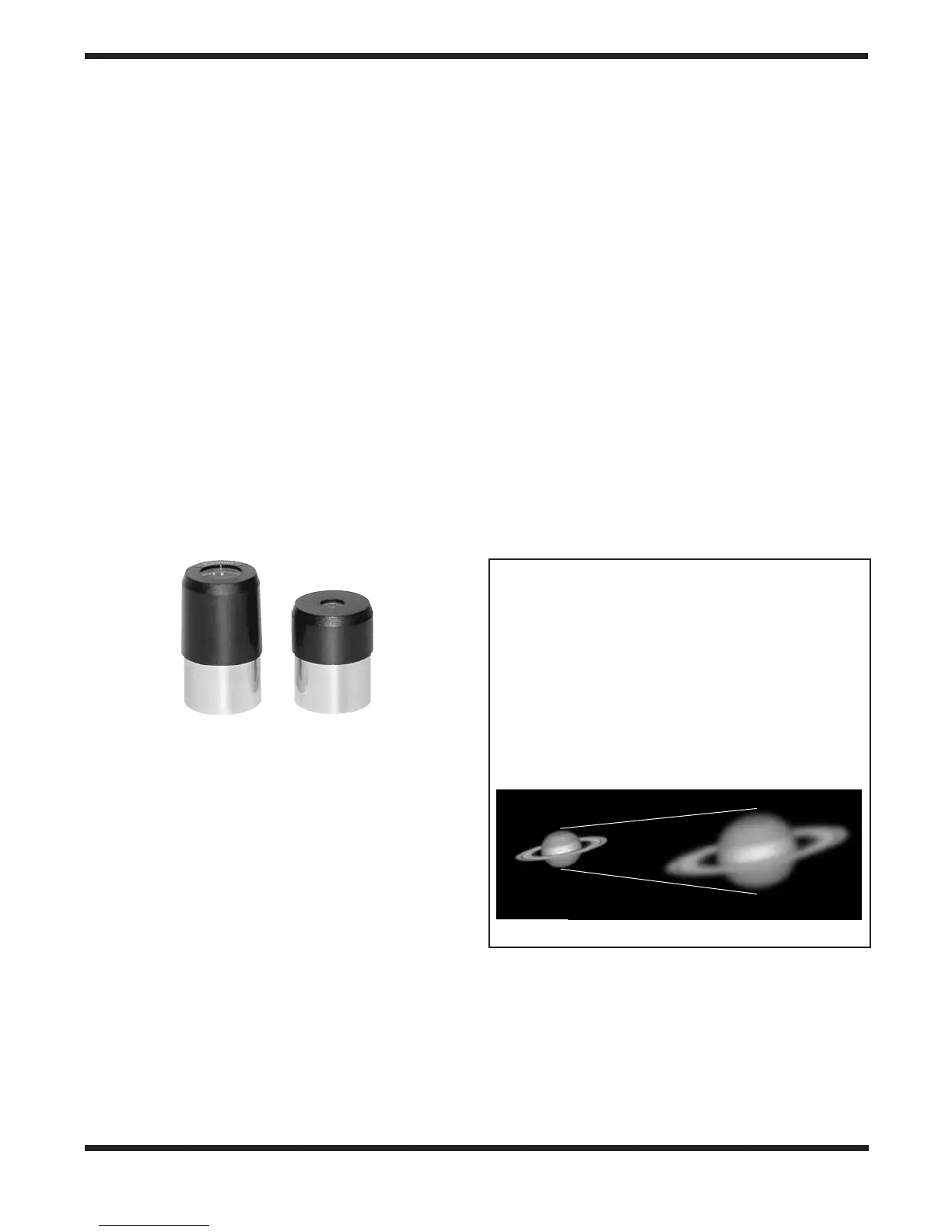
60. Your telescope comes with two Kellner eyepieces
(Figure 9): a 25mm, which gives a magnification of 28x,
and a 10mm, which gives a magnification of 70x. Other
eyepieces can be used to achieve higher or lower powers.
It is quite common for an observer to own five or more eye-
pieces to access a wide range of magnifications.
To calculate the magnification, or power, of a telescope-
eyepiece combination, simply divide the focal length of the
telescope by the focal length of the eyepiece.
Telescope Focal Length (mm) ÷ Eyepiece Focal
Length(mm) = Magnification
For example, the Observer 60, which has a focal length
of 700mm, used in combination with the 25mm eyepiece,
yields a magnification of
700 ÷ 25 = 28x
Whatever you choose to view, always start by inserting your
lowest-power (longest focal length) eyepiece to locate
and center the object. Low magnification yields a wide field
of view, which shows a larger area of sky in the eyepiece.
This makes finding and centering an object much easier.
Trying to find and center objects with a high power (narrow
field of view) eyepiece is like trying to find a needle in a
haystack!
Once you’ve centered the object in the eyepiece, you can
switch to a higher magnification (shorter focal length) eye-
piece, if you wish. This is recommended for small and bright
objects, like planets and double stars. The Moon also takes
higher magnifications well.
The best rule of thumb with eyepiece selection is to start
with a low power, wide-field eyepiece, and then work your
way up in magnification. If the object looks better, try an
even higher magnification eyepiece. If the object looks
worse, then back off the magnification a little by using a
lower-power eyepiece.
Figure 9. The 25mm and 10mm Kellner eyepieces.
25mm
10mm
Magnification Limits
Every telescope has a useful magnification limit of about
2X per millimeter of aperture. This comes to 120X for
the Observer 60. Some telescope manufacturers will use
misleading claims of excess magnification, such as “See
distant galaxies at 640X!”. While such magnifications are
technically possible, the actual image at that magnifica-
tion would be an indistinct blur.
Moderate magnifications are what give the best views. It
is better to view a small, but bright and detailed image
than a dim, unclear, oversized image.




 To Next Page