This document is an instruction manual for Orion Schmidt-Cassegrain Telescopes, specifically the 8", 9.25", and 11" models. It provides detailed information on the setup, use, and maintenance of these optical instruments.
Function Description
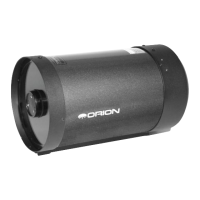
The Orion Schmidt-Cassegrain telescopes are compound or catadioptric telescopes that utilize a combination of mirrors and lenses to achieve large-diameter optics within a compact, short tube length, making them highly portable and versatile. The optical system consists of a zero-power corrector plate, a spherical primary mirror, and a secondary mirror. Light rays travel the length of the optical tube three times before exiting through a hole in the center of the primary mirror to the eyepiece. These telescopes are designed for both terrestrial and astronomical observation, allowing users to view distant objects with varying magnifications. The manual covers essential operations such as attaching visual accessories, inserting eyepieces, aligning the finder scope, focusing, and collimating the optics.
Important Technical Specifications
The manual provides a table detailing the specifications for the three models:
- Orion 8" SCT:
- Focal Length, Ratio: 2032mm, f/10
- Tube Material: Aluminum
- Coatings: StarBright™ XLT
- Highest Useful Magnification: 480x
- Secondary Mirror Obstruction: 2.7" (11% by Area, 34% by Diameter)
- Tube Length: 17"
- Tube Weight: 12 lbs.
- Orion 9.25" SCT:
- Focal Length, Ratio: 2350mm, f/10
- Tube Material: Aluminum
- Coatings: StarBright™ XLT
- Highest Useful Magnification: 555x
- Secondary Mirror Obstruction: 3.35" (13% by Area, 36% by Diameter)
- Tube Length: 22"
- Tube Weight: 20 lbs.
- Orion 11" SCT:
- Focal Length, Ratio: 2800mm, f/10
- Tube Material: Aluminum
- Coatings: StarBright™ XLT
- Highest Useful Magnification: 660x
- Secondary Mirror Obstruction: 3.75" (12% by Area, 34% by Diameter)
- Tube Length: 24"
- Tube Weight: 27 lbs.
All models feature StarBright™ XLT coatings, which are enhanced multi-layer coatings on the primary and secondary mirrors for increased reflectivity, and a fully coated corrector for optimal anti-reflection characteristics. The general rule for maximum useful magnification is 60x per inch of aperture.
Usage Features
- Visual Back Attachment: The visual back is crucial for attaching accessories. It is secured by a knurled slip ring.
- Star Diagonal Insertion: A star diagonal diverts the light at a right angle, providing a more comfortable viewing position. It slides into the visual back and is secured by a set screw.
- Eyepiece Insertion: Eyepieces, which determine magnification, fit into the star diagonal or directly into the visual back. They are secured by a set screw. Magnification is calculated by dividing the telescope's focal length by the eyepiece's focal length.
- Finder Scope Attachment and Alignment: A small, wide-field finder scope helps locate and center objects. It attaches to a dovetail finder scope base on the telescope's rear cell. Alignment involves adjusting thumbscrews to center a distant object in both the finder scope and the main telescope. The finder scope's image is typically upside down.
- Focusing: The telescope's primary mirror is controlled by a focusing knob on the rear cell. Turning the knob adjusts the mirror's position to achieve a sharp image. For astronomical viewing, focusing on a bright object and turning the knob counterclockwise (moving the mirror against gravity) is recommended to minimize mirror shift. The finder scope also has its own focus adjustment via a lock ring behind the objective lens cell.
- Image Orientation: When using a star diagonal, the image is right-side-up but mirror-reversed (left to right). When an eyepiece is inserted directly into the visual back (without a star diagonal), the image is upside-down and inverted (left to right). The finder scope's image is upside down.
- Field of View Calculation: The actual field of view is determined by dividing the eyepiece's apparent field by the magnification. This helps understand the angular size of the observed object.
Maintenance Features
- Optical Cleaning: Dust and moisture can accumulate on the corrector plate. Dust should be removed with a camel's hair brush or blower bulb. For remaining debris, an optical cleaning solution applied to tissue (not directly to the glass) should be used with low-pressure strokes from the center to the outer portion. Rubbing in circles should be avoided. A good cleaning solution can be made from 60% isopropyl alcohol and 40% distilled water, or diluted liquid dish soap.
- Dew Removal: If dew builds up, it can be removed with a hair dryer on a low setting or by pointing the telescope at the ground until the dew evaporates.
- Internal Moisture: If moisture condenses inside the corrector, accessories should be removed from the rear cell, and the telescope placed in a dust-free environment, pointing down, to allow the moisture to evaporate.
- Minimizing Contaminants: Replacing all lens covers after use and placing a cover over the rear cell opening when not in use helps prevent contaminants from entering the optical tube.
- Collimation: The optical system's alignment (collimation) is crucial for performance. While factory-collimated, severe jarring may require re-collimation. Only the secondary mirror can be adjusted using three collimation screws on its housing. Collimation is checked by observing the symmetry of a defocused bright star's ring pattern through a medium to high-power eyepiece. Adjustments involve turning the collimation screws to center the dark obstruction in the star's ring pattern. Laser collimators are not suitable for Schmidt-Cassegrains.
- Professional Servicing: Internal adjustments and cleaning should only be performed by an authorized repair department. For internal cleaning needs, users should contact Orion for a return authorization number and price quote.
- Warranty: Orion provides a two-year limited warranty covering defects in materials and workmanship. Customers must obtain a Return Authorization Number before returning products for repair or replacement. The warranty does not cover modifications, abuse, misuse, mishandling, unauthorized repair, or normal wear.

 Need help?


 To Next Page
 General