
 Need help?
Do you have a question about the Orion STARBLAST and is the answer not in the manual?
Attaching the EZ Finder II reflex sight to the optical tube using thumbnuts.
Inserting and securing an eyepiece into the telescope's focuser.
How to turn on, use, and adjust the EZ Finder II reflex sight.
Step-by-step guide on how to achieve a sharp image using the focus wheels.
Process for aligning the EZ Finder II with the main telescope's view.
Detailed steps for aligning the secondary mirror.
Detailed steps for aligning the primary mirror.
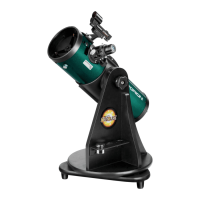
The Orion StarBlast 4.5" Altazimuth Reflector Tabletop Telescope is a compact and user-friendly instrument designed for astronomical observation, offering breathtaking views of celestial objects like the Moon, planets, and deep-sky wonders such as the Orion Nebula. Its portable design and straightforward operation make it an excellent choice for both beginners and experienced observers seeking a convenient and capable telescope.
The core of the StarBlast is its optical tube, which houses a parabolic primary mirror and a secondary mirror. The primary mirror, located at the rear of the tube, gathers incoming light and focuses it, while the secondary mirror, positioned near the front opening, reflects this focused light into the eyepiece. This Newtonian reflector design provides clear and detailed images, though it's important to note that the image in the eyepiece will be inverted (upside-down), which is normal for this type of telescope and does not affect astronomical viewing.
To begin observing, the optical tube is mounted on a sturdy altazimuth base made of wood. This base allows for intuitive movement along two axes: altitude (up/down) and azimuth (left/right). Users can easily aim the telescope by simply taking hold of the tube and moving it left or right to rotate the base, or up and down to adjust its vertical position. Both motions can be performed simultaneously for smooth and continuous aiming across the night sky, from horizon to horizon. For added stability and ease of aiming, it can be convenient to hold one hand near the carrying handle while moving the telescope. The altitude tension adjustment knob allows users to fine-tune the amount of tension in the up/down motion, ensuring the telescope moves smoothly and stays in place once aimed. If the focuser is in an inconvenient position for viewing, the tube clamp knob can be loosened to rotate the optical tube until the eyepiece is comfortably accessible.
Focusing the telescope is achieved using the focus wheels, which move the rack-and-pinion focuser in and out. Eyepieces are inserted into the focuser and secured with thumbscrews. The StarBlast comes with two Kellner eyepieces: a 17mm for lower magnification and a wider field of view, and a 6mm for higher magnification. Starting with the lower-power eyepiece is recommended to easily locate and center objects, then switching to a higher-power eyepiece for more detailed views of smaller, brighter objects like planets and the Moon. The telescope also includes a handy metal eyepiece rack built into the base for convenient storage of extra eyepieces.
A crucial accessory for aiming the telescope is the EZ Finder II reflex sight. This finder projects a tiny red LED dot onto a lens, which appears to float in space when looking through it. To use it, the power knob is turned clockwise until a click is heard, indicating it's on. The intensity of the red dot can be adjusted, with a dim setting preferred for dark skies and a brighter setting for light-polluted areas or daylight. Aligning the EZ Finder II with the telescope is a simple process best done during the day. The telescope is aimed at a distant object (e.g., a telephone pole) and centered in the telescope's eyepiece. Then, without moving the telescope, the EZ Finder II's azimuth and altitude adjustment knobs are used to position the red dot directly on the object. Once aligned, the EZ Finder II typically maintains its alignment, requiring only minimal adjustments if removed and remounted. The EZ Finder II is powered by a replaceable 3-volt lithium battery, which can be changed by gently prying open the battery casing.
The StarBlast's compact size is a significant advantage, making it extremely portable. Its short height often makes viewing most comfortable while sitting on the ground. However, if a raised viewing position is desired, the telescope can be placed on a platform like a milk crate or table.
When observing, choosing a suitable site is important. Avoiding direct artificial light sources like streetlights and car headlights will greatly improve dark adaptation and viewing quality. Observing over rooftops or chimneys should also be avoided due to warm air currents that can cause image blurring. For the best deep-sky views, escaping light-polluted city skies to darker country locations is highly recommended. The International Dark-Sky Association (IDA) is a valuable resource for information on combating light pollution and preserving dark skies.
Atmospheric conditions, referred to as "seeing" and "transparency," significantly impact viewing quality. Good seeing, characterized by minimal star twinkling, allows for steady images, especially at higher magnifications. Good transparency, meaning air free of moisture, smoke, and dust, is essential for observing faint objects. The magnitude of the faintest stars visible to the unaided eye can indicate transparency quality.
Celestial objects appear to move across the field of view due to Earth's rotation, requiring continuous adjustment of the telescope's position to keep objects centered. The StarBlast's smooth altazimuth motions make this tracking easy. Objects move faster across the field of view at higher magnifications because the field of view becomes narrower.
For solar observation, it is crucial to use an optional full-aperture solar filter that completely covers the front opening of the telescope. Never look directly at the Sun through the telescope or its finder scope without a professionally made solar filter, as this can cause permanent eye damage. The EZ Finder II should also not be used for solar viewing.
The telescope's optics are factory-aligned, but rough handling may necessitate mirror alignment, or "collimation." This process ensures the primary and secondary mirrors are optically aligned for peak performance. The StarBlast includes a collimation cap, a simple cap with a central hole and silver bottom that fits into the focuser, aiding in the collimation process by helping to center the observer's eye. The primary mirror also has a small center-mark, which assists in aligning the primary mirror with the collimation cap's dot. This center-mark should not be removed as it lies in the shadow of the secondary mirror and does not affect optical performance.
Collimation involves adjusting the secondary mirror first, ensuring it is centered in the focuser drawtube and its reflection of the primary mirror is as centered as possible. This is done by loosening three small alignment set screws in the center hub of the spider and adjusting a center screw, then re-tightening the alignment screws. Next, the primary mirror's tilt is adjusted using three spring-loaded collimation thumbscrews on the back of the mirror cell. The three thin thumbscrews that lock the primary mirror's position must be loosened before making adjustments to the wide collimation thumbscrews. The goal is to center the collimation cap's dot within the primary mirror's center ring. After collimation, the locking thumbscrews should be re-tightened. A star test, performed by de-focusing a bright star, can confirm accurate collimation if the expanding disk appears as a perfect, symmetrical circle with the secondary mirror's shadow centered.
Maintenance of the StarBlast is minimal. Storing it in a clean, dry, dust-free place, away from rapid temperature changes and humidity, is recommended. Dust caps should always be on the front of the scope and focuser when not in use. The steel optical tube's painted finish is scratch-resistant, and smudges can be wiped off with a soft cloth and household cleaner.
Cleaning the optics should be done infrequently, typically once a year or so, as improper cleaning can scratch mirror coatings. Small specks of dust or paint flecks generally do not affect visual performance. For eyepieces, quality optical lens cleaning tissue and fluid designed for multi-coated optics should be used. Loose particles should be blown off first, then a small amount of fluid applied to a tissue (never directly to the lens), and the lens gently wiped in a circular motion. Excess fluid is removed with a fresh tissue. Never reuse tissues or rub too hard, as this can scratch the lens.
For cleaning the mirrors, they must be carefully removed from the telescope. The secondary mirror is removed by unthreading the Phillips head screw in its center hub. The primary mirror cell is removed by taking out three screws on the outer edge of the mirror cell, then three mirror clips. The mirror should be handled by its edge and placed on a clean, soft towel. To clean, the mirror is submerged in a sink filled with room-temperature water, a few drops of liquid dishwashing detergent, and a cap-full of rubbing alcohol. After soaking, the mirror is gently wiped underwater with clean cotton balls, using light pressure and straight strokes. Each cotton ball should be used only once. The mirror is then rinsed under a stream of lukewarm water, and any remaining particles are gently swabbed with clean cotton balls. Finally, the mirror is dried with a stream of air (e.g., from a blower bulb) or by using the corner of a paper towel to remove stray drops of water. The bottom and edges of the mirror (not the mirror surface) can be dried with a towel. The entire assembly should be left in a warm area to dry completely before reassembling the telescope.
 General
| Aperture | 114 mm |
|---|---|
| Focal Length | 450 mm |
| Focal Ratio | f/4 |
| Mount Type | Altazimuth |
| Optical Design | Newtonian Reflector |
| Tube Material | Steel |
| Finderscope | Reflex Sight |





 To Next Page