
 Need help?
Do you have a question about the Orion SkyView Pro 127mm EQ and is the answer not in the manual?
Proper unpacking procedures and checking all included parts for completeness.
Step-by-step instructions for assembling the telescope and mount without tools.
How to balance the optical tube on both R.A. and Dec. axes for smooth movement.
Method for achieving sharp focus on celestial objects using the focus knob.
Procedure to align the finder scope with the main telescope for accurate aiming.
Guide to correctly positioning and utilizing the equatorial mount.
Essential steps for aligning the mount's axis with Earth's rotational axis.
How to choose and use eyepieces for different magnifications and targets.
Keeping celestial objects centered in the field of view during observation.
Using R.A. and Dec. setting circles to locate astronomical objects by coordinates.
General advice and tips for successful astronomical viewing sessions.
Critical safety warning regarding solar observation and necessary filters.
Proper methods for cleaning the telescope's optical lenses and maintaining clarity.
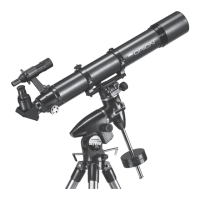
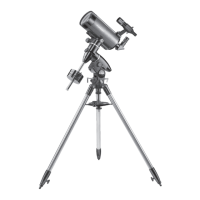
The Orion SkyView Pro 127mm EQ is a sophisticated telescope designed for high-resolution viewing and astrophotography of celestial objects. Its precision optics and sturdy equatorial mount allow users to explore hundreds of fascinating celestial denizens. The telescope is intended for both novice and experienced amateur astronomers, offering a blend of ease of use and advanced capabilities.
The primary function of the Orion SkyView Pro 127mm EQ is to provide magnified views of astronomical objects, from planets and the Moon to distant galaxies and nebulae. The equatorial mount is crucial for tracking celestial objects as they appear to move across the night sky due to the Earth's rotation. This tracking capability is achieved by aligning the mount's right ascension (R.A.) axis with the Earth's rotational axis, a process known as polar alignment. Once polar aligned, the telescope can keep an object centered in the field of view by rotating only on its R.A. axis, typically using a slow-motion control knob or an optional motor drive.
The telescope's optical tube is a Maksutov-Cassegrain design, known for its compact size and excellent image quality, particularly for planetary and lunar observations. Light enters through a front meniscus lens, reflects off a primary mirror, and then off a secondary mirror before being directed to the eyepiece. This design provides a long focal length in a relatively short tube, resulting in high magnifications with common eyepieces.
The finder scope, an 8x40 achromatic instrument, serves as a crucial aiming device. With its wider field of view and lower magnification, it helps users locate objects in the sky before switching to the main telescope's higher magnification. The star diagonal, which holds the eyepiece, provides a comfortable viewing angle, especially when observing objects high in the sky.
Assembly and Setup: The initial assembly of the telescope is straightforward, requiring about 30 minutes without special tools. Users are guided to spread the tripod legs, attach the equatorial mount, thread the central support shaft, and install the tripod support tray for added stability. The counterweight shaft and counterweights are then attached and balanced to ensure smooth movement of the optical tube. Slow-motion control knobs are affixed to the R.A. and declination (Dec.) worm gear shafts for fine adjustments. The optical tube is secured to the mount's dovetail slot, and the finder scope, star diagonal, and eyepieces are installed.
Balancing the Telescope: Proper balancing is essential for smooth operation. The telescope is balanced on both the R.A. and Dec. axes. For R.A. balance, counterweights are slid along the shaft until the optical tube remains horizontal when the R.A. lock lever is released. For Dec. balance, the optical tube is slid along its mounting plate until it remains stationary when the Dec. lock lever is released. This ensures that the telescope does not drift when the lock levers are disengaged, allowing for precise manual pointing.
Focusing: Focusing is achieved by slowly rotating the focus knob until the desired object appears sharp in the eyepiece. It's recommended to start with a low-power eyepiece and focus on a distant terrestrial object (at least 1/4-mile away) during the day to get accustomed to the process.
Finder Scope Alignment: The finder scope must be accurately aligned with the main telescope. This is done by first centering a distant object in the main telescope's eyepiece, then adjusting the finder scope's alignment thumbscrews until the same object is centered in the finder's crosshairs. This alignment should be checked before each observing session.
Magnification and Eyepieces: Magnification is determined by the focal length of the telescope and the eyepiece. The telescope comes with two Sirius Plössl eyepieces (25mm and 10mm) for different magnifications. Users are advised to start with the lowest power eyepiece to locate and center objects due to its wider field of view, then switch to higher magnifications for more detailed views of smaller, brighter objects.
Polar Alignment: For Northern Hemisphere observers, approximate polar alignment involves pointing the mount's R.A. axis towards Polaris (the North Star). This is achieved by leveling the tripod, setting the mount's latitude to the observer's geographical latitude, and then moving the tripod until the telescope's R.A. axis points roughly at Polaris. More precise polar alignment, especially for astrophotography, can be achieved using an optional polar axis finder scope, which installs into the R.A. axis of the mount and features a reticle with a star map for accurate alignment.
Using Setting Circles: The equatorial mount features setting circles for R.A. and Dec., which allow users to locate celestial objects by their celestial coordinates (found in star atlases). After accurate polar alignment, the setting circles must be calibrated by pointing the telescope at a known bright star and adjusting the circles to match its coordinates. Once calibrated, users can dial in the coordinates of a desired object to bring it into the finder scope's field of view.
Tracking Celestial Objects: Once polar aligned, celestial objects can be tracked by slowly rotating the telescope on its R.A. axis using the R.A. slow-motion control knob. This compensates for the Earth's rotation, keeping the object in the field of view. Optional motor drives can automate this tracking process.
Astronomical Observing Tips: The manual provides comprehensive observing tips, including site selection (away from light pollution), understanding atmospheric conditions ("seeing" and "transparency"), allowing the telescope to cool to ambient temperature ("thermal equilibrium"), and dark-adapting eyes. It also offers guidance on observing various celestial objects like the Moon, Sun (with a proper filter), planets (Jupiter, Saturn, Venus, Mars), and deep-sky objects (stars, nebulae, galaxies, star clusters).
Starhopping: This technique involves using a star chart to map a route from a bright, easily identifiable star to a fainter, desired object. Users point the telescope at the starting star, center it in the finder scope, and then make successive "hops" to other bright stars along the route until the target object is located in the eyepiece.
Terrestrial Viewing: While primarily designed for astronomy, the telescope can be used for terrestrial viewing. However, the equatorial mount's R.A. and Dec. axes motion is not ideal for land viewing. It's recommended to remove the optical tube and mount it on a photo-style tripod for terrestrial use. An optional 45° correct-image diagonal is suggested to provide an upright, correct-image view, as the included star diagonal inverts the image left-to-right. Low-power eyepieces are best for terrestrial viewing to maintain sharpness and clarity.
Astrophotography: With an optional camera adapter and a T-ring specific to the camera model, the telescope can function as a 1540mm f/12.1 telephoto lens for single-lens reflex cameras. The camera attaches to the eyepiece adapter, and the telescope's focuser is used to focus the image. A remote shutter release is recommended to prevent vibrations.
Transporting: The telescope comes with a padded carrying case for the optical tube and accessories, ensuring safe transport. Before placing the optical tube in the case, the eyepiece, diagonal, and finder scope/bracket must be removed, and all openings should be covered with dust caps.
Storing: For long-term care, the telescope should be stored in a clean, dry, dust-free place, away from rapid changes in temperature and humidity. A garage or shed is suitable, but outdoor storage is not recommended. Dust covers should always be used on the optical tube and finder scope when not in use.
Cleaning the Tube: The aluminum optical tube has a scratch-resistant painted finish. Smudges can be wiped off with a soft cloth and a household cleaner.
Cleaning Lenses: Optical lens cleaning tissue and fluid, specifically designed for multi-coated optics, should be used for cleaning the meniscus lens, eyepieces, and finder scope lenses. Regular glass cleaner or eyeglass cleaning fluid should not be used. Before applying fluid, loose particles should be blown off the lens with a blower bulb or compressed air. The fluid is applied to a tissue, not directly to the optics, and the lens is wiped gently in a circular motion. Oily fingerprints and smudges can be removed this way. Caution is advised to avoid scratching the lens, and for larger lenses, only a small area should be cleaned at a time with a fresh tissue.
 General
| Aperture | 127mm |
|---|---|
| Focal Length | 1000mm |
| Mount Type | Equatorial |
| Optical Design | Maksutov-Cassegrain |
| Finderscope | 6x30 |
| Eyepieces Included | 25mm and 10mm |



 To Next Page