EasyManua.ls Logo

Panasonic LP-RF Series - User Manual

Panasonic LP-RF Series
218 pages
Print Icon
To Next Page IconTo Next Page
Loading...
2021. 8
panasonic.net/id/pidsx/global
ME-LPRF-SM-11
Please read these instructions carefully before using this
product, and save this manual for future use.
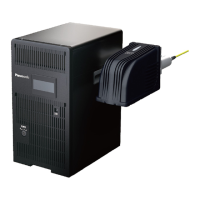
Laser Marker
Setup /
Maintenance Guide
LP-RF series

Table of Contents

Questions and Answers

Summary

Product Overview

1-1 Product Model

Identifies the available models for the FAYb Laser Marker LP-RF series, including their specifications.

1-2 Product Configuration

Details the basic composition of the laser marker, listing the main units and their functions.

1-3 Specification

Provides detailed technical specifications for the laser marker, covering laser type, marking field, and various operational parameters.

1-4 Outer Dimensional Drawing

Presents dimensional drawings of the laser marker head and controller, showing mounting and connection points.

1-5 Name of Each Component

Identifies and describes the function of each component of the laser marker head and controller.

Laser Marker Installation

2-1 Installation Environment

Specifies suitable operating environments and conditions for the laser marker, including temperature, humidity, and pollution degree.

2-2 Installation Space

Outlines the required space around the head and controller for proper air cooling performance and to prevent malfunction.

2-3 Head Installation

Details safety precautions and methods for installing the laser marker head, including carrying and directional placement.

2-4 Controller Installation

Provides instructions for safely carrying and installing the controller unit, including mounting orientation and screw tightening.

2-5 Connecting Laser Marker

Explains the procedures for connecting the head and controller, including cable connections and ingress protection measures.

2-6 Construction of System

Illustrates a sample system construction, detailing the interconnections of the laser marker with safety devices like relay units or PLCs.

Operation Method

3-1 Type of Operations

Describes the methods for controlling the laser marker, including PC configuration software and external device control.

3-2 Start-up & Termination

Details the step-by-step procedures for starting up and terminating the laser marker system safely and correctly.

3-3 Operation by PC Configuration Software

Explains how to configure and operate the laser marker using the Laser Marker NAVI smart software, covering online and offline modes.

3-4 Operation by External Devices

Covers methods for controlling the laser marker using external devices via I/O signals or communication commands.

External Control Using I;O

4-1 I;O Interface Specification

Details the available external control I/O interfaces, including terminal blocks and connectors, and their specifications.

4-2 Signals and Details of I;O Terminal Block

Lists and describes the signals and their functions for the I/O terminal block, covering inputs and outputs.

4-3 Signals and Details of I;O Connector

Lists and describes the signals and their functions for the I/O connector, covering inputs and outputs for data setting and specific functions.

4-4 I;O Rating;Circuit

Shows the input/output ratings and circuits for the I/O terminal block and connector, explaining NPN and PNP connection samples.

4-5 Connecting I;O Terminal Block

Explains factory default wiring and provides examples for connecting common terminals using internal or external power supplies.

4-6 Basic Control Timing Chart

Illustrates various control timing charts for operations like startup, shutter control, triggers, and data handling.

External Control by Communication Commands

5-1 Communication Interfaces

Describes the communication interfaces available on the controller, including RS-232C, Ethernet, and industrial network ports.

5-2 RS-232 C

Details the interface specifications, connection methods, and signals for RS-232C communication control.

5-3 Ethernet

Explains Ethernet port specifications, connection procedures, and communication settings for network control.

5-4 Checking the communication commands

Describes how to check transmitted and received commands using the command history function in the PC configuration software.

Link Control with External Devices

6-1 Link Control with Image Checker

Explains how to link the laser marker with an image checker for position correction, marking, and image checking operations.

6-2 Link Control with Code Reader

Details how to connect and control the laser marker with a code reader via RS-232C for file switching and character data modification.

Maintenance

7-1 Maintenance Items

Lists typical parts requiring cleaning or replacement, indicating main causes for degradation and daily maintenance procedures.

7-2 Maintenance Details of Parts

Provides detailed maintenance procedures for specific parts like protection glass, vents, fans, and contactors.

7-3 Obtaining Backup Data

Explains the procedure for periodically obtaining data backups from the laser marker using the Laser Marker NAVI smart software.

7-4 Serial Number Checking Method

Describes methods for checking the laser marker's serial numbers on the main unit and via the Laser Marker NAVI smart software.

7-5 Disposal of Laser Marker

Provides instructions for the proper disposal of the laser marker and its batteries according to regional regulations and recycling systems.

Troubleshooting

Start-up

Lists common problems encountered during system startup and their corresponding causes and measures for resolution.

Laser pumping

Addresses issues related to laser pumping not starting, including I/O terminal connections and remote mode settings.

Connection with Laser Marker NAVI smart

Covers troubleshooting steps for online connection failures, disconnections, and Ethernet/Bluetooth communication issues.

Lasing operation

Details troubleshooting for lasing problems, such as blocked beams, incorrect distances, insufficient power, and issues in RUN/REMOTE modes.

Marking quality

Addresses problems related to marking quality, including faded or distorted characters, workpiece instability, and laser oscillator aging.

Moving objects

Provides solutions for issues when marking moving objects, such as skipped markings, distorted characters, and unstable line speed.

External control

Troubleshoots problems with external device control, including communication failures, I/O control issues, and command errors.

Error Indication

Alarm: E001 - E599

Explains errors categorized as alarms, detailing their causes and release methods, including hardware and system errors.

Warning: E600 - E799

Describes warnings related to incorrect setting data or unmet laser radiation conditions, listing error codes and their corresponding measures.

Panasonic LP-RF Series Specifications

General IconGeneral
Light SourceLED
Power Supply Voltage12 to 24 V DC ±10%
Output TypeNPN/PNP
Input Voltage12-24 VDC
Output Voltage12-24 VDC
Output Current100 mA
ProtectionReverse polarity protection, short-circuit protection

Related product manuals