
 Need help?
Do you have a question about the Panasonic Lumix DMW-BTC13 and is the answer not in the manual?
This document provides operating instructions for the Panasonic Battery Charger models DMW-BTC12 and DMW-BTC13. It includes important safety information, technical specifications, usage guidelines, and warranty details.
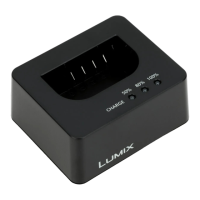
The Panasonic Battery Charger is designed to recharge specific Panasonic Lithium-ion battery packs. It operates by connecting to an AC power source via a supplied AC adaptor and USB connection cable. The charger features a [CHARGE] indicator that illuminates when charging begins and turns off upon completion. It also flashes to indicate issues such as extreme battery temperature or dirty terminals.
The battery charger is designed for ease of use. To charge a battery, first connect the battery charger and the AC adaptor using the supplied USB connection cable. Ensure the terminals are aligned correctly to prevent damage. Then, insert the AC adaptor into a power outlet. Finally, insert the battery into the charger, paying attention to its direction. The [CHARGE] indicator will light up, signaling that charging has begun. Once charging is complete, the indicator will turn off.
The charger and AC adaptor may produce whirring sounds during operation, which is normal. It is recommended to keep the charger and AC adaptor at least 1 meter (3.3 feet) away from radios to avoid interference.
For optimal performance and longevity, it is crucial to use only genuine Panasonic battery packs and the supplied AC adaptor and USB connection cable. Using unrecommended accessories or incorrect battery types may lead to malfunction or safety hazards.
If the [CHARGE] indicator flashes during charging, it may indicate that the battery temperature is too high or too low. In such cases, it is recommended to recharge the battery at an ambient temperature between 10 °C and 30 °C (50 °F and 86 °F). Flashing may also occur if the terminals of the charger or battery are dirty; these should be wiped with a dry cloth.
It is important to remove the battery once charging is complete, as leaving it in the charger for an extended period after being fully charged can lead to battery exhaustion. While recharging a partially charged battery is possible, frequent topping up of a fully charged battery is not recommended as it may cause characteristic swelling.
The device is classified as Class II equipment, meaning it has double insulation for enhanced safety. The socket outlet for the AC adaptor should be installed near the equipment and be easily accessible.
To reduce the risk of fire, electric shock, or product damage, the unit should not be exposed to rain, moisture, dripping, or splashing. Covers should not be removed, and users should not attempt to repair the unit themselves; servicing should be referred to qualified personnel.
For battery packs, it is critical to use the specified unit for recharging and not to use the battery pack with other equipment. Avoid getting dirt, sand, liquids, or foreign matter on the terminals, and do not touch the plug terminals with metal objects. The battery pack should not be disassembled, remodeled, heated, or thrown into fire. In case of electrolyte contact with skin or clothing, wash thoroughly with water. If electrolyte gets into the eyes, rinse thoroughly with water and consult a doctor immediately. Incorrect battery replacement carries a risk of explosion, so only manufacturer-recommended types should be used. When disposing of batteries, local authorities or dealers should be consulted for proper disposal methods. Batteries should not be heated or exposed to flame, and should not be left in a car exposed to direct sunlight with closed doors and windows for long periods.
For the AC adaptor, it should not be installed or placed in confined spaces like bookcases or built-in cabinets; adequate ventilation is essential. The unit remains in standby with the primary circuit "live" as long as the AC adaptor is connected to an electrical outlet.
The manual includes limited warranty information for both the U.S.A. and Canada. In the U.S.A., Panasonic Corporation of North America provides a warranty for defects in materials or workmanship, offering repair, replacement, or refund at their option. Digital Camera Peripherals and Rechargeable Batteries have a 1-year warranty for both parts and labor, while Digital Camera Accessories have a 90-day warranty for parts and labor. This warranty excludes non-rechargeable batteries, antennas, cosmetic parts, and damages from misuse, accidents, alterations, or acts of God.
For Canada, Panasonic Canada Inc. offers a similar limited warranty. Digital Camera Peripherals and Digital Camera Accessories have a 1-year warranty for parts and labor, and Rechargeable Batteries have a ninety (90) day warranty for parts and labor. The warranty requires a purchase receipt or other proof of date of original purchase, amount paid, and place of purchase. Similar exclusions apply as in the U.S.A. warranty.
For the European Union and countries with recycling systems, a crossed-out wheeled bin symbol indicates that used electrical and electronic products should not be mixed with general household waste. Proper disposal at designated collection points is encouraged to save resources and prevent negative environmental and health impacts. Penalties may apply for incorrect disposal.
 General
| Brand | Panasonic |
|---|---|
| Model | Lumix DMW-BTC13 |
| Category | Battery Charger |
| Language | English |




 To Next Page