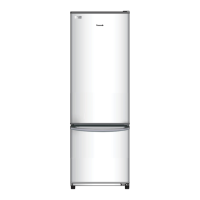
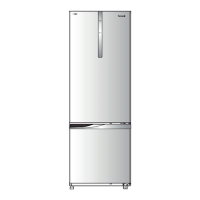
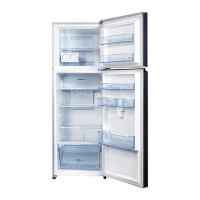
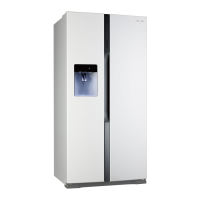
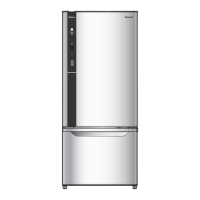
This document provides operating instructions for the Panasonic NR-BR307 and NR-BR347 refrigerator models, designed for household use. It covers safety precautions, usage guidelines, installation, parts identification, temperature control, ECONAVI operation, usage tips, ice cube making, cleaning, and troubleshooting.
Function Description
The Panasonic NR-BR307 and NR-BR347 are inverter refrigerators equipped with ECONAVI technology, designed for efficient food storage and preservation.
Refrigeration System:
The unit utilizes a non-CFC (Chlorofluorocarbon) cooling system, using HFC-134a as the refrigerant and Cyclo-Pentane for insulation. This design ensures the refrigerator does not harm the earth's ozone layer. The cooling system is non-frost, preventing ice buildup and maintaining optimal cooling performance.
Inverter Technology:
The refrigerator incorporates inverter technology, which allows the motor to run at different speeds based on the temperature inside the compartments. When the temperature is stable, the motor operates at a lower speed, contributing to energy saving and reduced noise. When powerful cooling is required, the motor runs at a higher speed to quickly achieve the desired temperature.
ECONAVI Operation:
The ECONAVI mode is an intelligent feature that learns the lifestyle patterns of your family. It detects door opening and closing frequency and duration, as well as periods of infrequent use. Based on these learned patterns, the refrigerator optimizes its operation to save energy. The ECONAVI operation is automatically enabled when the freezer compartment temperature control is set to "Med." It does not operate during quick freezing. The refrigerator learns lifestyle patterns over three weeks and applies this knowledge from the fourth week onwards. The effectiveness of ECONAVI varies depending on ambient temperature, brightness, door opening frequency, and food storage conditions.
Temperature Control:
The refrigerator features separate temperature controls for the refrigerator and freezer compartments.
- Refrigerator Temperature Control: This control allows adjustment of the refrigerator compartment temperature. Settings "1," "2," and "3" correspond to different temperature ranges, with "1" being higher (approximately 2°C ~ 3°C higher than "2"), "2" being the normal setting (approximately 3°C ~ 5°C), and "3" being lower (approximately 2°C ~ 3°C lower than "2").
- Cold Air Control: This control manages the cold air condition. Settings include "REFRIGE.MAX" (refrigerator compartment takes priority), "NORMAL" (normal cold air condition), and "FREEZER MAX" (freezer compartment takes priority). Temperature control varies based on environmental conditions and the quantity of food stored.
Usage Features
Food Storage:
- Refrigerator Compartment: Ideal for regular storage of food and drinks or temporary storage of items to be served soon. It is recommended to store warm food and drinks only after they have cooled down to room temperature to avoid raising the interior temperature and affecting the freshness of other foods.
- Vegetable Compartment (Crisper): Designed to store fruits and vegetables, maintaining a rather high humidity to keep them fresh and juicy for longer periods. Moisture is trapped in the crisper to preserve food quality.
- Freezer Compartment: Suitable for storing frozen or dried foods for extended periods. Meat and fish should be placed in the freezer for long-term storage.
- General Storage Tips:
- Do not block the cold air outlet with food items to ensure proper air circulation and prevent increased electricity consumption.
- Avoid overstuffing compartments; provide sufficient space between foods for effective cooling.
- Seal drinking water and beverage bottles to prevent odors.
- Wrap or pack vegetables, fruits, and fresh food in boxes before freezing or refrigerating.
- Cover juicy foods with tight lids, plastic film, or foil.
- Avoid keeping the door open longer than necessary, especially in hot, humid conditions.
- Some items, like uncut onions, potatoes, and burdocks, do not require refrigeration except during summer.
- Cool tropical fruits just before eating, as excessive cooling can cause discoloration or reduce vitamin content.
- Use hermetically sealed containers to prevent interior discoloration (e.g., from cut citrus fruits) and to prevent odors from spreading (e.g., from garlicky vegetables).
Ice Cube Making:
- Pull out the ice tray and fill it with water up to the water level line.
- Place the tray back into the freezer and wait for the ice to form.
- To remove ice cubes, twist the ice tray clockwise. The cubes will drop into the ice box below.
Safety Precautions:
- Electrical Safety: Do not plug/unplug with wet hands. Ensure the cord and plug are undamaged. Disconnect power during cleaning. Plug into a dedicated wall outlet with the rated voltage and current. Periodically remove dust from the power plug. If the supply cord is damaged, it must be replaced by the manufacturer or authorized service agent. Disconnect power immediately if a burning smell is detected or if any abnormality/failure occurs (e.g., abnormally hot cord/plug, deep cuts in cord, burning smell, tingling electricity).
- Usage Safety: Do not damage the cooling circuit (piping on the back). Avoid touching the compressor or pipes, as they can be hot and cause burns. Prevent children from hanging on the refrigerator door to avoid overturning. Do not place water containers on top of the refrigerator. This appliance is not intended for use by persons with reduced physical, sensory, or mental capabilities, or lack of experience/knowledge, unless supervised. Children should be supervised to ensure they do not play with the appliance.
- Emergency: Do not disassemble, repair, or modify the refrigerator yourself. Consult a dealer or authorized service center for repairs. Do not use mechanical devices to accelerate defrosting unless recommended by the manufacturer. Maintenance should only be performed by well-trained workers.
- Installation Safety: Ensure the ground connection system in the house is correctly installed for safety and efficiency.
Installation Guidelines:
- Distance from Wall: Maintain at least 30 cm clearance between the top of the refrigerator and the ceiling, 10 cm between the back and the wall, and 5 cm between the sides and the wall.
- Location: Avoid humid places to prevent rust and electrical leakage. Do not expose to direct sunlight or place near heat sources (e.g., cooking stoves/ovens) to prevent temperature increase. Ensure good air circulation.
- Stability: If placing on an uneven surface, adjust the adjuster bolt to ensure the refrigerator stands stably.
- Moving: When moving, remove ice tray, ice box, and evap pan, and ensure no water is in the refrigerator. Hold tightly and apply protective covering to fragile floors.
- LED Lamp and Grounding: The LED lamp is specially designed and cannot be replaced individually; contact Panasonic Service Center for replacement. If the refrigerator lacks a grounding wiring plug, connect it to a grounding connection to prevent electrical hazards.
Maintenance Features
Cleaning the Refrigerator:
- Interior Cleaning: Wipe stains with warm water. For stubborn stains, use warm water and soap with a soft cloth, then wipe off the soap with a damp soft cloth.
- Exterior Cleaning: Clean with a soft cloth, warm water, and soap, then wipe off the soap.
- Door Gasket (PC/FC): Wipe gently. Avoid wiping off petroleum gel applied to reduce friction. If the door opening seal comes off, push it back into the groove. The door opening seal is replaceable at the end of its life.
- Evap Pan: Clean the evap pan (located over the compressor at the back) every three months to prevent odor generated from humidity.
- Prohibited Cleaning Items: Do not use chemical substances or liquids (e.g., alkaline/faintly alkaline cleaners, cleanser/soap powder, benzine, thinner, alcohol, acid, petroleum, scrubbers, hot water) as they can damage or corrode the surface.
Removing Parts for Cleaning:
- Trays:
- To remove: Tilt the tray upward to unhook the protrusion at the back, then pull forward.
- To attach: Push the tray until it reaches the end lock.
- Shelf Egg, Shelf PC, Shelf Bottle:
- To remove: Lift upward, alternating between the right and left sides.
- To attach: Place on both supporters and press until it reaches the end of supporters.
- Escutcheon Glass Tray Crisper:
- For stains: Remove and rinse with clean water.
- For deep stains: Soak in warm water, then rinse with clean water.
- Crisper and Case FCB:
- To remove: Pull the case until it reaches the end of the stopper. Rise up the front of the case slightly, then completely take out.
- To attach: Push the case on both supporters. Rise it up, then push until it reaches the end.
- Evap Pan:
- To remove: Tilt the evap pan slightly and lift it upward until the hole unlocks from the hook. Pull the evap pan until it touches the evap pipe, then carefully take it out from under the evap pipe.
- To attach: Insert the evap pan under the evap pipe. Insert the evap pan hole into the hook and press-fit both sides. Do not deform the evap pipe.
Troubleshooting:
The manual provides a troubleshooting guide for common issues:
- Refrigerator not operating: Check plug/socket, main fuse/electrical system, and try unplugging for 5 minutes before replugging.
- Insufficient cooling: Check temperature control setting, overloading, hot food inside, exposure to sunlight/heat, door closure, and frequency of door opening.
- Vapor/condensation: Check for high humidity, poor air circulation, door closure, frequent/long door opening, and hot food inside.
- Noise: Check if the refrigerator is on a stable floor, properly installed, or if any object is in contact with it. Cracking sounds due to temperature adjustment are normal. Noise should lessen after the refrigerator has cooled.
- LED lamp not turning on: Contact Panasonic service center.
- Food becoming frozen: Check if food is near the cold air duct or if the temperature control is set to "Max." Adjust to "Med" or "Min."
- ECONAVI issues: If ECONAVI does not operate, check if the refrigerator compartment temperature is set to "Med," if doors are opened frequently, or if hot food is stored. Power failures can reset learning data. ECONAVI may stop during defrosting or restart learning. If ECONAVI runs too often, check if the light intensity sensor is hidden or dirty. ECONAVI operation maintains cooling performance even if it runs frequently.


 To Next Page
 General