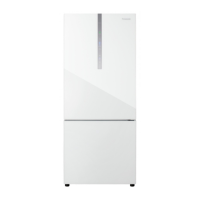
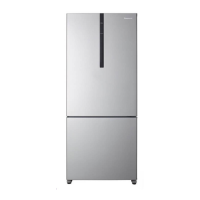
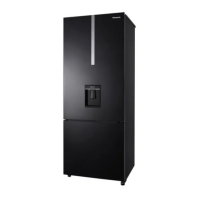
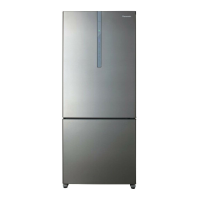
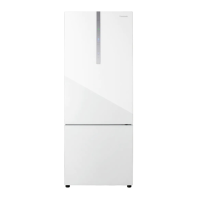
This document outlines the operating instructions for Panasonic Inverter refrigerators, specifically models NR-BX471W, NR-BX421W, NR-BX471C, NR-BX421B, NR-BX471G, and NR-BX421G, designed for household use. It emphasizes safety precautions, usage guidelines, installation procedures, parts identification, temperature control, and maintenance. The refrigerator utilizes NON-CFC materials, including R600a refrigerant and Cyclo-Pentane insulation, to minimize environmental impact.
Function Description
The Panasonic Inverter refrigerator is designed to provide efficient and reliable food storage. It features multiple compartments: a Fridge Room, a Prime Fresh Room (with LED Blue AG in some models), and a Freezer Room. The Inverter technology allows the compressor motor to run at varying speeds based on the internal temperature, ensuring energy saving and reduced noise when the temperature is stable, and powerful cooling when needed.
The refrigerator incorporates an ECONAVI mode, which is a microchip-controlled system integrated into the main control board. This mode automatically adjusts operation to save energy by detecting the refrigerator's frequency of use, such as door opening and closing patterns. For models NR-BX471W, NR-BX471C, NR-BX471G, and NR-BX421W, ECONAVI also considers ambient brightness using a light intensity sensor. The system learns household lifestyle patterns over three weeks and applies this data from the fourth week onwards to maximize energy efficiency. ECONAVI operation is automatically enabled when both the freezer and refrigerator compartments are set to "Med" temperature.
A "Quick Freezing" mode is available to rapidly reduce the temperature in the freezer, enhancing food preservation. Similarly, a "Prime Fresh+" mode is designed to quickly cool the Prime Fresh room for optimal storage of fresh items.
Some models (NR-BX471G / NR-BX421G) include a water dispenser, allowing users to access cold water without opening the fridge door.
Usage Features
Safety Precautions:
Users are warned against plugging/unplugging with wet hands, damaging the power cord, and using a damaged cord. The refrigerator should be plugged into a dedicated wall outlet of the rated voltage and current. Dust should be removed periodically from the power plug. In case of burning smell or abnormality, the unit should be unplugged immediately. When recycling, door seals must be removed to prevent child entrapment. The cooling circuit (piping on the back) should not be damaged, and the compressor and pipes should not be touched due to high temperatures. Children should not hang on the door. Water containers should not be placed on top of the refrigerator. Ventilation openings must be kept clear. The appliance is not intended for use by persons with reduced physical, sensory, or mental capabilities unless supervised. Explosive substances, deodorizers, or other electrical appliances not recommended by the manufacturer should not be stored inside. Users are advised not to disassemble, repair, or modify the refrigerator themselves. The refrigerator must be fixed to avoid unbalance and plugged into an earthed mains socket.
General Usage:
After disconnecting the plug, wait 5 minutes before plugging it in again to allow the compressor to stabilize. Temperature should be adjusted according to operating conditions for energy saving. Condensation in the fresh case should be wiped periodically. If away for several days with no refrigerated items, the plug should be disconnected. The outside wall of the refrigerator may warm up due to the built-in Mullion Dryer Pipe, which is normal. Condensation on the cabinet surface during high humidity should be wiped off. The door should not be kept open longer than necessary.
Food Storage:
Warm or hot food should not be placed directly in the refrigerator. The refrigerator should not be overloaded, ensuring gaps between foodstuffs for proper cooling. Fruits and vegetables should be stored in the vegetable case to preserve quality. Drinking water and beverages should be sealed to prevent odor contamination. Foodstuffs like vegetables, fruits, and fresh food should be wrapped or packed before freezing or refrigerating. Meat or fish intended for extended storage should be placed in the freezer. Juicy food should be covered with tight lids, plastic film, or foil. Hot dishes should be cooled to room temperature before refrigeration. Glass bottles should not be frozen to prevent breakage and injury. High impact on glass trays should be avoided. Items larger than trays or shelves should not be refrigerated to ensure the door closes completely. The door opening seal should be checked frequently for complete closure.
Temperature Control:
Temperature can be adjusted for the Fridge, Prime Fresh, and Freezer rooms. Models NR-BX471W, NR-BX471C, NR-BX471G, and NR-BX421W use a door control panel, while NR-BX421B and NR-BX421G use an inside control panel. Settings include Max, Med, and Min, with "Med" being the general recommendation for ECONAVI operation. A "9 levels" mode allows for more detailed temperature adjustment.
Quick Freezing and Prime Fresh+:
To activate "Quick Freezing" or "Prime Fresh+", specific buttons on the control panel are pressed until the corresponding LED lights up. These modes automatically stop after a set duration (60-150 minutes for Quick Freezing, 105-150 minutes for Prime Fresh+) and return to normal operation. Flashing LEDs indicate defrosting in progress, with the modes starting after defrosting is complete. Quick Freezing overrides Prime Fresh+ if both are set.
Prime Fresh Room:
This room is ideal for storing fresh meat or fish, extending their storage life compared to the Fridge room. If food freezes too much, set the temperature control to "Min." If food is not partially-frozen as intended, set it to "Max." Partially-frozen food is easier to cut.
Water Dispenser (for NR-BX471G / NR-BX421G):
To use, slide the child lock to "UNLOCK," then gently push the lever with a cup. After use, gradually remove the cup and slide the child lock to "LOCK." Only drinking water (up to 3 liters, below 50°C) should be poured into the tank. The water tank should be cleaned before first use. The tray must be correctly installed to maintain cooling efficiency. Water hardness should be 100 mg/L or less.
Maintenance Features
Cleaning the Refrigerator:
Before cleaning, disconnect the power plug and wait 5 minutes. Stains on interior surfaces should be wiped off quickly with a cloth lightly soaked in neutral kitchen detergent, then wiped with a damp cloth. The ice twister, trays, and door shelves should be removed and washed in lukewarm water every three months. The door gasket should be cleaned at least once a month with a soft damp cloth, being careful not to wipe off the petroleum gel applied on the hinge side. The door gasket is replaceable by an authorized service agent.
Prohibited Cleaning Items:
Do not use chemical substances, liquids, alkaline or faintly alkaline kitchen detergents, cleanser or soap powder, benzine, thinner, alcohol, acid, petroleum, scrubbers, or hot water, as these can damage or corrode surfaces.
Removing and Attaching Parts:
Instructions are provided for removing and attaching trays, egg shelves, bottle shelves, vegetable cases, Prime Fresh cases, and the ice twister. Trays are heavy and should be handled with care. The ice twister and ice box can be disassembled to increase freezer space.
Water Tank Maintenance (for NR-BX471G / NR-BX421G):
The water tank can be pulled up and tilted for removal. The valve tip is inserted into a hole, and the tank is pushed under a "V" symbol for attachment. If the rubber gasket reverses during cleaning, it should be pushed back into its original position. The valve can be removed by rotating counterclockwise.
Hygiene Filter Replacement (for NR-BX471G / NR-BX421G):
The hygiene filter, located at the right corner, should be replaced every 3 years or as appropriate. It can be purchased from an authorized service center.
Troubleshooting:
The manual includes a troubleshooting guide for common issues such as the refrigerator not operating, not cooling enough, dew/snow appearance, noise generation, food freezing, bad odors, hot surfaces, and ECONAVI not operating correctly. Solutions range from checking power connections and door closure to adjusting temperature settings and contacting a Panasonic service center.



 To Next Page
 General