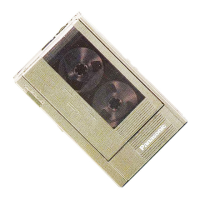
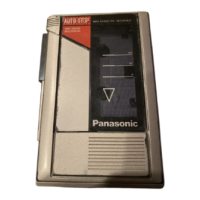
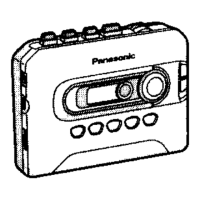
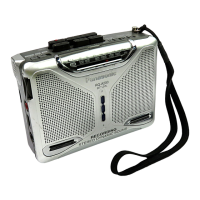
The provided document is a service manual for the Panasonic RQ-332S Portable Cassette Mini Cassette Recorder with Built-in Microphone. This device is a compact, monaural cassette recorder designed for both recording and playback, featuring a built-in microphone for convenience.
Function Description
The RQ-332S serves as a portable audio recorder and player, primarily utilizing compact cassette tapes. Its core functions include:
- Recording: It employs an AC bias recording system, allowing for clear audio capture through its built-in microphone or an external microphone connected via the MIC jack. A recording indication lamp (16) illuminates during recording.
- Playback: The device plays back recorded cassette tapes, with audio output through its integrated PM dynamic speaker or an external monitor connected to the MONITOR jack (14). A playback button (3) initiates playback.
- Fast Forward/Rewind: Dedicated buttons (4 and 5) enable quick navigation through cassette tapes, allowing users to rapidly locate desired sections.
- Pause/Eject: A single button (2) serves to pause playback or recording, and also to eject the cassette tape from the compartment.
- Volume Control: An analog volume control (9) allows users to adjust the audio output level during playback.
- Remote Control: A REMOTE control jack (12) provides an interface for external control, enabling start and stop functions from a distance.
- Tape Counter: A tape counter (13) with a reset button helps users track their position on the tape.
- Battery Check: A battery-check lamp (17) indicates the battery status, ensuring users are aware of remaining power.
Important Technical Specifications
- Power Requirement:
- Batteries: 6V (four UM-3, R6 size dry batteries).
- AC: With AC adaptor/charger RP-667.
- Car/boat battery: With optional car/boat adaptor RP-917.
- Rechargeable battery: With optional rechargeable battery pack RP-9214.
- Motor: Electrical governor motor.
- Power Output: 550 mW...RMS (max.).
- Frequency Range: 80 ~ 10,000 Hz.
- Recording System: AC bias.
- Tape Speed: 4.8 cm/s (1-7/8 ips.).
- Program Time: 1 hour with C-60 cassette tape.
- Fast Forward Time: Approximately 110 seconds with C-60 cassette tape.
- Rewind Time: Approximately 90 seconds with C-60 cassette tape.
- Track System: 2-track monaural recording and playback.
- Input:
- MIC: Sensitivity 0.25 mV, applicable microphone impedance 200Ω~600Ω (recommended microphone WM-2213N).
- DC IN: 6V.
- Output:
- MONITOR: 8Ω.
- REMOTE: For start and stop at hand.
- Speaker: 6.5 cm (2-1/2") PM dynamic speaker.
- Dimensions: 17.0cm(W) x 10.2cm(H) x 4.9cm(D) [6-3/4"(W) x 4"(H) x 2"(D)].
- Weight: 700 g (1-1/2 lbs.).
- Wow and Flutter: Less than 0.45% (RMS) (using a 3 kHz test tape C-WAT).
- Takeup Torque: 55±15 gr (using a cassette torque meter SRK-CT).
- Standard Recording Input Level: 1kHz, -72±4dB.
- Bias Oscillation Frequency: 43±5kHz.
- Erase Current: 7.6±1mA.
- Overall Frequency Response:
- 150 Hz: -4±5dB.
- 1kHz: 0 dB.
- 6kHz: -4±6dB.
Usage Features
The RQ-332S is designed for ease of use, emphasizing portability and straightforward operation:
- Push Button One-Touch Recording: Simplifies the recording process, allowing users to start recording quickly.
- Auto-Stop Mechanism: Automatically stops the tape at the end of playback or recording, preventing tape damage and conserving battery life.
- Built-in Microphone: Eliminates the need for an external microphone in many situations, enhancing portability. A sensitivity switch (10) for the built-in microphone allows adjustment for different recording environments.
- Multiple Power Options: The ability to operate on batteries, AC power (with an adaptor), car/boat power (with an adaptor), or a rechargeable battery pack offers significant flexibility for various usage scenarios.
- Compact Design: Its small dimensions and light weight make it highly portable and easy to carry using the integrated carrying belt (18).
- Clear Controls: The control layout (Figure 1) is intuitive, with clearly labeled buttons for common functions like record, playback, stop, fast forward, rewind, and pause/eject.
Maintenance Features
The service manual provides detailed instructions for various adjustments and disassembly, indicating that the device is designed for maintainability:
- Disassembly Instructions: Step-by-step guidance for disassembling the main case assembly, bottom case assembly, and PCB, facilitating access to internal components for repair or replacement.
- Pressure Roller Adjustment: Instructions for measuring and adjusting the pressure roller tension (standard 400±50 gr) to ensure proper tape transport and prevent wow and flutter. This involves using a tension gauge and bending a specific part of the pressure roller spring.
- Head Azimuth Adjustment: Procedure for adjusting the screw to achieve maximum output at the monitor jack when playing a C-AA test tape, ensuring optimal sound quality.
- Tape Speed Adjustment: Method for adjusting the motor control circuit to achieve a standard tape speed of 3,000 Hz ±2% (measured with a C-WAT test tape and frequency counter), correcting for speed variations.
- Recording Bias Current Adjustment: Instructions for adjusting VR2 to set the recording bias current to a standard voltage of 7.5±0.5mV, crucial for recording quality.
- Battery-Check Lamp Adjustment: Procedure for adjusting VR3 to ensure the battery-check lamp illuminates correctly when the power source voltage is between 4.4V and 4.5V, providing accurate battery status indication.
- Exploded Views and Parts List: Detailed diagrams and a comprehensive list of mechanical and electrical parts, including their part numbers, facilitate identification and ordering of replacement components.
- Schematic Diagram and Wiring Connection Diagram: These diagrams provide a complete overview of the device's circuitry and wiring, essential for troubleshooting and repair. Voltage values at various points in the circuit are provided for diagnostic purposes.
The RQ-332S is a robust and user-friendly portable cassette recorder, designed with both operational convenience and serviceability in mind.

 Need help?
 General

 To Next Page