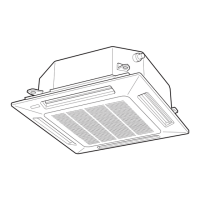
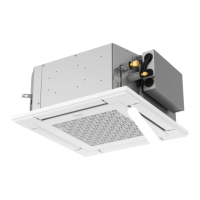
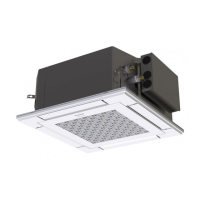
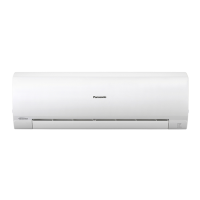
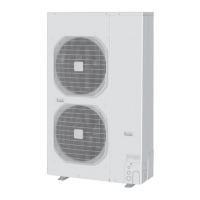
This document provides operating instructions for a Panasonic Split System Air Conditioner, specifically focusing on the indoor unit. The air conditioner is designed to provide comfortable room conditions and uses R410A refrigerant.
Function Description
The Panasonic Split System Air Conditioner is designed for both cooling and heating, with specific models for low silhouette ducted indoor units. The system operates by utilizing the heat of the outside air (heat pump system) for heating. It includes a microcomputer-controlled defrosting system that activates when outdoor temperatures are low and frost forms on the outdoor heat exchanger coil, which helps maintain heating performance. During defrosting, the indoor fan may stop or run at very low speed, and a "STANDBY" indicator will appear on the display. The indoor fan also has a cold draft prevention system, which delays its start during heating operation until the indoor heat exchanger coil has warmed up sufficiently.
The "DRY" operation mode is designed to reduce humidity. In this mode, once the room temperature reaches the set level, the unit automatically cycles on and off. To prevent humidity from rising again, the indoor fan also turns off when the unit stops operating. The fan speed is automatically set to "LO" and cannot be adjusted during "DRY" operation. However, "DRY" operation is not possible if the outdoor temperature is 59°F or less.
The air conditioner is equipped with a power failure recovery feature. If the power supply is temporarily cut off, the unit will automatically resume operation with the same settings once power is restored.
Usage Features
The air conditioner is controlled by an optional Timer Remote Controller or a High-spec Wired Remote Controller. Users should refer to the operating instructions provided with these remote controllers for detailed usage.
For optimal performance and safety, it is crucial to ensure proper installation by qualified technicians. The unit requires a specific voltage supply, which should match the voltage shown on the nameplate. All wiring must conform to local electrical codes, and installation with an Earth Leakage Circuit Breaker (ELCB) or Residual Current Device (RCD) is strongly recommended to prevent electric shock or fire. Each unit must be properly grounded.
Users should avoid installing the air conditioner in areas with fumes, flammable gases, excessive humidity (like a greenhouse), or near high heat-generating objects. For the outdoor unit, installation should avoid areas where salty sea water can splash or in sulphurous air near a spa to prevent heavy corrosion.
During operation, users should not turn the air conditioner on and off using the power mains switch; instead, the ON/OFF operation button on the remote controller should be used. It is important not to stick anything into the air outlet of the outdoor unit, as the fan rotates at high speed, posing a danger. Similarly, touching the air inlet or the sharp aluminum fins of the outdoor unit should be avoided to prevent injury. The fire alarm and air outlet should be kept at least 5 feet (1.5 m) away from the unit.
For energy saving, users are advised not to block the air intake and outlet of the unit, as obstruction can impair performance and potentially damage the unit. Direct sunlight should be prevented from entering the room by using sunshades, blinds, or curtains, as this can prolong the cooling process. Keeping windows, doors, and other openings closed helps prevent conditioned air from escaping.
If the air conditioner discharges air with an odor, it may be due to accumulated indoor odor components, cigarette odor, or cosmetic odor within the unit, or dust inside the unit. In such cases, consulting a dealer for cleaning is recommended. If dewdrop accumulates near the air discharge, it indicates that indoor moisture is being cooled by the air and condensing. Fog occurring during cooling operation, especially in places with large amounts of oil mist, suggests that cleaning of the heat exchanger is necessary.
Maintenance Features
Regular maintenance is essential for the safe and efficient operation of the air conditioner. Before any cleaning or servicing, the air conditioner must be turned off, and the power disconnected by pulling off the power plug, switching off the breaker, or using the power disconnecting means. Water should never be poured on the indoor unit, as this can damage internal components and cause electric shock.
The air intake and outlet sides of the indoor unit should be cleaned with a vacuum cleaner brush or wiped with a clean soft cloth. If these parts are stained, a clean cloth moistened with a mild liquid detergent can be used. When cleaning the air outlet side, care must be taken not to force the vanes out of place.
Harsh chemicals, solvents, or very hot water should never be used to clean plastic parts of the indoor unit. Some metal edges and fins can be sharp, so caution is advised when cleaning these areas.
The internal coil and other components of the outdoor unit require annual cleaning by an authorized dealer or service center. Users should not attempt to clean these internal parts themselves.
The air filter, which is field-supplied for low silhouette ducted type (F2) units, collects dust and particles and needs regular cleaning. The frequency of cleaning depends on the environment in which the unit is used. A clogged filter significantly reduces the air conditioner's efficiency. Since the air filter is not provided with the unit at shipment, it must be installed in the air intake for clean air and extended service life. Users should consult their dealer or service center for air filter installation and cleaning.
In case of malfunction, users should not attempt repairs themselves but should contact the sales dealer or service dealer. If the inspection mark and letters E, F, H, L, P appear on the LCD of the remote controller, this information should be reported to the dealer. Regular checks for refrigerant leaks are important, as refrigerant gas can produce toxic gases if it comes into contact with fire.



 To Next Page

 General