This document provides a comprehensive service manual for the Panasonic Electronic Warm Jar models SR-MG102 and SR-MG182. It covers various aspects from product specifications and diagrams to troubleshooting, test methods, and replacement parts.
Product Overview and Function
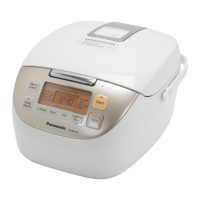
The Panasonic Electronic Warm Jar is designed for cooking and keeping rice warm, with additional functionality for cake baking. It features a user-friendly interface and is available in a white (W) color. The product is intended for markets including Thailand, Sin-DBD, Malaysia, Sin-RBD, and Indonesia.
The primary functions include:
- Cooking: Prepares white rice efficiently.
- Keeping Warm: Maintains the cooked rice at an optimal temperature for extended periods.
- Cake Baking: Offers an alternative cooking mode for baking cakes.
The device incorporates a control board (power side and operating side), a lid heater, a cast heater, and a side heater to ensure even cooking and warming. A grounding wire is included for safety.
Important Technical Specifications
The specifications vary slightly between the SR-MG102 and SR-MG182 models, primarily in capacity and power consumption.
General Specifications:
- Product Colour: White (W)
- Destination Markets: Thailand, Sin-DBD, Malaysia, Sin-RBD, Indonesia
- Power Supply: Available in 220V, 230V, and 240V configurations, depending on the destination.
- Center Thermostat Working Temperature: 127°C ± 6°C
- Thermal Fuse Specification: 172°C
- Power Cord Length: 1 m
- Accessories: Steaming basket, Scoop, Measuring cup, Power cord.
SR-MG102 Specifics:
- Plug Type: C3P, S3P
- Keeping Warm Power Consumption: 69W (220V), 75W (230V), 81W (240V)
- Cooking Power Consumption: 600 W
- Cake Baking Power Consumption: 620 W
- Cooking Capacity (White Rice): 1~5 cups
- Product Dimensions:
- Width: 251 mm
- Depth: 332 mm
- Height: 210 mm
- Weight (Approx.): 3.0 Kg
- Keep Warm Temperature:
- Thailand: 75°C ± 4°C
- Indonesia: 77°C ± 4°C
- Others: 73°C ± 4°C
SR-MG182 Specifics:
- Plug Type: C3P, S3P, SH3P
- Keeping Warm Power Consumption: 95W (220V), 104W (230V), 112W (240V)
- Cooking Power Consumption: 800 W
- Cake Baking Power Consumption: 835 W
- Cooking Capacity (White Rice): 2~10 cups
- Product Dimensions:
- Width: 279 mm
- Depth: 357 mm
- Height: 243 mm
- Weight (Approx.): 3.9 Kg
- Keep Warm Temperature:
- Thailand: 75°C ± 4°C
- Indonesia: 77°C ± 4°C
- Others: 73°C ± 4°C
Usage Features
The warm jar is designed for ease of use with clear indicators and intuitive controls. The main components include an outer lid, pan, handle, and body.
Self-Diagnosing Features:
The device includes a self-diagnosing system that displays specific symbols on the LCD if an abnormality occurs. These symbols guide troubleshooting:
- "Keep Warm" function cut off (exceeds 96 hours): Indicates the need to press the [Keep Warm/Off] button to resume.
- All buttons inoperative: Suggests replacing the pan sensor, checking its branch component, or replacing the P.C.B.
- "H01" on LCD: Points to issues with the pan sensor or its branch component.
- "H02" on LCD: Indicates a problem with the lid sensor or its branch component.
- "H05" on LCD: Suggests replacing the relay or P.C.B.
- "H06" on LCD: Indicates a fault in the relay.
Quick Check Test of the Control Board:
A systematic quick check test is provided to verify the control board's performance:
- Simultaneous Button Press: Connect to power, then simultaneously press [Start/Reheat], [Menu Select], and [Keep Warm/Off] buttons.
- LCD Panel Light-up: If all LCD areas light up, the control board is normal. Releasing any of the three keys cancels the test.
- Hour Light-up and Cooking Start: Upon releasing the three keys, the [Hour] lights up, the buzzer sounds, and cooking starts. The device should then switch to warming mode when the pan sensor reaches the cooking end level.
- Function Button Check: Press the [Keep Warm/Off] button and check if other function buttons operate normally.
Maintenance Features
The manual provides detailed instructions for troubleshooting and replacing key components, emphasizing safety precautions for handling microprocessors and electrical parts.
Troubleshooting (Main Unit):
A comprehensive table helps diagnose issues based on symptoms:
- Cooking LED lights up/does not light up/does not operate: May indicate issues with the cast heater, pan sensor, warming heater, lid heater, thermal fuse, terminal, AC cord, outer lid comp., or pan.
- "H01", "H02", "H05", "H06" on LCD: Specific to pan sensor, lid sensor, or P.C.B. issues.
- Cannot cook rice correctly: Could be due to improper measurement, insufficient loosening of rice, or dirt on the pan sensor.
- Rice scorched: Check for dirt or foreign substances on the pan sensor.
- Keep Warm temperature too high/low: Check pan sensor or P.C.B.
- Droplets/dry rice surface: May be caused by unplugging, insufficient lid loosening, or the lid being open for too long.
- Bottom of warm jar melts/fires: Indicates a serious malfunction requiring immediate attention and replacement of affected parts.
Troubleshooting (P.C.B.):
Another table focuses on issues related to the control panel components:
- Cooking LED lights up/does not light up/does not operate: May involve the tact switch, LCD, ceramic resonator, buzzer, transformer, relay, triac, flat cable, or Li battery.
- Cannot cook rice correctly: Could be due to issues with the transformer or relay.
- Rice scorched: Check the transformer or relay.
- Keep Warm temperature too high/low: Check the transformer or relay.
- Buzzer does not sound: Indicates a problem with the buzzer.
- Part of LCD blank: Suggests an issue with the LCD or flat cable.
- Clock display disappears after unplugging: Points to a problem with the Li battery.
Test Methods:
- Bubble Test: Verifies proper contact between the pan and cast heater. Water bubbles should appear evenly distributed in three areas. Uneven bubbling indicates poor contact, possibly due to foreign material or a defective part.
- Steaming Test: Checks the cooker's steaming function. Tissue paper with holes is placed at the bottom of the pan, and the cooker is run without closing the lid to protect plastic parts from thermal distortion.
- Keep Warm Test: Measures the warming temperature using a mercury thermometer placed between urethane foam blocks in the pan. The temperature should be within 69°C-77°C after more than an hour. Deviations suggest issues with the pan sensor or control circuit board.
Replacement Procedures:
Detailed steps are provided for replacing critical components:
- Replacing P.C.B. (Comp.): Involves removing the power socket, retaining screws of the body, hinge cover, and then carefully disconnecting and removing the P.C.B. components. Anti-static measures are recommended.
- Replacing Cast Heater: Requires removing the power socket and body, then the base of the sensor (including pan sensor wiring, connections, and grounding wire), and finally the cast heater itself.
- Replacing Pan Sensor and Thermal Fuse: Involves removing the cast heater, then uprighting tabs to take out the pan sensor. The thermal fuse is fixed inside the pan sensor, so replacing the pan sensor effectively replaces the thermal fuse. Care must be taken not to deform or slant the spring during reassembly.
Safety Precautions:
The manual emphasizes that service information is for experienced repair technicians only. It warns against non-technical individuals attempting repairs due to potential dangers, including serious injury or death from electricity. Specific precautions for handling microprocessors and control circuits are outlined, such as proper grounding, using grounded tools, avoiding contact with IC pins before grounding, and minimizing welding time. It also warns about the voltage of the transformer for the control panel (AC 110V, 120V, 220V, 230V, 240V) and the risk of electric shock.
Replacement Parts List:
A comprehensive list of replacement parts is provided, including part names, part numbers, and country/quantity information for various markets. Components marked with a special characteristic symbol are critical for safety and must be replaced with manufacturer-specified parts. This list covers parts from the steam vent to the outer spring, including various internal components, control units, and accessories.

 Need help?
 General


 To Next Page