
 Need help?
Do you have a question about the Panasonic TX-48MZ800E and is the answer not in the manual?
Instructions to find the TV's electronic manual via the Settings menu.
Key warnings for safe operation, placement, and handling of the TV set and its components.
Explanation of symbols used on the product for safety and operational precautions.
Panasonic's disclaimer for malfunctions caused by misuse or product damage.
Step-by-step guide for attaching and detaching the TV stand for safe setup or packing.
List of items provided with the TV set for initial setup and operation.
Details on automatic and manual panel compensation for OLED lifetime and performance.
Explanation of the quick standby mode and its energy-saving implications.
How to switch between different connected external sources and inputs.
Instructions for pairing the remote control with the TV for seamless operation.
Steps for connecting the TV to a wired or wireless network for internet access.
Guide to navigating the main interface, tabs, and search functions of the Google TV home screen.
Managing channels, including scanning, skipping, swapping, and editing.
Setting up restrictions and PIN codes to control access to content and inputs.
Options for managing recordings, including recording lists, timeshift, and PVR settings.
Process for scanning for digital terrestrial and cable channels.
Adjusting picture quality parameters like mode, brightness, contrast, and colour.
Optimizing picture settings for gaming and computer input for reduced latency.
Enhancing sound quality using Dolby technologies and selecting sound modes.
Managing Google account and signing in for personalized services and app access.
Managing installed applications, their permissions, storage, and security restrictions.
Connecting the TV to a network using an Ethernet cable.
Pausing live TV and recording it simultaneously for playback.
Recording TV programs to a connected USB storage device.
Operating connected HDMI devices using the TV's remote control.
Casting content from mobile devices or mirroring screens to the TV.
Information on how to update the TV's software automatically via the internet.
Information on compatible HDMI signal resolutions and refresh rates.
Lists supported video and audio file formats for playback via USB.
Details on supported image file types and their resolutions for display.
Table showing supported resolutions and refresh rates when connecting via DVI.
Regulations and limitations for wireless LAN usage based on country.
 General
| Screen shape | Flat |
|---|---|
| Response time | - ms |
| Display diagonal | 48 \ |
| Display brightness | - cd/m² |
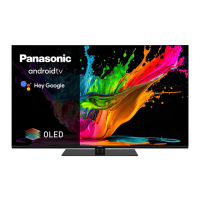
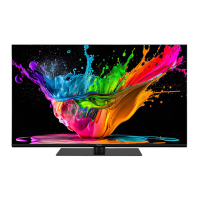
| Display technology | OLED |
| Native aspect ratio | 16:9 |
| Contrast ratio (typical) | - |
| Display diagonal (metric) | 121 cm |
| Motion interpolation technology | Smooth Motion Drive Pro |
| Dynamic contrast ratio marketing name | Ultra Contrast |
| Video apps | Disney+, Netflix, YouTube |
| Smart modes | Cinema, Dolby Vision, Dynamic, Filmmaker, Game, Normal, Sports, True Cinema |
| Operating system installed | Google TV |
| Hybrid Broadcast Broadband TV (HbbTV) version | 2.0.3 |
| Number of OSD languages | 35 |
| Product color | Black |
| Panel mounting interface | 200 x 200 mm |
| Game features | Auto Low Latency Mode (ALLM) |
| Audio formats supported | 3GPP, 3GP, AAC, AC3, AC4, ASF, DTS, FLAC, M4A, MKA, MP3, OGG, RA-Lossless, WAV, WMV |
| Image formats supported | BMP, GIF, HEIF, JPEG, PNG, WEBP |
| Video formats supported | 3GP, 3GPP, ASF, AVI, AVS, DAT, FLV, H.264, H.265, M4V, MOV, MP4, MPEG, MPG, OGM, RM, RMVB, TP, TRP, TS, VC-1, VOB, WEBM, WMV |
| High Dynamic Range (HDR) technology | Dolby Vision, High Dynamic Range 10 (HDR10), High Dynamic Range 10+ (HDR10 Plus), Hybrid Log-Gamma (HLG) |
| Sound modes | Custom, Game, Movie, Music, News, Sports |
| Audio decoders | Dolby Atmos |
| RMS rated power | 32 W |
| Number of speakers | 2 |
| Tuner type | Analog & digital |
| Digital signal format system | DVB-C, DVB-S, DVB-S2, DVB-T, DVB-T2 |
| AC input voltage | 220 - 240 V |
| AC input frequency | 50/60 Hz |
| Power consumption (off) | 0.3 W |
| Power consumption (standby) | 0.5 W |
| Power consumption (typical) | - W |
| PC in (D-Sub) | No |
| HDMI ports quantity | 3 |
| USB 2.0 ports quantity | USB 2.0 ports have a data transmission speed of 480 Mbps, and are backwards compatible with USB 1.1 ports. You can connect all kinds of peripheral devices to them. |
| Ethernet LAN (RJ-45) ports | 1 |
| Common interface Plus (CI+) version | 1.4 |
| USB 3.2 Gen 1 (3.1 Gen 1) Type-A ports quantity | 0 |
| Package type | Box |
| Package depth | 165 mm |
| Package width | 1200 mm |
| Package height | 756 mm |
| Package weight | 22700 g |
 Weight and Dimensions
| Stand width | 441 mm |
|---|---|
| Depth (with stand) | 221 mm |
| Width (with stand) | 1068 mm |
| Height (with stand) | 659 mm |
| Weight (with stand) | 18700 g |
| Depth (without stand) | 46 mm |
| Height (without stand) | 625 mm |
| Weight (without stand) | 15000 g |


 To Next Page