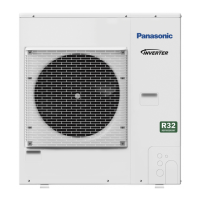
This document provides operating instructions for a Panasonic Air Conditioner, covering both Low Silhouette Ducted (Type F1) and Ceiling (Type T2) indoor units, as well as various outdoor unit models. It emphasizes safety, proper usage, and maintenance to ensure optimal performance and longevity of the appliance.
Function Description
The Panasonic Air Conditioner is designed to provide comfortable room conditions by performing cooling and heating operations. It utilizes a heat pump system for heating, which means its heating performance may be affected by outside temperatures. The unit is equipped with various features to manage airflow, temperature, and operational efficiency.
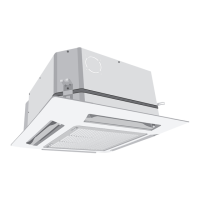
The indoor units, available in Low Silhouette Ducted (Type F1) and Ceiling (Type T2) types, are responsible for distributing conditioned air within the room. The outdoor units, including models from the PE1, PE2, PEY1, PEY2, and PZ2 series, house the compressor and other components necessary for the refrigeration cycle. The system supports different refrigerant types, including R410A and R32, depending on the specific model and region (Europe or Oceania).
The air conditioner can be controlled using optional remote controllers: a Wireless Remote Controller (CZ-RWST3 for Type T2, CZ-RWSC3 for all indoor units), a Timer Remote Controller (CZ-RTC4 for all indoor units), or a High-spec Wired Remote Controller (CZ-RTC5A/CZ-RTC5B for all indoor units). These controllers allow users to adjust settings such as fan speed, temperature, and operation mode.
The unit also incorporates several automatic functions to enhance user comfort and protect the system. During cooling operation, if the room temperature reaches the set level, the outdoor unit will cycle on and off automatically. Similarly, during "DRY" operation, the indoor unit fan may stop when the outdoor unit is off to prevent humidity from rising. The fan speed may also automatically adjust to a "breeze" setting when the room temperature is close to the set level.
For heating, the appliance may initiate a defrosting operation to melt frost that forms on the outdoor unit. During defrosting, the indoor unit fan may stop or run at a very slow speed, indicated by a "STANDBY" message on the remote controller. Heating operation resumes after several minutes once the indoor heat exchanger coil warms up sufficiently. In the event of a temporary power failure, the unit is designed to automatically resume operation with the same settings once power is restored.
Usage Features
To ensure safe and efficient operation, users are advised to read the operating instructions thoroughly before using the air conditioner.
Safety Precautions:
- Always confirm the specified refrigerant type with an authorized dealer or specialist. Using an incorrect refrigerant can cause severe damage and injury.
- The air conditioner does not provide fresh air ventilation. When using gas or oil heating appliances in the same room, open doors or windows frequently to prevent oxygen depletion and potential suffocation.
- Never use or store flammable vapors or liquids near the unit.
- Avoid touching the unit with wet hands.
- Do not insert fingers or other objects into the indoor or outdoor units, as rotating parts can cause injury.
- Ensure the appliance is stored in a well-ventilated area, away from continuously operating ignition sources.
- Do not modify or disassemble the unit.
- In case of any abnormality (e.g., frequent ELCB trips, burnt odor, abnormal noise, water leaks, abnormal heat, uncontrolled fan speed), immediately stop using the unit, disconnect power, and contact a dealer for maintenance or repair.
- Do not sit or step on the unit.
Installation and Wiring:
- Installation must be performed by qualified technicians according to the provided instructions.
- Verify that the electrical supply voltage matches the unit's nameplate specifications.
- Avoid installing the unit in locations with smoke, combustible gas, extremely high temperatures, or where heat-generating objects are placed.
- The outdoor unit should not be installed where salty seawater or sulphurous air can directly splash onto it, to prevent heavy corrosion.
- All wiring must comply with local electrical codes and be performed by a qualified electrician. Each unit must be properly grounded, and an exclusive power outlet with overcurrent protection (ELCB or RCD) must be provided.
Operation Preparation:
- Turn on the power mains 5 hours before the initial start of operation (for warm-up).
- For continuous use, leave the power mains ON.
- If the unit will not be used for a long time, pull off the power plug or switch off the breaker to isolate it from the main power supply.
Energy Saving Tips:
- Do not block the air intake and outlet of the unit.
- During cooling, use sunshades, blinds, or curtains to prevent direct sunlight from entering the room.
- Keep windows, doors, and other openings closed to prevent conditioned air from escaping.
Maintenance Features
Regular maintenance is crucial for the air conditioner's performance and longevity.
Air Filter Maintenance:
- The air filter should always be kept clean, as a clogged filter impairs unit performance.
- Consult your dealer or service center when the "Filter" indicator appears on the wired remote controller display.
General Cleaning:
- For safety, always turn off the air conditioner and disconnect the power before cleaning.
- Do not pour water on the indoor unit, as this can damage internal components and cause electric shock.
- Wipe plastic parts with a soft cloth. If very dirty, use a cloth moistened with water.
- Avoid using solvents, harsh chemicals, or very hot water, as these can cause deformation or discoloration of plastic parts.
- Be cautious when cleaning metal edges and fins, as they can be sharp.
- For indoor units installed in high locations, use a firm stool or ladder for cleaning.
- The internal coil and other components of the outdoor unit must be cleaned periodically by a dealer or service center. Users should not attempt to clean the inside of the indoor and outdoor units themselves.
Troubleshooting:
The manual provides a comprehensive troubleshooting guide for common issues, including:
- Noise: Streaming water sounds (refrigerant flow, drainage), cracking noises (temperature changes of parts).
- Air Quality: Discharged air smells (accumulated odors, dirty unit), dewdrops near air outlet (cooled internal moisture), fog during cooling (dirty heat exchanger), fog during heating (defrost operation).
- Fan Operation: Fan rotating after operation stops (smooth operation, drying heat exchanger), airflow direction changes or cannot be set (low discharge temperature, defrost operation, flap movement).
- Dust Discharge: Dust accumulated inside the indoor unit being discharged.
- Initial High-Speed Operation: Fan rotating faster than setting speed for 3-30 minutes (operation check).
- No Operation: No operation immediately after power on/resume (compressor protection circuit), unit not starting when turned on (breaker off, power button off, fuse blown), clogged air intake/outlet.
- Poor Cooling/Heating: Fan speed set to "Low", improper temperature settings, direct sunlight exposure, open doors/windows, clogged air filter, too many heat sources, too many people in the room.
- Outdoor Unit Issues: Noise during heating (defrost operation), steam during heating (defrost operation), fan rotating after operation stops (smooth operation).
If the air conditioner does not work properly after checking these items, users are instructed to stop operation, turn off the power, and contact their dealer, reporting the serial number and any error codes displayed on the remote controller. Self-repair is strongly discouraged due to safety risks.


 To Next Page


 General