• Thetoothtobetestedandtheadjacentteethmustbecleananddry.Interproximal
embrasures should be made free of any impacted food debris, saliva, water or plaque
byossingorscalingwithaninstrumentandair-dryingbeforetesting.
• It is often useful to electrically isolate the tooth being tested from its neighbors by
surrounding it with a clear mylar strip, such as those used in fabricating Class III
composite restorations.
• A dry cotton roll should be placed in the buccal vestibule to isolate the tooth from the lip
and cheek. A plastic mirror should be used to keep the tongue off of the tooth during testing.
• Metal or ceramic surfaces cannot be used as contact points for the pulp testing probes. Teeth
selectedforpulptestingmustpossessenoughexposedenamelordentintoallowtheprobeto
make contact without contacting the gingiva or a metal restoration. In certain cases, this may
necessitatetheuseofthePrecisionProbeSet(availableseparately).
• Fullyinstructthepatientastowhatyouwillbedoingsotheyarenotsurprisedduringthetest.
Itmaybehelpfultoavoidtheuseoftheword“pain”inyourinstructions.
PULP TESTING PROCEDURE
1) AlwaysusetheLipClipandwiretoensureacompleteelectricalcircuit.
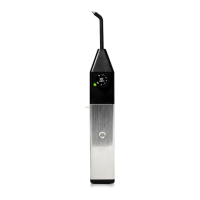
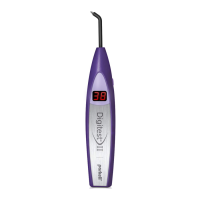
2) Selecttheappropriatemetalprobeandinsertitintotheopenendofthepowerunit(8).
3) Toensuregoodelectricalcontactbetweentheprobeandthetooth,applyasmallamountof
toothpastetotheexposedtipofthemetalprobe.
4) Holdtheunitinyourhandsothattheoutputcontrolknob(9)isincloseproximitytoyour
thumb.Theindicatorlight(10)shouldbevisibletoyou.Theprobemayberotatedtoany
convenient angle.
5) Clicktheoutputcontrolknob(9)tothe“ON”positionbyturningitclockwisetoactivatethe
unit.Theindicatorlight(10)willbegintoblinkcontinuously,indicatingthattheGentlePulse
stimulus is ready to be applied to the tooth.
6) Setthedialtothelowestsetting,andapplytheprobetiptothemiddleofthelabialor
lingual surface of the tooth being tested. Avoid soft tissue and restorations such as crowns,
amalgams or composites.
7) Thepowershouldbeslowlyincreasedbyturningtheoutputcontrolknobclockwiseuntilthe
patientbecomesawareofthestimulus.Attherstsignofaresponse,removetheprobefrom
the tooth and make a note of the reading on the dial.
8) Asacheckofthereadingobtained,acorrespondingcontroltoothinthesamearchshould
be tested for comparison, if possible. Molars should be matched to molars, premolars to
premolars, cuspids to cuspids, and incisors to incisors. If this is not possible because teeth
are absent, endodontically treated, or have full coverage restorations, a similar tooth in the
opposite arch is always a better control than no control at all.
9) Topreservethebattery,thedeviceshouldbeturnedoffimmediatelyafterusebyrotatingthe
controlknobcounter-clockwiseuntilaclickisheard.Shouldtheoperatorforgettoturnthe
poweroff,theinstrumentwillshutitselfoffafter5-6minutes.Toreactivatethedeviceafteran
automatic shut off, simply turn off the device and turn it on again.
CLINICAL OBSERVATIONS
There are many factors that can affect the response of teeth to electric pulp testing. Among
these are patient age and gender, pain threshold, previous pain history, tooth trauma, presence
ofpathology,useofprescriptionandnon-prescriptionmedications,orillicitdruguse.Ingeneral,
thick teeth like molars require a greater stimulus than anterior teeth. Additionally, enamel will
require a greater stimulus than dentin or cementum.
Itisimpossibletopreparea“tableofnormalvalues”forpulptesterreadingsbecause
THEREISNO“NORMAL”INPULPTESTING.Rather,theclinicianshouldperform
sequentialcomparisonsbetweenthesubjecttoothandthecontroltoothatconsecutiveofce
visits, observing how the readings are changing as time progresses. By utilizing electric pulp


 To Next Page
 Loading...