Need help?
Do you have a question about the Parmco PD6-PBL and is the answer not in the manual?
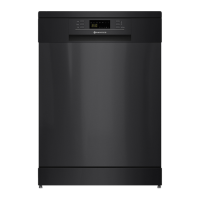
This document provides installation and operating instructions for a Parmco dishwasher, model PD6-PBL. It covers various aspects of the appliance, including its function, technical specifications, usage, and maintenance.
The Parmco dishwasher is designed for domestic use, offering a convenient way to clean dishes. It features a control panel with buttons for power, program selection, delay start, "Dry+" function, ALT function, pause, and child lock. The appliance has a capacity of 15 place settings and operates with a water pressure between 0.04-1.00MPa. The dimensions of the dishwasher are 600mm (W) x 600mm (D) x 845mm (H). It can be connected to hot water up to a maximum of 60°C.
The dishwasher offers several washing cycles, including:
The control panel allows users to select programs, delay the start time by up to 24 hours, and activate the "Dry+" function for enhanced drying. The ALT function allows for washing in either the upper or lower basket, or both. The child lock feature prevents accidental changes to settings during operation.
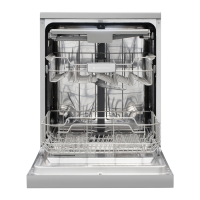
Loading the dishwasher baskets correctly is crucial for optimal performance. Items like cups, glasses, and pots/pans should be placed upside down, and curved items should be slanted to allow water to run off. Items must be stacked securely to prevent tipping and should not obstruct the spray arms. Very small items should not be washed in the dishwasher as they could fall out. The upper basket's height can be adjusted to accommodate larger utensils. The lower basket is designed for larger items like pots, pans, lids, serving dishes, and bowls, with foldable racks for increased flexibility. Cutlery should be arranged in the cutlery tray to ensure proper water runoff.
Certain items are not suitable for washing in the dishwasher, including cutlery with wooden, horn china, or mother-of-pearl handles, plastic items that are not heat resistant, older cutlery with glued parts, pewter or copper items, lead crystal glass, steel items subject to rusting, wooden items, and items made from synthetic fiber. Overloading the dishwasher should be avoided to ensure good results and reasonable energy consumption.
The dishwasher requires the use of rinse aid and detergent. The rinse aid dispenser has adjustable settings to prevent spots and improve drying. Detergents, including concentrated detergents and detergent tablets, should be added just before starting the wash cycle to prevent them from getting damp and not dissolving properly. For detergent tablets, it is recommended to use longer programs to ensure complete dissolution.
Regular cleaning and maintenance are essential for the dishwasher's longevity and performance. The filtering system, consisting of a coarse filter, a flat (main) filter, and a micro (fine) filter, collects food particles and debris. These filters should be inspected after each use and cleaned regularly under running water. The entire filter assembly should be cleaned once a week using a cleaning brush. Incorrect replacement of the filters can reduce performance and damage dishes.
The spray arms should also be cleaned regularly to prevent hard water chemicals from clogging the jets. To clean, unscrew the nut on top of the spray arm, remove it, wash it in soapy water with a soft brush, and rinse thoroughly.
For general care, the control panel should be cleaned with a lightly dampened cloth, and the exterior with a good appliance polish. Harsh cleaners or scouring pads should be avoided. If the dishwasher is not used regularly, it should be run through a wash cycle every week to keep the seal moist.
To protect against freezing, if the dishwasher is left in an unheated place during winter, the electrical supply should be cut off, the water supply and inlet pipe should be turned off and drained, and the filter in the tub and bottom should be removed and soaked in water.
Before moving the appliance, it should be emptied, the plug removed, and the water supply and drain hose turned off. The appliance should be kept in a vertical position during movement. The seals should be checked periodically for any food remains that could cause odors.
The dishwasher is equipped with an error code system to warn users of malfunctions:
The manual also provides a troubleshooting guide for common problems such as the dishwasher not starting, drain pump not working, noise, suds in the tub, stained tub interior, dishes and flatware not clean, spots and filming on glassware and flatware, cloudiness on glassware, yellow or brown film on inside surfaces, white film on inside surface, clogged detergent dispenser lid, detergent left in dispenser cups, steam, black or grey marks on dishes, water standing on the bottom of the tub, overfill dispenser or rinse aid spills, and dishwasher leaks. Solutions range from checking power supply and water connections to cleaning filters, adjusting detergent/rinse aid levels, and ensuring proper loading. For serious issues, it advises contacting a service agent.
The product comes with an extended 7-year warranty, covering manufacturing defects and ensuring compliance with New Zealand Consumer Guarantees Act. However, the warranty does not cover damage from improper installation, misuse, neglect, or unauthorized repairs. It is recommended to attach the serial number label to the manual for convenience.
 General
| Brand | Parmco |
|---|---|
| Model | PD6-PBL |
| Category | Dishwasher |
| Language | English |

 To Next Page