®
Model No. OS-8515B Experiment 5: Total Internal Reflection
15
Experiment 5: Total Internal Reflection
Purpose
In this experiment, you will determine the critical angle at which total internal reflec-
tion occurs in the acrylic rhombus and confirm your result using Snell’s Law.
Theory
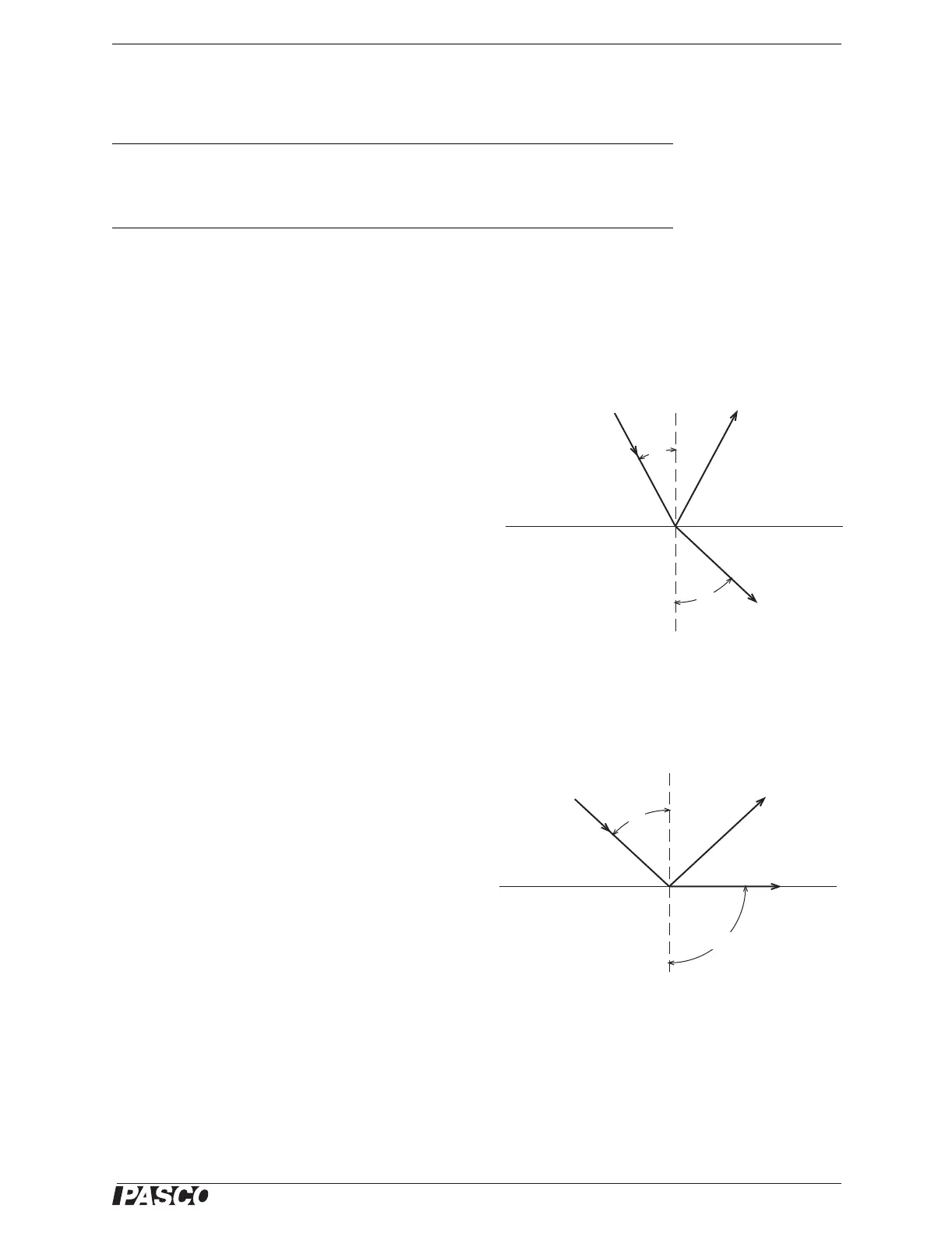
For light crossing the boundary between two transpar-
ent materials, Snell’s Law states
n
1
sin θ
1
= n
2
sin θ
2
where θ
1
is the angle of incidence, θ
2
is the angle of
refraction, and n
1
and n
2
are the respective indices of
refraction of the materials (see Figure 5.1).
In this experiment, you will study a ray as it passes out
of the rhombus, from acrylic (n = 1.5) to air (n
air
=1).
If the incident angle (θ
1
) is greater than the critical
angle (θ
c
), there is no refracted ray and total internal
reflection occurs. If θ
1
= θ
c
, the angle of the refracted
ray (θ
2
) is 90°, as in Figure 5.2.
In this case, Snell’s Law states:
n
sin θ
c
= 1 sin 90°
Solving for the sine of critical angle gives:
Required Equipment from Basic Optics System
Light Source
Rhombus from Ray Optics Kit
Other Required Equipment
Protractor
White paper
Surface
Refracted ray
(n
1
> n
2
)
Incident ray
n
1
n
2
q
1
q
2
Reflected ray
Figure 5.1
Refracted ray
Incident ray
n
n
air
= 1
q
c
Reflected ray
90°
Figure 5.2
sin θ
c
1
n
---=



 To Next Page