®
Model No. OS-8515B Experiment 2: Prism
9
Experiment 2: Prism
Purpose
The purpose of this experiment is to show how a prism
separates white light into its component colors and to
show that different colors are refracted at different
angles through a prism.
Theory
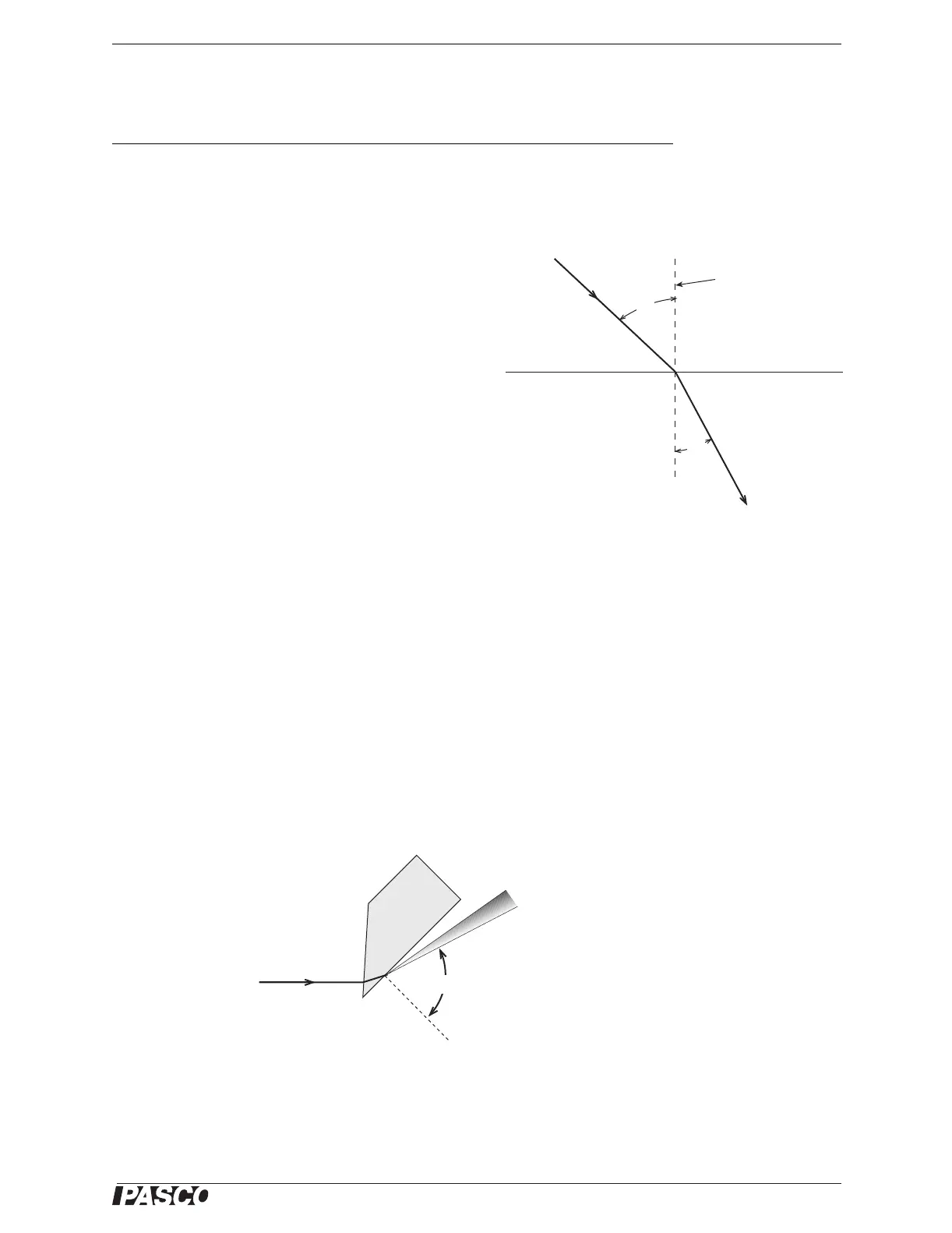
When a monochromatic light ray crosses from one
medium (such as air) to another (such as acrylic), it is
refracted. According to Snell’s Law,
n
1
sin θ
1
= n
2
sin θ
2
the angle of refraction (θ
2
) depends on the angle of incidence (θ
1
) and the indices of
refraction of both media (n
1
and n
2
), as shown in Figure 2.1. Because the index of
refraction for light varies with the frequency of the light, white light that enters the
material (at an angle other than 0°) will separate into its component colors as each fre-
quency is bent a different amount.
The rhombus is made of acrylic which has an index of refraction of 1.497 for light of
wavelength 486 nm in a vacuum (blue light), 1.491 for wavelength 589 nm (yellow),
and 1.489 for wavelength 651 nm (red). In general for visible light, index of refrac-
tion increases with increasing frequency.
Procedure
1. Place the light source in ray-box mode on a sheet of blank white paper. Turn the
wheel to select a single white ray.
2. Position the rhombus as shown in Figure 2.2. The acute-angled end of the rhom-
bus is used as a prism in this experiment. Keep the ray near the point of the rhom-
bus for maximum transmission of the light.
Required Equipment from Basic Optics System
Light Source
Rhombus from Ray Optics Kit
Blank white paper
Normal to surface
Surface
Refracted ray
(n
1
> n
2
)
Incident ray
n
1
q
1
q
2
n
2
Figure 2.1: Refraction of Light
q
Single white ray
Normal to surface
Color
spectrum
Figure 2.2



 To Next Page