®
Basic Optics System Teacher’s Guide
50
Experiment 9: Apparent Depth
Typical results:
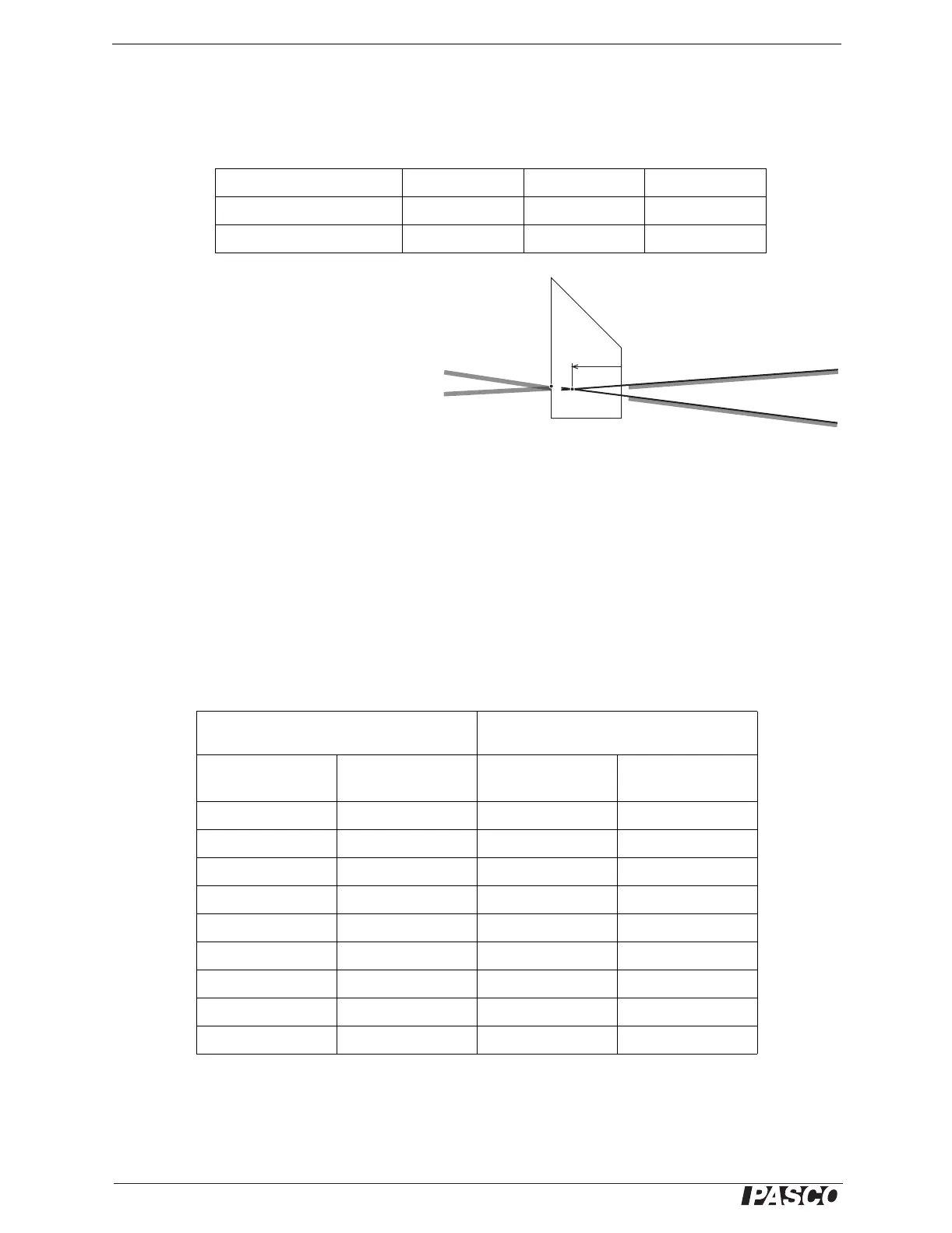
Typical ray-tracing results are represented at
50% scale in Figure TG.1. The gray regions
represent the actual light beams; the black
lines and dots represent the student’s actual
marks. Notice that this student traced along the
edges of the light beams.
The actual thickness of the rhombus is
t = 3.175 ± 0.025 cm. Based on the accepted
value of n = 1.49, the theoretical apparent
depth is d = 2.13.
Answers to questions: 1. Of the two methods, the parallax method is the more precise. Using that method,
both d and t could be measured with a precision of less than 1 mm. Using the ray-tracing method, the points at
which the rays crossed had a larger uncertainty due to the thickness of the light beams. 2. For the typical data
above, the percent differences between the accepted and experimental values of n are 0.7% for Part 1 and 5% for
Part 2.
Experiment 10: Reversibility
Typical results:
Table 1.1: Results
dtn
Part 1: Parallax method 2.12 cm 3.18 cm 1.50
Part 2: Ray-tracing method 2.23 cm 3.18 cm 1.43
Table 10.1: Data
Trial 1
Ray Incident on Flat Surface
Trial 2
Ray Incident on Curved Surface
Angle of Incidence
θ
i1
Angle of Refraction
θ
r1
Angle of Incidence
θ
i2
Angle of Refraction
θ
r2
0° 0 0 1.0
10° 7.0 7.0 7.5
20° 13.5 13.5 19.5
30° 20.0 20.0 30.0
40° 25.5 25.5 39.0
50° 31.0 31.0 49.0
60° 35.5 35.5 59.0
70° 39.5 39.5 70.0
80° 41.0 41.0 77.0
2.23 cm
Figure TG.1



 To Next Page