
 Need help?
Do you have a question about the PATHFINDER 2600 HPS and is the answer not in the manual?
Essential safety equipment mandated by regulations.
Additional safety items for enhanced boating experience.
Safety feature that shuts down the engine in emergencies.
Information display for engine and boat functions.
Protects engine from contaminated fuel; includes maintenance.
Details the garboard drain plug for hull drainage.
Control water flow for livewells and drainage.
Cockpit drainage system using thru-hull fittings.
Components and operation of the livewell pump.
Plates for mounting trolling motors, T-Tops, etc.
Standard 36V trolling motor wiring and mounting.
Controls power distribution for house and trolling motor systems.
Integrated swim/dive platform ladder for easy entry/exit.
How cockpit water drains overboard automatically.
Features of the livewell for keeping bait alive.
Wiring diagram for the main boat harness.
Wiring details for connecting accessories.
Pinout for the 8-pin accessory plug.
Electric trim tabs for performance and ride adjustment.
Improves shallow water performance via engine height adjustment.
Optional system for quickly stopping the boat in shallow water.
Instructions for cleaning vinyl upholstery.
Instructions for cleaning colored and accent vinyls.
This document is the owner's manual for the Pathfinder 2600 HPS boat, revised in May 2020. It provides comprehensive information about the boat's specifications, operation, maintenance, and features.
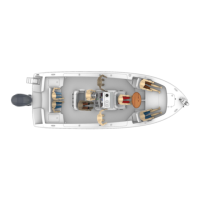
The Pathfinder 2600 HPS is a versatile angling boat designed for performance, quality, and fishability. Its overall length (L.O.A.) is 26 feet 2 inches, with a beam of 8 feet 10 inches and a draft of 15 inches. The boat weighs 4,100 pounds with the engine and has a fuel capacity of 78 gallons. The deadrise at the transom is 18 degrees, and it can accommodate a maximum of 400 horsepower. The maximum capacity is 11 persons or 2,950 pounds.
The manual includes a detailed boating safety checklist, categorizing items as "MUST HAVE ITEMS" (required by regulation) and "Recommended Items." Required items include personal flotation devices (Type I, II, III, or V for each person onboard, plus one Type IV throwable), fire extinguishers (quantity varies by boat length), visual distress signals (combination day/night VDS, daytime VDS, and nighttime VDS), sound signals (horn or whistle, and bell for vessels over 12m), ventilation for gasoline systems (natural or powered), and backfire flame control (backfire flame arrestor for gasoline engines except outboards). Recommended items are further broken down for "Boats on Inland Waters," "Boats on Nearshore Waters," "Boats on Offshore Waters," and "Boats on River Waters," covering items like first aid kits, anchors, sun protection, VHF radios, GPS/chartplotters, EPIRBs, life rafts, and various marine hardware.
Pathfinder advises that maintenance and repairs should be performed by an authorized Pathfinder Dealer. The boat is constructed with high-quality materials, but regular care is essential due to saltwater exposure. After each use, the boat should be thoroughly rinsed with fresh water. Upholstery care instructions are provided on page 28. A light coat of lubricant on metal railings, screws, and electrical connections is recommended to prevent electrolysis. Waxing the gel coat once a year with an approved fiberglass wax is advised to improve longevity.
New engines require a break-in period for proper mating of moving parts. Specific break-in procedures and times vary by engine model and are detailed in the Yamaha Engine Owner's Manual.
The spring-loaded engine stop switch, located at the helm, automatically shuts down the engine in emergencies to prevent uncontrolled operation. The safety lanyard must be attached to its base to activate the protective shutdown circuitry. The lanyard should be securely attached to the operator at all times when the engine is on. Operating the boat with a malfunctioning engine stop switch system is dangerous and requires immediate resolution by a Pathfinder Dealer.
The main switch panel, located above the steering wheel, controls lights, horn, accessories, livewell, and bilge. Dual activation switches can be flipped "Up" or "Down" to activate different accessories. The bilge switch is an on-demand switch for the bilge pump, serving as a backup if the float indicator clogs. Two trim tab switches are standard, and a compass is mounted on top of the console.
The instrument panel features a Yamaha digital gauge and dual activation switches with accessory plug-ins. The digital gauge displays a Yamaha tachometer (with engine temperature, oil level, and engine trim indicators) and a Yamaha speedometer (with speed, hour meter, trip meter, and clock). Refer to the Yamaha owner's manual for detailed gauge information.
The boat comes with a duffel bag containing essential items: large and short livewell standpipes, a 1.5" livewell pacifier plug, two ignition keys and an emergency kill cord/engine stop lanyard, an engine start cord, a garboard drain plug, a gas fill key, two glove box keys, and various accessory manuals.
The Pathfinder 2600 HPS is equipped with a fuel-water separator, a metal cylindrical unit secured in the central aft rigging box. It ensures maximum performance and protects the outboard engine from contaminated gasoline. The separator should be checked by removing it and dumping its contents into an approved waste collection device. If excessive water is present, the filter component should be changed. Yamaha recommends replacing the 10-micron fuel filter after the first 10 hours or 1 month of operation, and every 50 hours or 6 months thereafter, with more frequent replacement in high humidity or extensive engine operation.
This small metal plug is located at the lowest point on the hull, at the bottom of the transom above the keel. It can be loosened by hand for draining when the hull is out of the water. The plug has a rubber seal for watertightness and must be hand-tightened firmly before launching.
The bilge should be checked before and after launching. A small amount of water is normal, but a large amount or any signs of fuel or oil require immediate attention from a certified marine technician. Fuel or oil should never be pumped overboard. The bilge pump is mounted to ABS plastic. Large quantities of water may indicate a leak or a malfunctioning bilge pump/float switch. The automatic float switch is wired to the 24-hour side of the battery switch via the "BILGE" breaker. If the pump doesn't activate when submerged, try manually turning it on via the switch panel. If it still fails, check the breaker on the battery switch panel. The automatic float switch also has an independent fuse near the batteries. If the pump fails, unhook it from its cradle, check for obstructions, and reassemble. If it still doesn't work, it likely needs replacement. The bilge pump has an anti-airlock nozzle, so mist or spray while running is normal.
Ball valves control seawater inflow for livewells and act as a safeguard against water entry. When the handle is aligned with the direction of flow, the valve is "OPEN." When the handle crosses the direction of flow, the valve is "CLOSED."
The deckdrain system uses 1 1/2” thru-hull fittings on the aft port and starboard hull sides, positioned below the cockpit floor for gravity drainage. These drains are rigged with ball valves, accessible through pie eyes on the transom, allowing the boat to be "self-bailing" when open. When closed, no water enters or exits the cockpit.
The livewell pump assembly includes a scoop strainer, thru-hull fitting, ball valve, and pump. The ball valve must be in the "OPEN" position for livewell operation.
Diagrams on page 27 show screw-retention backing plates for the trolling motor, T-Top, and leaning post, integrated during construction.
The 2600 HPS comes standard with a 36V trolling motor wiring system. A mounting plate is built into the bow. Trolling motors should be attached by drilling with a 13/64" drill bit, using a 1/4" tap, and 1/4" #20 machine screws. The plate accommodates all trolling motor brands. Page 24 details optional trolling motor systems with battery chargers and wire routing.
The 12 Volt House/Engine battery selector switch, 36 Volt Trolling Motor switch, and Breaker switch panel are located on the starboard side of the helm console. All switches and breakers are prewired, except for three accessory breakers. The 5 amp Acc. 3 Breaker is for stereo memory, while Acc. #1 and #2 are for optional equipment (e.g., single and twin Power Poles). The 50 amp Trolling Motor breaker is prewired to the Trolling Motor receptacle. When not in use, leave the battery switches in the OFF (O) position to prevent drainage.
To turn on the 12 Volt House/Engine system, rotate the switch to position 1. If power is not supplied, check the 40-amp "Helm Panel" breaker. The 12 Volt House/Engine battery switch allows pulling power from trolling motor batteries or a secondary battery to supplement the house battery. Position 2 isolates power to the second battery, and 1&2 combines both for simultaneous power. To activate the 36 Volt Trolling Motor system, rotate its switch to ON. If power is not supplied, push in the 50-amp breaker.
The 2600 HPS features a Swim/Dive Platform with a stainless boarding ladder at the stern for easy entry and exit. To operate, lift the metal ladder, extend it fully, and let it fall into the water. DANGER: No passenger should attempt to enter or exit the boat by the ladder or any other means while the engine is on.
Prop selection is determined by the local Pathfinder Dealer based on recommendations from Pathfinder Boat Company and Yamaha Marine for optimal overall performance. Prop design and size depend on performance requirements (e.g., smaller pitch for faster hole shot, larger pitch for higher overall speed, four-bladed props for increased speed or shallower running). Always inspect the engine and prop for tangled fishing line, debris, cracked blades, or fluid leaks before launching. Consult the Yamaha Owner's Manual for prop issues.
The Pathfinder 2600 HPS has a 78-gallon aluminum fuel cell located midship between the stringers, below and in front of the console. The fuel fill receptacle is on the port gunwale forward of the console, with a recessed fuel overflow vent just below it. WARNING: Inspect the fuel system for leaks at least once a year to avoid serious injury or death from fire or explosion. DANGER: Do not smoke while fueling. Turn off engines and all electrical equipment. Use only recommended gasoline (see Yamaha Owner's Manual); avoid fuels with alcohol or alcohol-related derivatives that can deteriorate marine fuel system hoses. The fuel system is pressure-tested at the factory. Any fuel-related problems require immediate attention from a Pathfinder dealer.
The cockpit is self-bailing, meaning water drains directly overboard through two aft cockpit drains, not into the bilge. Ball valves control water flow (refer to page 12). The bilge drains any water entering the hull's interior. Livewell and cockpit drains are closed systems flushing water out through stern scuppers. All hoses are sealed and double-clamped. Continuous bilge pump operation may indicate a hose leak or seal break, requiring immediate investigation by a Pathfinder Dealer.
The improved livewell system features a dual inflow and unique drain system to prevent dead zones and expel harmful chemicals. The boat is shipped with the shut-off valve in the "off" (90-degree) position. To use, turn the valve counterclockwise to align with the pipe. This valve also serves as a safeguard against leaks. The livewell uses two standpipes (smaller for crustaceans, taller for baitfish) and a pacifier-style drain plug to control water levels. Standpipes are placed in the hole in the starboard aft section of the livewell and secured with a plexiglass cover. If the livewell doesn't pump water, shift the throttle into reverse and back the boat several feet to purge air pockets. Clear any detritus from the standpipe grate if clogged. An optional recirculation system recycles water within the well, controlled by a switch on the panel, ideal for transporting bait. Note: Turn the shut-off valve to the 90-degree off position BEFORE working on the livewell pump or plumbing to prevent water inflow into the bilge.
A wiring diagram is included for troubleshooting electrical problems or adding electronics. A trained marine electrician is recommended for all electrical issues. The ground terminal and breaker panel are in the glove box inside the console. All grounds lead to the ground terminal and then to the battery via a large black wire. The manual provides a "Pathfinder Main Harness" table detailing pin numbers, functions, wire colors, and AWG for console and accessory connections, including a diagram of the 8 PIN Plug. Always use recommended breaker/fuse amp sizes; oversizing can cause electrical shorting. Open slots on the ground block and breaker panel are available for additional hook-ups, which should use accessory switches and be performed by a qualified marine electrician. Pull cords are run forward and aft through rigging tubes for easy additional wiring.
Integrated 9 X 12-inch Bennett electric trim tabs are standard, enhancing boat performance. Being electric, they eliminate hydraulic fluid leaks. Trim tabs maximize performance, balance weight, and adjust hull attitude. The port switch affects the port side, and the starboard switch affects the starboard side. Lowering a tab creates stern lift on that side, lowering the opposite bow. Raising a tab lowers the stern on that side, lifting the opposite bow. Use light taps to adjust the boat's attitude for an even, safe, and comfortable ride. Lowering both tabs forces the bow down for heavy seas or stiff chop. Raising both tabs lifts the bow for better running performance, used in conjunction with engine trim. In severe weather, trim tabs can lift the windward side to avoid spray.
Salt-water washdown is standard. The pump is in the bilge, forward of the livewell pump, accessible via the splashwell hatch or aft port hatch. To operate, hook a hose to the raw water receptacle in the aft section of the rod locker and flip the "Saltwater" switch. The pump pressurizes the system and shuts off with an internal pressure switch, reactivating on demand. Only spray gel-coated fiberglass surfaces; avoid other areas. Rinse the boat with freshwater immediately after use.
The 2600 HPS comes standard with forward port and starboard lockable rod lockers for secure rod storage. They have large openings with gas shock-assisted lids for quick access. Independent tubes protect brittle tips on rods up to 9 feet.
Under gunwale rod racks are standard on both port and starboard sides, providing space for four additional rods.
A standard jackplate is installed to improve shallow water performance, allowing the motor to be trimmed straight up, keeping more prop in the water. Jackplates have specific applications and performance requirements. Review the jackplate owner's manual and Yamaha engine manual before operation. Note: Hydraulic jackplates increase stress on the transom; a transom saver or other supporting device is recommended to minimize this stress.
If chosen, the 2600 HPS comes with a JL Audio Stereo system Media Master 50 and four matching speakers. Refer to the JL Audio Owner's Manual. The boat is pre-wired for four cockpit speakers and two hardtop speakers even without the stereo option.
Command Link Gauges are an optional upgrade from standard digital gauges, offering more user-selectable information. Speed data can be displayed from a pitot tube, Triducer, or NMEA protocol GPS unit. Refer to the Yamaha engine owner's manual for full functionality.
Power Poles are an optional feature that allows quick and quiet stopping in shallow water. They are useful for enjoying a view or fishing. Refer to the Power Pole owner's manual for operational and mechanical information. For post-factory installation, contact a Pathfinder dealer.
Page 24 provides a wiring diagram for the 4-bank battery charger, cranking battery, 36 Volt Trolling Motor, and 12V load. It also shows how to connect a second cranking battery.
Page 25 illustrates the hull wire harness connections, including STBD Power Pole, Port Power Pole, Port Underwater Light, Fresh Water Pump, Port Trim Tab, Livewell-3 Pump, Livewell-2 Pump, Bubbler, Hull/Aft Deck Connections, Jackplate Switch Connection, Jackplate, STBD Underwater Light, Bilge Pump, Raw Water Pump, Power Assist Steering, Anchor Light, STBD Trim Tab, Livewell-1 Pump, Battery Switch, Fuel Bond, Fishbox Macerator, Hull/FWD Deck Connection, Console Grounds, Fuel Gauge, Stereo Connections, Trim Tab Switch, and Switch Panel Connections.
Page 26 shows the deck wire harness connections, including Port Cockpit Light, Port Aft Speaker, Port Aft Compartment Light, Aft Deck/Hull Connection, Recirc-1 Pump, Recirc-2 Pump, Livewell Light, Aft Compartment Light, STBD Aft Compartment Light, STBD Aft Speaker, STBD Cockpit Light, STBD FWD Speaker, STBD FWD Compartment Light, FWD Compartment Light, Port FWD Compartment Light, Port FWD Speaker, and FWD Deck/Hull Connection.
Page 27 provides diagrams of reinforcements, including 5" x 6" Whaleboard, 2-6" X 6" x 1/4" Aluminum, 4-8" X 8" ALUMINUM PLATES, 1-4" x 12 1/4" x 3/8", 4-4" x 10 1/2" x 3/8" Waleboard, 6" x 33" Aquaplas (front cockpit wall), Spring Line Cleat backing board, Port & Strbd side, and 2-6" X 21" 1-6" X 6" WALEBOARD.
Page 28 provides detailed care instructions for Spradling International MARINE vinyl-coated fabrics, specifically for PERMAGUARD® (white or primary seating vinyls) and Colors and Accent Vinyls. For PERMAGUARD®:
For Colors and Accent Vinyls (Acrylic or Napa Topcoat):
The owner's relationship with their local Pathfinder dealer is crucial for service, repair, and warranty issues. Pathfinder has an extensive dealer network knowledgeable in service and repairs for all boat models. All warranty claims and repair issues should be addressed through the local Pathfinder dealer to ensure timely resolution and a direct link from the boat owner to the factory.
 General
| Brand | PATHFINDER |
|---|---|
| Model | 2600 HPS |
| Category | Boat |
| Language | English |


 To Next Page