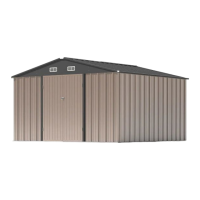
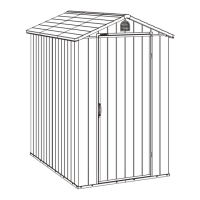
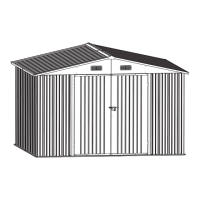
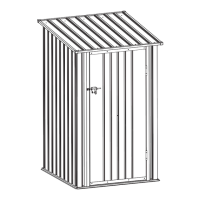
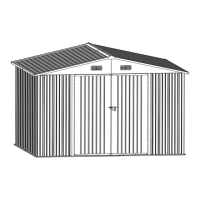
This document is an assembly and owner's manual for a Patiowell Metal Garden Shed, SKU: T-PS23-0230A. It provides detailed instructions for constructing the shed, along with important information regarding its care, maintenance, and safety.
Function Description:
The Patiowell Metal Garden Shed is designed as an outdoor storage solution for gardens and other outdoor spaces. Its primary function is to provide a secure and weather-resistant enclosure for tools, equipment, and other items, helping to keep outdoor areas tidy and organized. The shed's metal construction suggests durability and resistance to various weather conditions, making it suitable for long-term outdoor use. The inclusion of doors indicates accessibility for storing and retrieving items.
Important Technical Specifications (Derived from parts list and assembly steps):
The shed's construction involves a variety of metal components, including:
- Foundation: Composed of parts like BS1, BS2, BS1L, BS2L, and BF3, which form the base structure.
- Plates: Various panels identified as W1A, WS2A, WS3A, DLA, DRA, P1, P2, P3, P4, 12L, 12R, 21L, and 21R. These likely form the walls and roof sections.
- Strips: Structural supports and trim pieces, including B1, DX2, ULA, UR1, US1R, 20, 9, 10L, 10R, 11, 15, 16, 17, 18, and US1. These are crucial for reinforcing the shed's frame and connecting panels.
- Standard Components: Hardware such as DC (door catches), DH (door hinges), DF (door fasteners), DG (door handles/latches), GC (corner protectors/caps), GS (supports), V1 (washers), and V2 (washers).
- Screws: A range of screws for assembly, including F1 (M4x10), F2 (M4x10), F3 (M5x12), F4 (M6x10), and F5 (M4x16). The quantities of these screws are substantial (e.g., F1 X215, V2 X175), indicating a robust and secure assembly.
The assembly process suggests a modular design, where smaller sub-assemblies are created before being integrated into the main structure. The use of different screw types and washers (V1, V2) implies specific fastening requirements for different parts, ensuring structural integrity and weather sealing. The presence of door components (DLA, DRA, DH, DF, DG) confirms that the shed includes functional doors, likely sliding or hinged, for access. The roof structure involves multiple panels (P1, P2, P3, P4) and reinforcing strips (15, 16, 17, 18), indicating a designed system for weather protection.
Usage Features:
- Outdoor Storage: Designed specifically for garden and outdoor use, providing a dedicated space for tools, lawnmowers, bicycles, or other outdoor equipment.
- Accessibility: Features doors (DLA, DRA) with hinges (DH) and latches/handles (DF, DG) for easy entry and exit. The assembly steps for the doors show both left and right door panels, suggesting a double-door configuration or options for door placement.
- Security: The presence of door catches (DC) and fasteners (DF, DG) implies a basic level of security, though external locks would likely be needed for enhanced protection.
- Weather Resistance: The metal construction and detailed assembly, including the use of washers and recommendations for silicone caulking, aim to provide protection against elements like rain, wind, and snow.
- Foundation Requirement: The manual emphasizes checking local building codes for footings and suggests anchoring the shed to an immovable object or the ground for stability, indicating it is a permanent or semi-permanent structure.
Maintenance Features:
The manual provides comprehensive care and maintenance guidelines to ensure the longevity and optimal performance of the shed:
- Finish Maintenance:
- Regular cleaning and waxing of the exterior surface are recommended to maintain the finish.
- Prompt touch-up of scratches with a wire brush and manufacturer-recommended paint is advised to prevent rust and maintain aesthetics.
- Roof Maintenance:
- Keeping the roof clear of leaves and snow using a long-handled, soft-bristled broom is crucial.
- Heavy snow accumulation can damage the roof and make entry unsafe. For snow-prone areas, Roof Strengthening Kits are mentioned as an available option for added protection.
- Door Maintenance:
- Door tracks should be kept clear of dirt and debris to ensure smooth sliding.
- Annual lubrication of door tracks with furniture polish or silicone spray is recommended.
- Keeping doors closed and locked is essential to prevent wind damage.
- Fastener Maintenance:
- All supplied washers should be used to protect against weather infiltration and prevent metal scratching by screws.
- Regularly checking for loose screws, bolts, and nuts, and retightening them as necessary, is important for structural integrity.
- Moisture Control:
- Placing a plastic sheet (vapor barrier) under the entire floor area with good ventilation is suggested to reduce condensation inside the shed.
- General Tips:
- Inked part numbers on coated panels can be washed off with soap and water.
- Silicone caulking can be used for watertight seals throughout the building.
- Safety Precautions (also maintenance-related):
- Avoid storing flammable or corrosive substances.
- Do not store swimming pool chemicals, combustibles, or corrosives unless in air-tight, approved containers.
- Do not lean heavy articles against the walls to prevent distortion.
- Do not store hot items (e.g., recently used grills, blowtorches) in the shed.
- Do not stand on the roof.
- Reduce wind exposure, especially on the door side, by considering wind direction when placing the shed.
The manual emphasizes the importance of following assembly instructions carefully, checking local building codes, and working with two or more people for assembly. It also highlights the provision of extra fasteners for convenience.

 Need help?
 General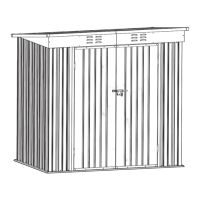




 To Next Page