Need help?
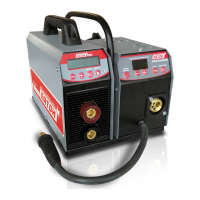
Do you have a question about the Paton ProMIG-200 and is the answer not in the manual?
Guidance on selecting extension cable length and cross-section for MMA welding operations based on current.
Specifies the allowed welding processes (MIG/MAG, TIG, MMA) and prohibits modifications or misuse.
Guidance on operating environment, cooling, and positioning to ensure safe and effective use.
Details on required mains voltage, grounding methods, and warranty voidance for incorrect connections.
Instructions for selecting the correct plug and socket, and safety notes for mains connection.
Illustrates the welding current profile and timing for the SMAW process.
Adjustable function to improve arc initiation by increasing amperage during the arc ignition phase.
Enhances arc stability and improves metal transfer during short-circuit welding.
Automatically reduces welding current to prevent electrode sticking to the workpiece.
Adjusts the slope of the voltage-current characteristic based on electrode type for optimal welding.
Ensures the welding arc does not extend excessively, useful for ceiling welds.
Reduces open-circuit voltage to a safe level for enhanced electrical safety.
Introduces controlled current modulation for better control over heat input and weld quality.
Illustrates the current profile for TIG-LIFT welding.
Enables contact arc ignition without oscillators, eliminating shock current at ignition.
Details the welding current and timing for the TIG-2T torch button mode.
Explains the operation of the torch button for TIG-2T mode, often with an oscillator.
Details the welding current and timing for the TIG-4T torch button mode.
Explains the operation of the torch button for TIG-4T mode, typically with an oscillator.
Allows starting the welding process at low currents to preheat the area.
Sets the current level for filling the crater at the end of the weld.
Smoothly increases current to save electrode life and prevent splatter.
Controls current decrease for proper crater filling and weld integrity.
Switches current between peak and base levels for better heat control and weld appearance.
Illustrates the gas and current profiles for MIG/MAG welding.
Describes the torch button operation for short to medium welds in 2T mode.
Details the welding current and timing for the 4T torch button mode.
Explains torch button operation for reduced hand fatigue in 4T and alternative 4T modes.
Allows precise control of current rise rate for reduced spatter and improved weld quality.
Protects the weld zone by pre-cleaning with shielding gas before arc ignition.
Purges the welding zone with shielding gas after arc extinguishment.
Facilitates a seamless shift into welding mode by gradually increasing voltage and wire feed speed.
Procedure for accessing and changing device functions, including unlocking the menu.
Navigates through available welding modes (MMA, TIG, MIG/MAG).
Restores current welding mode settings to factory defaults.
Allows saving and recalling up to 16 different presets for each welding mode.
Detailed list of adjustable parameters and their default values for MMA welding.
Detailed list of adjustable parameters and their default values for TIG welding.
Detailed list of adjustable parameters and their default values for MIG/MAG welding.
Highlights risks of fatal electric shock, emphasizing cable integrity and insulation.
Warns against direct observation of the arc; requires protective masks and eye protection.
Stresses ventilation and health hazards from welding fumes, especially with certain materials.
Discusses potential effects on medical equipment like pacemakers and advisory for users.
Advises removing flammable items and avoiding welding near hazardous materials or containers.
Mandates sturdy footwear, insulating gloves, protective masks, and flame-retardant clothing.
 General
| Welding Method | MIG/MAG, MMA |
|---|---|
| Input Frequency | 50/60 Hz |
| MMA Welding Current Range | 20-200 A |
| Wire Diameter | 0.6-1.0 mm |
| Electrode Diameter | 1.6-5.0 mm |
| Input Voltage | 220 V |

 To Next Page