OPERA
TION
The P
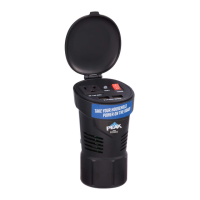
ower Inverter converts 12-volt DC (direct current) input voltage to 110/120-volt, 60 Hz AC
(alternating current) power.
The Inverter produces a “modifi ed sine wave.” The modifi ed sine wave is suitable for most AC
powered appliances and personal electronic devices.
The following devices may not work with a modifi ed sine wave:
Photocopiers, laser printers, magneto-optical hard drives•
Some laptops•
Metal halide arc (MHI) lights•
Some fl uorescent lights with electronic ballasts•
Power tools that use solid-state power•
Fans and power tools that use variable speed controls•
Some new furnaces and pellet stoves with microprocessor control•
Digital radios and clocks•
Sewing machines with speed/microprocessor control•
Electronics that modulate radio frequency signals on the AC line•
X-10 home automation systems•
Oxygen concentrators and other medical equipment•
Most battery chargers can be connected to the AC receptacle. Battery chargers that use separate
transformers or chargers that plug into the AC receptacle to supply a low-voltage DC-to-AC output
should work. However, battery chargers for small nickel-cadmium batteries can be damaged if plugged
into the Inverter.
The following appliances or devices could be damaged if plugged into the Inverter:
Small battery operated appliances that can be plugged directly into the AC receptacle such as •
fl ashlights, cordless razors and toothbrushes
Certain battery chargers for cordless tool battery packs. These chargers can be identifi ed by a •
warning label stating dangerous voltages are present at the battery terminals.
Monitor the temperature of the batter
y charger for about 10 minutes. If the battery
charger becomes abnormally warm, disconnect it from the Power Inverter immediately.
If you are unsure about powering any appliance or device with the Inverter, contact the manufacturer
or consult the owner’s manual of the device.
P
ower Source
The 12-v
olt cigarette lighter/accessory socket must provide between 10.5 and 15 volts DC and must
be able to provide suffi cient current (in amperes) to operate the device.
Do not e
xceed the maximum input voltage of 15 volts DC. The Inverter could be
damaged.
P
ositioning of Power Inverter
Allo
w at least one inch (25 mm) of clearance around the Inverter to allow for airfl ow. Always use the
Inverter where there is adequate ventilation. Do not block cooling vents or the fan.
FIRE HAZARDS
• Do not place the Inverter near fl ammable materials or in any location that may accumulate
fl ammable fumes or gases.
Do not expose the Inverter to extreme heat or fl ames. The surrounding air temperature •
should be between 50° and 86°F (10° and 30°C). Do not place the Inverter on or near a
heating vent or any equipment which is generating heat above room temperature. Do not
place the Power Inverter in direct sunlight.
ELECTR
OCUTION HAZARD
Do not operate the Power Inverter if it is wet. Do not allow water, moisture or other liquids to
come in contact with the Power Inverter, the device being operated or the power source.
Connecting to 12-v
olt Cigarette Lighter/Accessory Socket
Do not use with positive gr
ound electrical systems. Connecting the Inverter to a
positive ground electrical system will damage the Inverter. Only use the Power Inverter on
negative ground electrical systems. If in doubt, check with your vehicle dealer or consult the
vehicle’s owner’s manual.
To connect the Power Inverter:
Make sure the ON/OFF switch is in the OFF (O) position and all devices are disconnected from 1.
the Power Inverter.


 To Next Page
 Loading...