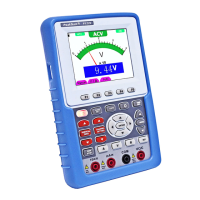
2.3 Measurement Applications
This section contains instructions for using your PeakTech 2020 GN / PeakTech 2030 KT for specific
measurement procedures. However, this is but a small sampling of the many applications possible for this
oscilloscope. These particular applications were selected to demonstrate certain controls and features not
fully covered in BASIC OPERATING PROCEDURES, to clarify certain operations by example, or for their
importance and universality.
2.3.1 Amplitude Measurements
The modern triggered sweep oscilloscope has two major measurement functions. The first of these is
amplitude. The oscilloscope has an advantage over most other forms of amplitude measurement in that
complex as well as simply waveforms can be totally characterized (i. e. complete voltage information is
available).
Oscilloscope voltage measurement generally fall into one of two types: peak-to-peak or instantaneous peak-
to-peak (p-p) measurement simply notes the total amplitude between extremes without regard to polarity
reference. Instantaneous voltage measurement indicates the exact voltage from each every point on the
waveform to a ground reference. When making either type of measurement, make sure that the VARIABLE
controls are click-stopped fully clockwise.
Peak-to-Peak Voltages
To measure peak-to-peak voltage, proceed as follows:
1. Set up the scope for the vertical mode desired per the instructions in 2-3 BASIC OPERATING
PROCEDURES.
2. Adjust the TIME/DIV switch (15) for two or three cycles of waveform, and set the VOLTS/DIV
switch for the largest-possible totally-on-screen display.
3. Use the appropriate Vertical POSITION control (4) or (7) to position the negative signal peaks on
the nearest horizontal gratitude line below the signals peaks, per Figure 2-5.
4. Use the Horizontal POSITION control (10) to position one of the positive peaks on the central vertical
gratitude line. This line has additional calibration marks equal to 0.2 major division each.
5. Count the numer of division from the gratitude line touching the negative signal peaks to the
intersection of the positive signal peak with the central vertical gratitude line. Multiply this number by
the VOLTS/DIV switch setting to get the peak-to-peak voltage of the waveform. For example, if the
VOLTS/DIV switch were set to 2 V, the waveform shown in Figure 2-5 would be 8.0 V
pp
(4.0 div x 2
V).
6. If x 5 vertical magnification is used, divide the step 5 voltage by 5 to get the correct p-p voltage.
However if 10 x attenuator probes are used, multiply the voltage by 10 to get the correct p-p voltage.
7. If measuring a sine wave below 100 Hz, or a rectangualar wave below 1000 Hz, flip the AC/GND/DC
switch to DC.
Caution: Make certain the waveform is not riding on a higher-amplitude DC voltage.
- 47 -


 To Next Page
 Loading...