1401 North Plano Road, Richardson, Texas 75081
Phone: 972-234-3202 | Fax: 972-497-0441
Use care when touch-ing
the exterior of an oper-
ating motor. Modern motors normally run
hot. They are designed to operate at higher
temperatures. This is a normal con-dition
but they may be hot enough to be painful or
injurious to the touch.
Use low pressure grease
guns only. High pressure
guns tend to blow out or unseat bearing
seals, leaving the bearing open to collect
grime, dust and foreign particles.
PENNBARRY 3
2. Check motor and bearing
temperatures for excessive heat.
If any problem is indicated, TURN OFF
POWER TO UNIT IMMEDIATELY. Lock
out the electrical supply, check carefully
for the cause of the trouble and correct
as needed. Even if the fan appears to be
operating satisfactorily, shut down after a
brief period and check all fasteners, set-
screws and keys for tightness.
During the rst eight (8) hours of opera-
tion, check the fan periodically for exces-
sive vibration or noise. At this time, also
check motor input current and motor bear-
ing temperatures to insure that they do not
exceed manufacturer’s recommenda-tions.
After eight hours of satisfactory operation,
shut down the fan and lock out the electri-
cal power to check the following items and
adjust if necessary:
a. All set-screws, keys and fasteners.
b. Drive coupling alignment.
c. Belt alignment.
d. Belt tension.
Maintenance
Do not attempt maintenance on fan until
the electrical supply has been completely
disconnected. If a disconnect switch has
not been provided, remove all fuses from
the circuit and lock the fuse panel so they
cannot accidentally be replaced.
Lubrication is a primary maintenance
responsibility. Check all bearings periodi-
cally. Inspect belts for tightness. If the fan
is installed in a corrosive or dirty atmos-
phere, periodically clean the impeller, inlet
and other moving parts.
FAN SHAFT LUBRICATION
Fan shaft bearing pillow blocks are fur-
nished in either the prelubricated sealed-
for-life type or the greasable type depend-
ing on what was ordered. The prelubricat-ed
type requires no servicing for 7 to 10 years
of normal use and the greasable type are
factory greased eliminating the need for
greasing initially. Follow the lubri-cating
schedule recommended by the fac-tory.
When required, apply grease while the
shaft is rotating. This practice should not
supersede any safety considerations.
LUBRICATION SCHEDULE
Always follow the bearing manufacturer’s
recommended lubrication schedule. If
none is available us the following general
schedule.
a. Under average conditions where ambi-
ent temperatures do not exceed 120°F.,
lubrication is required 1 to 2 times a year.
b. Under dirt laden atmospheres or where
there is a temperature range of 120°F to
150°F, lubrication is required from 3 to 6
times a year.
c. Under extreme temperature conditions
and extremely dirty atmospheres, lubrica-
tion should be at least once or twice a
month.
Table 1: Recommended Lubricants
MOTOR LUBRICATION
In general, standard motors are furnished
with prelubricated, sealed-for-life ball bear-
ings which require no lubrication for 7 to
10 years of normal service. Where motors
have been ordered with greasable bear-
ings, these bearings are factory lubricated
and require no attention for one year under
normal conditions. If grease relief ttings
are provided, remove them when perform-
ing maintenance to allow grease to ow
out. Whenever possible, apply grease while
the motor is running. This practice should
not supersede any safety considerations.
DO NOT OVER GREASE, as most lubri-
cants deteriorate motor windings, thereby
reducing motor life.
Hidden Danger
In addition to the normal dangers of rotat-
ing machinery, fans present an additional
hazard in their ability to suck in not only air,
but loose material as well. Solid objects can
pass through the fan and be discharged
by the impeller as potentially dangerous
projectiles. Therefore, screen intake to
ductwork, whenever possible, to prevent the
accidental entrance of solid objects. Never
open access doors to a duct system with the
fan running.
When starting the fan for the rst time, com-
pletely inspect the ductwork and inte-rior
of the fan (with power locked off), to make
certain there is no foreign material which
can be sucked into or blown through the
ductwork.
Guards
All fans have moving parts which require
guarding in the same way as other moving
machinery.
Where the fan is accessible to untrained per-
sonnel or the general public, use maximum
safety guards, even at the cost of some
performance loss. Unprotected fans located
less than 7’ above the oor also require
guarding as specied in the Occupational
Safety and Health Act (OSHA).
PennBarry recommends the use of guards
on all exposed nonducted fans, ceiling and
wall mounted.
Centrifugal fans may be connected directly
to ductwork which will prevent contact with
the internal moving parts, but when the inlet
or outlet is exposed, install a suitable guard.
Operation & Maintenance Manual
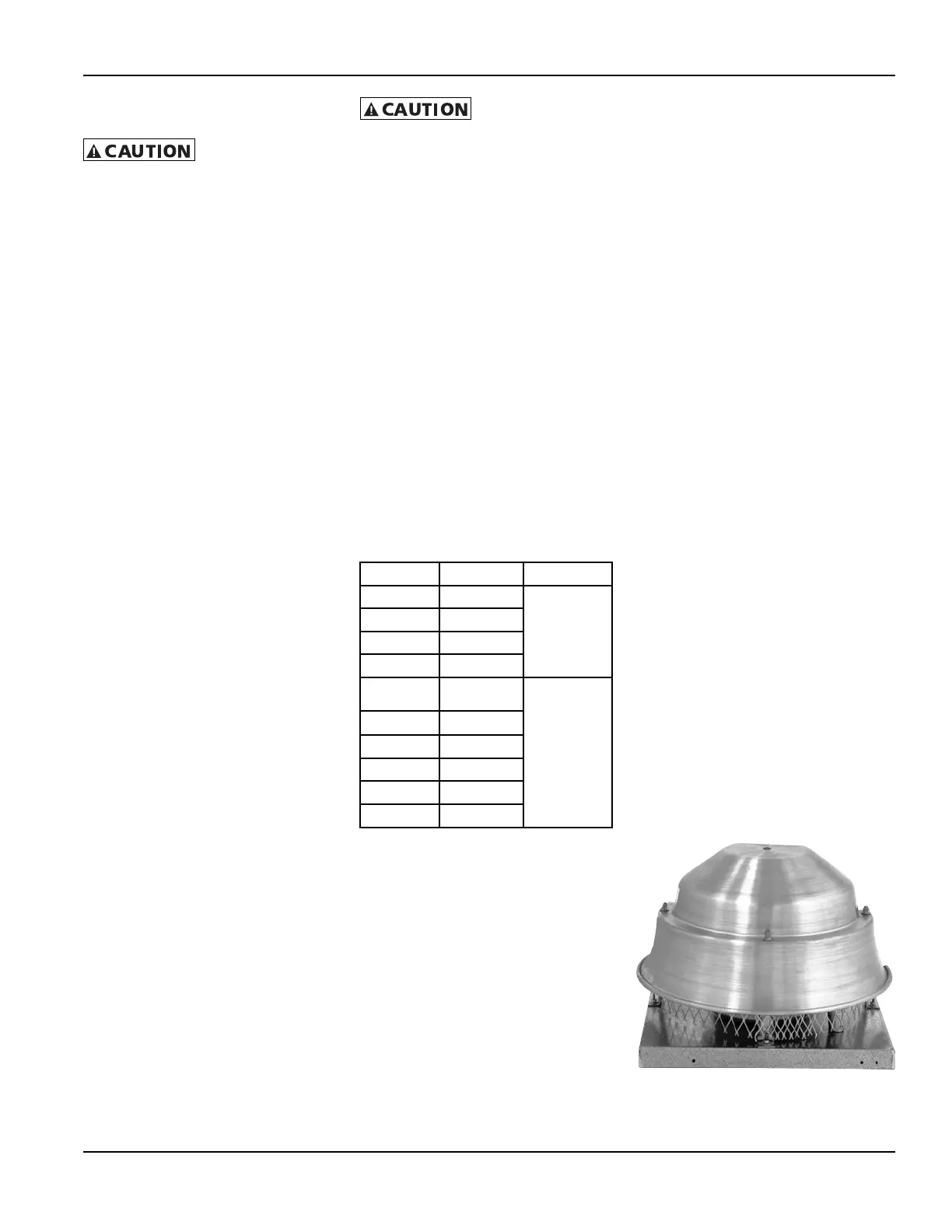
Domex, Centrifugal Roof, Direct & Belt Drive Exhausters
Manufacturer Product Temp. Range
BP LG-#P-1
Below 32° F
(0° C)
Gulf Gulfcrown EP-1
Imperial Oil Unirex EP-1
Shell Alvania R-1
BP
Energrease,
MPMK11
32° F to 150° F
(0° C to 66° C)
Gulf Gulfcrown EP-2
Imperial Oil Unirex EP-2
Shell Alvania R-3
Sun Oil Sun Prestige 42
Texaco Regal AFB2


 To Next Page
 Loading...