EasyManua.ls Logo

Pentax ME Super - Stopping the Action and Depth-of-Field Control

Pentax ME Super
51 pages
Print Icon
To Next Page IconTo Next Page
To Previous Page IconTo Previous Page
Loading...
a
wide
lens
aperture.
As
the
camera
automatically
chooses
the
fastest
possible
shutter
speed
for
the
given
exposure,
wide
apertures
will
give
you
shutter
speeds
in
excess
of
1/250
sec.
when
lighting
is
sufficient.
(NOTE:
This
technique
does
not
work
in
low-lighting
as
low
lighting
necessitates
a
slow
shutter
speed.)
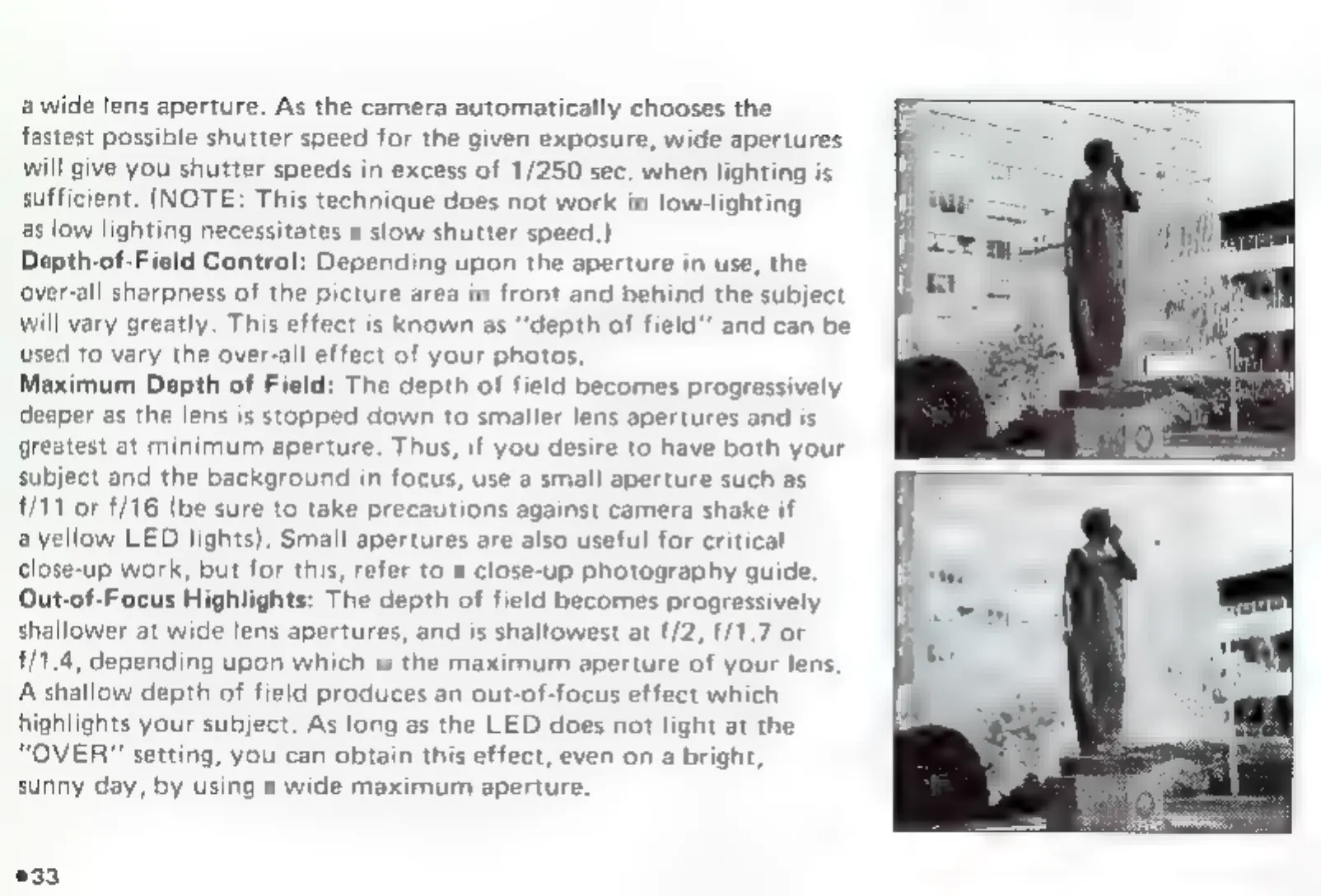
Depth-of-Field
Control:
Depending
upon
the
aperture
in
use,
the
over-all
sharpness
of
the
picture
area
in
front
and
behind
the
subject
will
vary
greatly.
This
effect
is
known
as
“depth
of
field”
and
сап
be
used
10
vary
the
over-all
effect
of
your
photos.
Maximum
Depth
of
Field:
The
depth
of
field
becomes
progressively
deeper
as
the
lens
is
stopped
down
to
smaller
lens
apertures
and
is
greatest
at
minimum
aperture.
Thus,
if
you
desire
to
have
both
your
subject
and
the
background
in
focus,
use
a
small
aperture
such
as
1/11
or
1/16
(be
sure
to
take
precautions
against
camera
shake
if
a
yellow
LED
lights).
Small
apertures
are
also
useful
for
critical
close-up
work,
but
for
this,
refer
to
a
close-up
photography
guide,
Out-of-Focus
Highlights:
The
depth
of
field
becomes
progressively
shallower
at
wide
lens
apertures,
and
is
shallowest
at
1/2,
f/1.7
or
1/1.4,
depending
upon
which
is
the
maximum
aperture
of
your
lens.
A
shallow
depth
of
field
produces
an
out-of-focus
effect
which
highlights
your
subject.
As
long
as
the
LED
does
not
light
at
the
"OVER"
setting,
you
can
obtain
this
effect,
even
on
a
bright,
sunny
day,
by
using
а
wide
maximum
aperture.
өзз

Other manuals for Pentax ME Super

Related product manuals