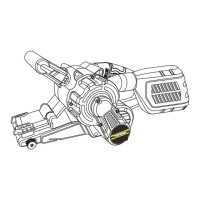
Fig. 5
Coarse Grit 60–80
Initial sanding on rougher surfaces.
For fast stock removal.
Rough sanding and stripping of painted and rusted surfaces.
Medium Grit 100–140
Intermediate sanding.
Removal of minor surface imperfections.
Fine Grit 150–220
Fine sanding.
Sanding prior to staining, priming, or sealing.
MAINTENANCE
WARNING: To ensure safety and reliability, all repairs should be per-
formed by a qualified service technician.
WARNING: For your safety, always turn off the switch and unplug the
reciprocating saw from the power source before performing any mainte-
nance or cleaning.
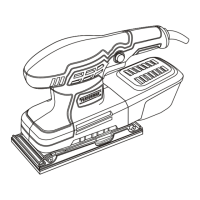
Periodic maintenance of your sander allows for long life and trouble-free
operation. The sander can generate considerable quantities of sanding residue.
A cleaning and maintenance schedule should be maintained.
As a common-sense and preventive maintenance practice, follow these
recommended steps:
Inspect the pad; Check it for wear or damage
.
Keep the ventilation slots of the motor clean to prevent overheating of the
motor.
Electric tools are subject to accelerated
wear
and
possible
premature
failure
when they
are
used
to
work
on
fiberglass,
wallboard,
spackling
compounds
or
plaster.
The
chips
and
grindings
from
these
materials
are
highly abrasive
to
electrical
tool
parts,
such
as
bearings,
brushes,
commutators,
etc. Consequently,
it
is
not
recommended
that
this
tool
be
used
for
extended
work
on
any fiberglass
material,
wallboard,
spackling
compound,
or
plaster.
During
any
use
on these
materials,
it
is
extremely
important
that
the
tool
is
cleaned
frequently
by blowing
with
an
air
jet.
Use a soft clean and damp cloth to wipe the tool housing. A mild detergent
can be used but nothing like alcohol, petrol or other cleaning agent. Never
use caustic agents to clean plastic parts.



 To Next Page