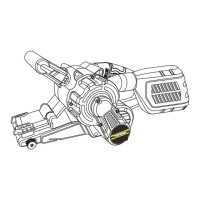
Unplug the sander before changing accessories. Accidental start-ups
may occur if sander is plugged in while changing an accessory.
Always wear safety goggles and dust mask when sanding, especially
when sanding overhead.
A suitable breathing respirator must be worn while sanding chemically
pressure treated objects.
Always wear ear protection
during extended periods of operation.
Whenever possible, use clamping devices
or other suitable means to
secure the workpiece to a firm surface.
Do not sand wet materials
(e.g., wallpaper) or moist surfaces. Penetration
of water into the machine increases the risk of an electric shock.
Do not use sandpaper larger than needed. Extra paper extending beyond
the sanding pad can also cause serious lacerations.
Use the dust bag and empty it frequently. Do not throw sanding dust on
an open fire, because materials in line particle form may be explosive.
Recommended size of extension cords
Amperage rating
of the tool (120 V
circuit only)
Total length of the extension cord
25’ (7.6 m) 50’ (15.2 m) 100’ (30.4 m) 150’ (45.7 m)
More
than
Not
more
than
Minimum Gauge for the extension cord (AWG)
0 6 18 16 16 14
6 8 18 16 14 12
WARNING: Some dust created by power sanding, sawing, grinding, drill-
ing, and other construction activities contains chemicals known to cause
cancer, birth defects or other reproductive harm. Some examples of these
chemicals are:
•Lead from lead-based paints,
•Crystalline silica from bricks and cementand other masonry products, and
•Arsenic and chromium from chemically-treated lumber.
Your risk from these exposures varies,depending on how often you do this type
of work. To reduce your exposure to these chemicals: work in a well ventilated
area, and work with approved safety equipment, such as those dust masks that
are specially designed to filter out microscopic particles.



 To Next Page