Quickly open the hopper as you come out of the turn
heading back in the opposite direction with the fertilizer
overlapping to the center of your last parallel pass.
Repeat this process throughout the rest of the lawn.
Method 2: Make a trim-pass and header-pass as in the previous
section. Then continue filling in the center making descending
spiral passes around the periphery ending in the center. This
method helps compensate for an unbalanced pattern distribution
because the right side pattern always overlaps the left side pattern.
Either method may be used simultaneously with the spray features
on the machine. When trim-spraying the edging pass use the
appropriate trim nozzle for the gear selected and spray as needed.
When Broadcast-spraying the center area use the appropriate
Broadcast nozzle for the gear selected and spray as need
Spreader Calibration
Adjustment of the spreader establishes the correct spread pattern.
The center discharge hole establishes the center of the pattern.
The right-hand discharge hole (as viewed from the Operator
position) establishes the spread pattern on the left-hand side. The
left-hand discharge hole establishes the spread pattern on the right
-hand side. Calibration establishes the correct application rate and
balances the spreader pattern.
Verify that the spreader discharge holes are closed.
If the spreader discharge holes are not completely closed, adjust
the length of the control cable running from the controls on the left
handlebar down the handle to the outer hopper control plate by
loosening and repositioning the locknuts.
If you did not purchase a calibration kit with your Triumph, obtain
the following materials:
Eleven collection pans, 3 to 4 INCHES (8 to 10 centimeters)
high and about 1 FOOT (0.3 meter) square (i.e., aluminum
roasting pans)
A clear graduated tube, 1/2-Inch (13 millimeter) internal
diameter, 3 to 4 INCHES (8 to 10 centimeters) tall (to act as a
graduated cylinder for measuring the collected fertilizer pellets)
Use a thin-tipped permanent marker to mark the tube at
QUARTER-INCH (6 millimeter) increments all the way up the
tube.
Clear, graduated ONE QUART (one liter) measuring cup
Stop watch or wristwatch.
This owner’s manual, and a pencil to record your collection
amounts.
Example Calibration procedure. IMPORTANT: The actual
settings for the fertilizer you are using will be different.
Establish the spreader Rate adjustment and calibration adjustment
for a fertilizer to be applied at the rate of 3 POUNDS / 1,000 ft
2
(1.36 Kg / 93 m
2
).
Spreader Operation 23
Place the spreader operating lever in the CLOSED position.
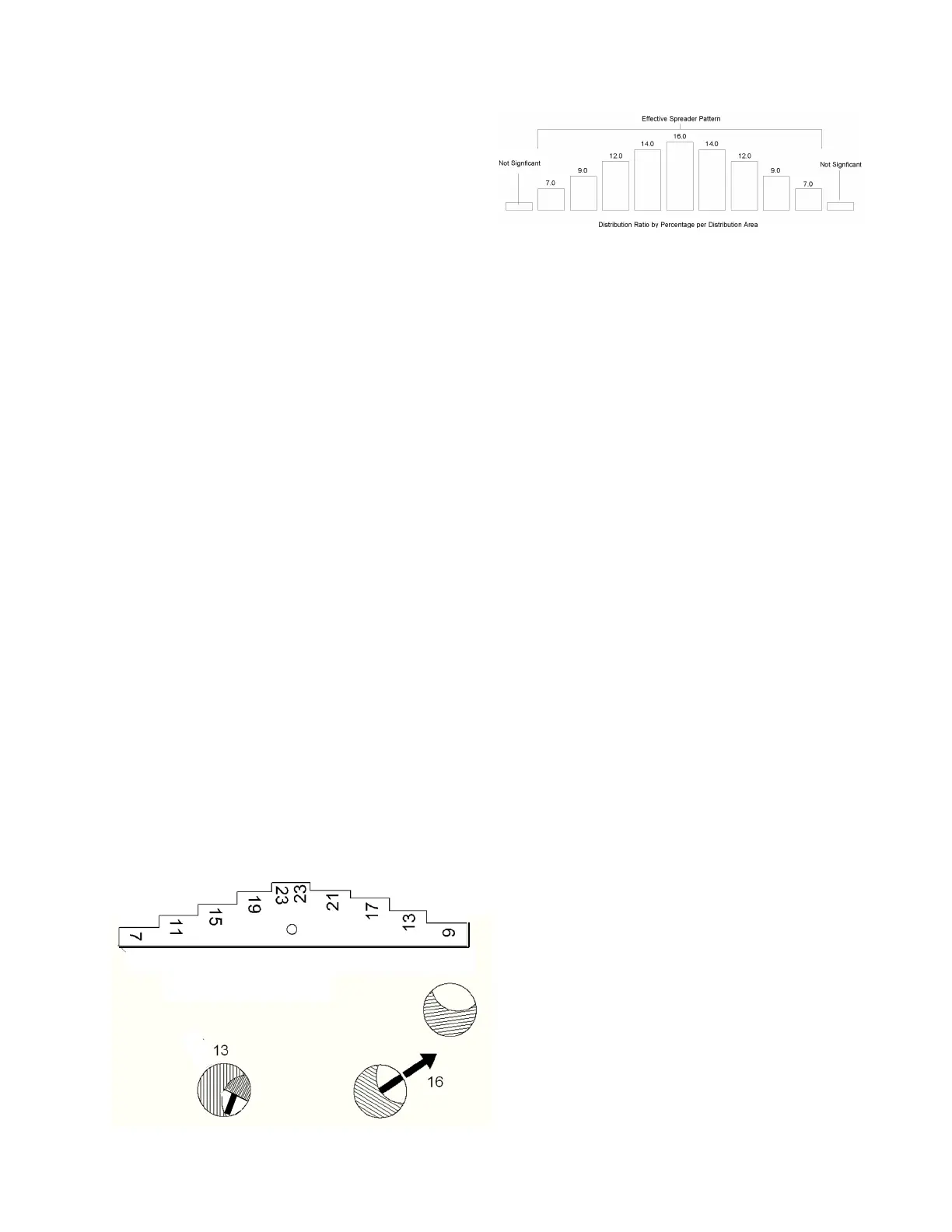
Open the Hopper and using the Calibration Gage (FIGURE 12)
provided with the machine as shown in FIGURE 13, set the
center hole opening to 16. Position the Rate Adjustment Knob
against the Hopper Lever and tighten the knob.
Close and open the Hopper several times and confirm hole
opening.
Adjust Third-hole setting.
Without changing the Rate Adjustment Knob setting, open
the Third-hole and insert the Calibration Gage, orientated as
shown in FIGURE 13, in the Third-hole.
Using the Third-hole Lever, position the Third-hole
Adjustment Plate against the Calibration Gage and position
the Memory-Lock until it pops into the Lever and locks its
position.
Remove the Calibration Gage.
Close and open the Third-hole several times and verify the
Third-hole setting is 13. Readjust as necessary.
Record both the Calibration Gage setting and the Memory-
Lock setting for future use. NOTE: The correct Calibration
Gage setting must be verified from time to time.
The Memory-Lock setting is adequate for reference in the
field, but it must be adjusted to the Calibration Gage during
the Daily machine Servicing.
Determine the effective spread width of the granular product:
Place 11 calibration pans in a line on two-foot centers on a
paved area such as a parking lot. NOTE: Checking the
effective spread pattern and adjusting the distribution
pattern requires multiple passes over the calibration pans.
This process is done on a paved area to avoid burning the
vegetation by over-fertilizing, and to allow the product to be
collected and reused.
With the material to be spread loaded in the spreader, make
at least three passes from the same direction over the pans
in a path perpendicular to the line of pans while spreading
material.
Pour the contents of the first pan on your far left into the
graduated cylinder or clear tube. Measure and record the
material deposited. Dump the collected pellets back into the
bag or hopper. Repeat this measurement for each pan, one
by one, until all eleven pans are emptied and recorded.
The distribution pattern should be balanced as in FIGURE
13A with a higher amount of product, collected in the
center pan and tapering off equally to both sides. NOTE:
The distribution pattern shown in FIGURE 13A represents
an ideal pattern, which will not be reproducible in the field.
The numbers are used for reference only.
To balance the distribution pattern for the right side, move
the lever as necessary to increase or decrease the opening
in the adjustment hole. Reset the memory lock.
Repeat the passes over the pans and measure the material
deposited in the pans. Readjust the openings as necessary
until the distribution pattern meets the requirements.
The effective spread width is the measured distance
between the left and right pans that contain 50% of the
volume of the center pan.
Record each opening setting for future recalibration.
Determine the Rate Adjustment Knob setting which delivers
the desired amount of fertilizer for the calibrated effective
spreader width (above) for both HIGH GEAR and LOW GEAR
speeds.
FIGURE 13A, Spread distribution
FIGURE 13, Spreader Setting
FIGURE 12, Calibration Gauge


 To Next Page
 Loading...