REGOLAZIONE TENSIONE
CINGHIE DI TRASMISSIONE
Questa regolazione va eseguita con motore
spento e presa di forza disinserita.
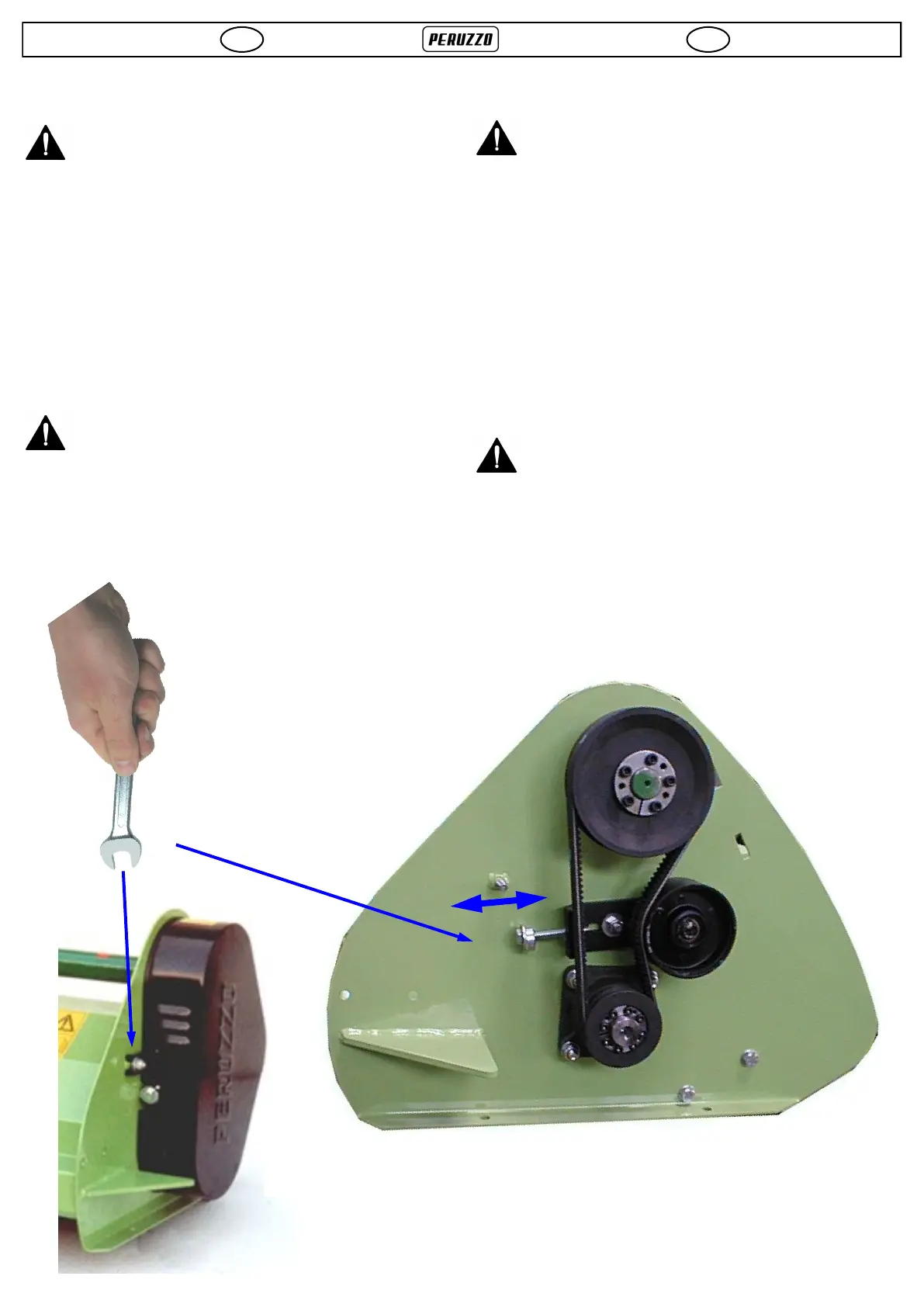
Togliere il carter di protezione cinghie.Fig. 15
Il corretto tensionamento delle cinghie è dato dal giusto
carico ottenuto dal dado del tirante del galoppino ( vedi
fig. 15 A ), fino a dare una corretta tensione alle
cinghie. La cinghia deve flettere, non più di mezzo
centimetro.
Controllare mediante una sbarra che le pulegge siano
allineate onde evitare surriscaldamento delle cinghie.
( Vedi Fig. 15 B ).
Rimontare accuratamente il carter di protezione.
SOSTITUZIONE CINGHIE
Questa operazione va eseguita con motore
spento e presa di forza disinserita.
Togliere il carter di protezione delle stesse.
Scaricare la tensione delle cinghie come sopra
descritto. ( Vedi Fig. 15 A ) Sostituire le cinghie e
regolare la tensione come sopra descritto. Rimontare
accuratamente il carter di protezione.
STRETCHING ADJUSTMENT OF THE DRIVING
BELTS
This operation must be effected with power-off
engine and P.T.O. disconnected.
Take the belt guard off. (fig. 15 )
The right belt tightening is due acting to the nut in fig.
15 A adjust the tightening, up to the right stretching.
The belt must bent itself up to 5 mm by pressing it with
your finger.
Check with proper bar that the two driving pulleys must
be aligned in order to prevent their overheating or
breakage (fig. 15 B).
Replace belts protecting guard in the proper way.
REPLACEMENT OF BELTS
This operation must be effected with power-off
engine and P.T.O. disconnected.
Take the belts protecting guard off.
Unload the spring by acting on the nuts.
( See Fig. 15 A )
Replace the belts and adjust their stretching as above
explained.
Replace belts protecting guard in the proper way.
Fig. 15
I GB
40
Fig. 15 A



 To Next Page
 Loading...