52
p
arked cars), where you can concentrate fully on fa-
m
iliarising yourself with the new vehicle.
2.17.4 Starting and the rst meters
First things rst: Driving a ScooterTrike is a relaxing
activity - and you should be seated accordingly. Lean
back - the back rest will support your upper body
weight. Don’t cramp your grip around the handlebars
of your ScooterTrike. Simply rest your hands lightly on it.
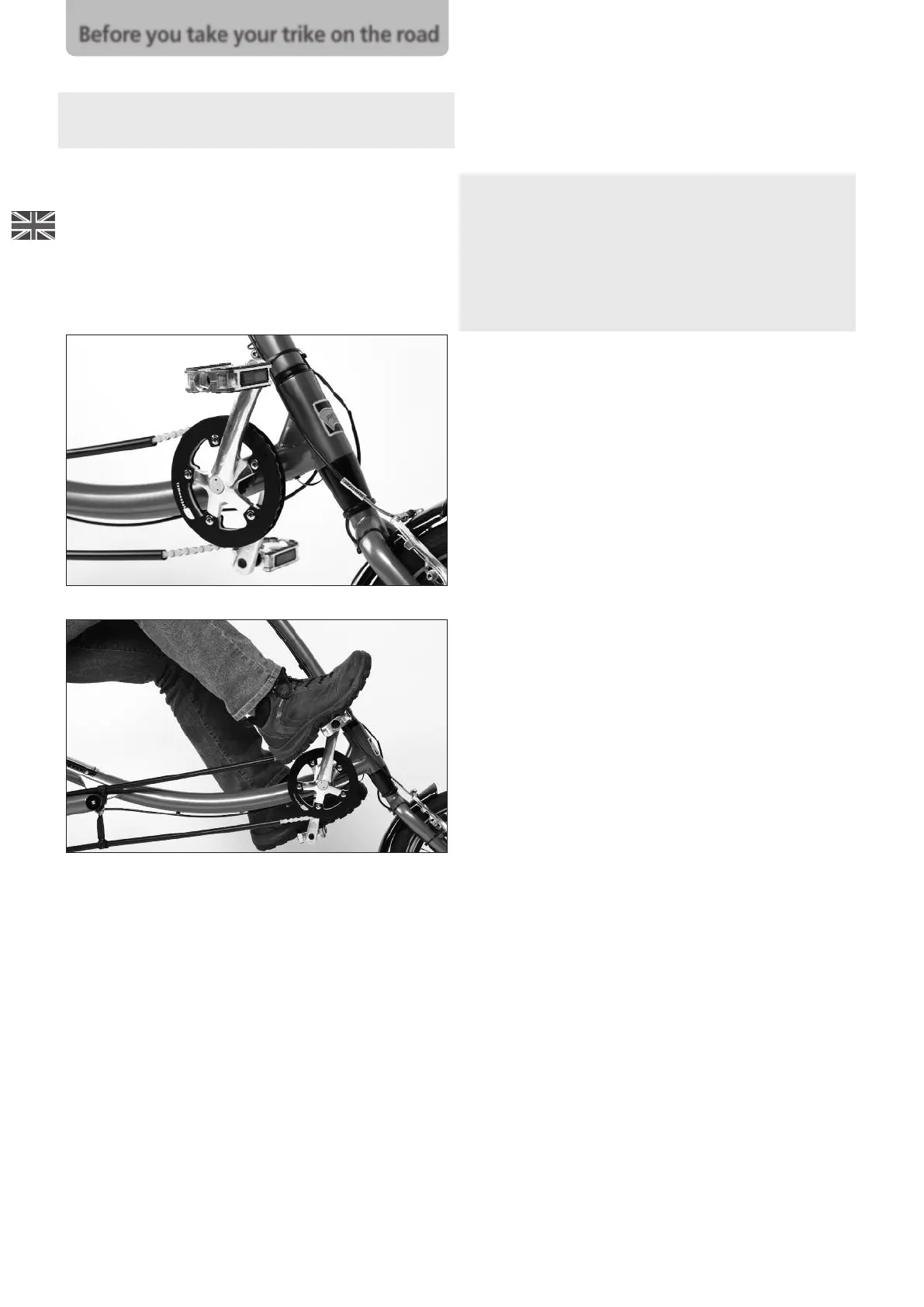
To start, position the right pedal (for left-handed
people possibly the left pedal) in its top-back position
(one o’clock position) (Fig. 17/18). Place both feet on
the pedals. Don’t worry - it might feel a bit strange at
rst, but you cannot tip over, because the three
wheels offer secure stability. Once you
have positioned
yourself comfortably, push forwardon the top pedal to
get going and use your other leg to
start accelerating.
2.17.5 Reversing option
Caution: The ScooterTrike is equipped with an integrated
reversing option. This may be particularly helpful
when you have manoevered yourself into a position,
where turning would be very difcult (e.g. in a dead end).
Activating reverse drive:
bring the ScooterTrike to a complete standstill. Now
s
imply pedal backwards, as if you wanted to brake.
T
he ScooterTrike will now travel backwards and will
thus allow you to move into the desired direction.
Note:
Keep a watchful eye on your surroundings and trafc
while reversing! Never exceed walking speed while
reversing so that you can stop immediately. The re-
versing mode is not designed for prolonged use, instead,
it should only be used as a manoevering aid for short
distances and not for sustained travel!
In severe steering angles (tight curves) at low speeds,
handlebars and knees could come into contact
with each other (depending on body size). Familiarise
yourself with this kind of condition so that you are
prepared if the situation arises and are not taken by
surprise!
2.17.6 Troubleshooting
With just a few trial runs under your belt, you should
be able to use your ScooterTrike without any hitches.
It is quite normal during the initial familiarisation
phase to feel some muscle ache, particularly in your
thighs. Depending on your driving habits and seat
position, your knee joint could also be affected -
because of too much pressure transfer between the
back rest and pedals. Knees are not designed to take
much pressure. It will help in this case to change into
a higher gear for lighter, rounder pedaling movements
with moderate pressure on the pedals.
Changing the distance between seat and pedals may
also help, as the knee joint is forced into adverse
movement if that distance is set either to short or too
long. Try various different seat setting until you nd
a position in which you can drive your ScooterTrike
over extended periods of time without any physical
discomfort.
2.18 Special instructions/
Characteristics Tandems
2.18.1 Steering system/ Steering position
All our tandems are delivered with rear steering as
standard. That means that the pilot is seated at
the back and takes charge of all driving decisions,
like steering, gear change and braking (unlike in
traditional tandems, where all these tasks are per-
formed in the front position). If you wish, a parallel
steering option can also be activated. That will,
however, require the front handlebars to be mounted in
a standard handlebar upright, which has to be mounted
properly in the frontal steering pipe (see Fig. 19).
Fig. 17
Fig. 18
Before you take your trike on the road



 To Next Page