Page 4
© 2014 PG LifeLink, Inc. - All rights reserved
PG L
IFELINK Mark V Line Isolation Monitor Instruction Manual Rev. 2.0
1. Introduction
Isolated Power Systems (IPS) protect patients and attending personnel from certain
electric shock hazards caused by common ground faults, without disconnecting
power to critical electro-medical equipment. These specialized power safety
systems are intended for use in patient care areas of health care facilities, and are
designed to impede the circulation of hazardous fault currents resulting from
damaged electrical insulation, or the presence of conductive materials such as
uids near energized conductors. IPSs are especially suited to protecting critical
loads because, unlike GFCI or RCD protection devices, the presence of a single line-
to-ground fault will not “trip” a circuit, thus preventing loss of power to critical
equipment.
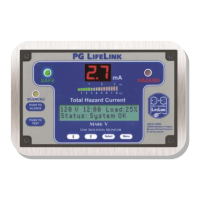
The PG LifeLink Mark V Line Isolation Monitor (LIM) is designed to continuously
monitor the operation of an Isolated Power System, and alert personnel in the
event that a line-to-ground fault is detected, or that the safety system has otherwise
been compromised. The Mark V employs a unique monitoring technique to
simultaneously analyze the line-to-ground impedance of both output legs of an IPS.
It divides the line voltage by the lower of the two ground impedance
measurements to calculate and display the system’s Total Hazard Current (THC).
THC is the predicted maximum current that could ow from any energized
conductor of an IPS through any unintended path to ground (rst-fault) in the
event of a worst-case direct short to ground (second-fault) on the opposite leg. If
the system’s THC exceeds a predetermined level, a “Hazard” alarm is activated,
indicating that a rst-fault condition has occurred and corrective action is required
to identify and remove the source of the fault. Note that IPS are designed to
maintain very high ground impedance on both energized conductors, thereby
restricting the ow of actual fault current to very low levels even under a rst-fault
condition. Therefore, critical power is maintained and medical procedures can be
safely completed without endangering patients or staff.
A complete discussion of the details of isolated power systems, their operation, and
their installation requirements is beyond the scope of this document. Additional
information can be found under the Technical Resources section of our website
http://www.pglifelink.com. Technical assistance is also available by calling +1 800-
287-4123 or via email at techsupport@pglifelink.com.
For design, installation, and testing requirements specic to your region, consult
your national and local Codes.
United States – National Fire Protection Association publications:
NFPA 70 -
National Electrical Code (Article 517)
; and
NFPA 99 - Health Care Facilities Code
Canada –
CSA C22.1—Canadian Electrical Code, Part 1
; and
CSA Z32 - Electrical
safety and essential electrical systems in health care facilities
Mexico – Mexico Ofcial Norm NOM-SEDES-2012; and NOM-197-SSA1-2000.


 To Next Page
 Loading...