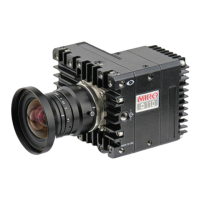
Vision Research, Inc. | Phantom Ultrahigh-Speed Camera Manual
Tell me more about the GPS port on the back of the camera.
The GPS port on the Phantom UHS-12 and UHS-40 cameras can be used to provide
date, time and location information from the GPS satellite network. Vision Research
sells a compatible GPS receiver (VRI-GPS-18X-LVC-5M). With the GPS receiver
connected to the camera, assuming it has a valid satellite fix, GPS timing can be used
similarly to IRIG timing. You can synchronize the camera’s internal clock to the GPS,
timestamp frames with GPS timing accuracy, and even save the camera’s latitude and
longitude with any Cine file. (Location error is < 3 meters after a satellite fix.)
The GPS connection supplies 5 volts at 0.2 A maximum and an RS-232 connection to
a GPS device.
1 PPS pulse is used for timing in the camera.
Communication with the device is at 4800 baud over the NEMA 0183 standard protocol,
which is very common.
The GPS position is recorded in the Cine header file.
Connection diagram is available.
I see there are two power input ports. One is the Primary
DC Power and the other is the Battery Backup. How do
these work?
The primary input is where you plug the 280W A/C power supply provided with the
camera. This is your primary source of power for the camera. You can optionally
connect a backup source of power, often a battery, to the backup battery power input.
If the camera power switch is set to AUTO, and if there is a loss of power on the
primary input even momentarily, the backup power will immediately take over—
providing uninterrupted power to the camera. This is important to protect any images
stored in the camera’s high-speed memory from accidental loss.
Connecting power to the battery backup port will not turn on the camera. (See FAQ
about the AUTO/ON/OFF switch.) There is no drain from the connected battery unless
a loss of primary power causes the power input to switch to the battery backup.
The battery backup port will not charge a connected battery.
In case of primary power loss, the backup battery port will not only protect images
saved in memory, but can provide sufficient power to power all camera operations
until the input voltage drops below the minimum required, ~18VDC.
If primary power is restored, that again becomes the power source for the camera
and the battery port reverts to backup mode.


 To Next Page
 Loading...