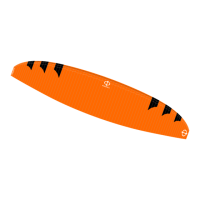
Frontal collapse
The front collapse, oen misunderstood as a "front stall", is also a consequence of turbulence. In contrast to the asymmetric side
collapse, the entire leading edge folds down.
The ALLEGRO opens aer the frontal collapse, as well as the side collapse independently.
To speed up the reopening, we recommend slight double-sided braking.
Stall manoeuvres
Spin
A wing rotates negatively when the airflow detaches on one half of the wing. The canopy turns around the vertical axis with the
center of rotation within the span. The inner wing flies backwards.
There are two causes for spinning:
- a brake line is pulled too far and too fast (for example, when starting a spiral dive)
- one side is slowed down too much in slow flight (for example during thermal flying)
If an accidentally initiated negative spin is immediately corrected, the ALLEGRO goes back to normal flight without any major loss
of altitude. The brake that has been pulled too far should be released until the airflow on the inner wing attaches again.
Attention!
Aer a longer negative spin, the paraglider may shoot on one side. This can result in an impulsive collapse or a cravate.
Fullstall
The Fullstall is a complex maneuver whose correct technique can not be fully explained in this manual. Those who want to learn
this maneuver should do so under the supervision of a pilot who masters this maneuver perfectly - the best way is to learn during
safety training.
The available brake travel down to the stall point depends on the wing size or loading! In turbulent air, the stall can occur much
earlier or significantly later. Those who want to use the full brake travel, must train many full stalls and get a feeling for the
partially or fully developed stall.
Parachutal stall
The parachutal stall is a flight condition without forward speed and with a significantly higher sink rate. The parachutal stall can
be initiated by the pilot by strong symmetrical braking and is effectively the precursor to a full stall.
The ALLEGRO automatically exits the parachutal stall by fully releasing the brakes.
A very heavily used wing with a porous cloth and / or with an incorrect correct trim setting (for example, as a result of many winch
starts or deep spirals) can stay in a stable parachutal stall. This can happen, e.g. when the B-stall is released slowly, or aer a large
frontal collapse.
In addition, the tendency to a parachutal stall is higher with a wet glider or by flying in the rain or in very cold air.
In the case of a stable parachutal stall you should push the A-risers forward or pull them down, or - even better - push the
accelerator. Aer a slight pendulum movement, the glider returns to normal flight.
In the case of a parachutal stall close to the ground the pilot has to decide whether the altitude is high enough for a pendulum
movement or it is better to prepare himself for a hard landing.
Attention!
When the wing is in a parachutal stall, additional brake input may result in a fullstall!
Cravates
Aer a big collapse or aer a badly executed full stall, a part of the wing might be tangled up in the lines, and wonʼt reopen
automatically. This is what you call a cravate. During our extensive test flights with the ALLEGRO we never experienced a cravate
but this situation can not be eliminated with any paraglider.



 To Next Page