
 Need help?
Do you have a question about the Philips 8505 Series and is the answer not in the manual?
Describes the new Home launcher, channels, and accessing settings.
Explains how to find and manage apps and the Philips TV Collection.
Instructions to read safety information before using the TV.
Instructions for mounting the TV stand and wall mounting.
Advice on optimal TV placement for viewing and Ambilight.
Guidance on connecting and handling the power cable.
Instructions for connecting the satellite dish.
Identifies keys on the remote control and their functions.
Step-by-step guide for pairing the remote control with the TV.
Explains how to use voice search with the remote.
Instructions for replacing the remote control batteries.
How to switch the TV on, off, or to standby mode.
Basic TV operations using the TV's physical keys.
Guides on installing TV channels and antenna/cable setup.
Explains channel lists, icons, radio stations, and searching channels.
How to sort and filter channel lists.
Covers switching channels, locking/unlocking, and parental rating.
How to access channel-specific options like subtitles.
Setting preferred subtitle languages and selecting others.
Setting preferred audio languages and selecting others.
Using Picture-in-Picture mode to view content in a corner.
Creating, editing, and reordering favourite channel lists.
Accessing and navigating Teletext pages.
Using interactive TV features like HbbTV and MHEG.
Information on using iTV pages and navigating them.
Guide to installing satellite channels, including Unicable systems.
How to adjust satellite installation settings for optimal reception.
Using CAM modules for descrambling satellite channels.
Setting up Unicable systems for satellite connection.
Adding additional satellites to the existing installation.
Troubleshooting common satellite installation issues.
Expert guide for manually installing transponders and channels.
Automatic and manual channel updates for antenna/cable.
Performing a full TV installation and resetting all settings.
Configuring DVB-T/C reception, channel number conflicts, and frequency modes.
Checking and improving digital channel reception quality.
Manually installing analogue channels and setting up the TV system.
Steps to copy a channel list to a USB drive.
Uploading a channel list to a TV.
General guide to connecting devices with quality cables.
Information on HDMI ports, quality, HDCP, and ARC.
Using EasyLink for HDMI CEC device control.
Using CAM modules and smart cards for conditional access.
Connecting HTS via HDMI ARC or optical cable.
Connecting smartphones/tablets via Philips TV Remote App.
Pairing, selecting, and removing Bluetooth devices.
Connecting headphones and adjusting volume.
Connecting and formatting USB hard drives for apps.
Connecting and configuring a USB keyboard for text input.
Viewing photos/videos from USB flash drives.
Connecting camcorders via HDMI for playback.
Connecting a computer to use the TV as a monitor.
Connecting the TV to a network via Wi-Fi or Ethernet.
Steps for connecting the TV wirelessly to a network.
Requirements for connecting the TV via a wired network.
Steps for establishing a wired network connection.
Viewing network settings and configuring static IP.
Instructions for signing into a Google Account on the TV.
Accessing and configuring Android TV settings.
Overview of the Android TV Home screen and its features.
Accessing and installing featured apps.
Configuring privacy settings for TV Collection apps.
Agreeing to terms of use for Philips TV Collection apps.
Overview of apps, installation sources, and requirements.
Using Google Play for Movies & TV, Music, and Games.
Downloading and installing apps from the Google Play Store.
Locking apps based on age rating or setting up restricted profiles.
Setting up and using a restricted profile for the Home menu.
Managing installed apps, stopping them, or clearing cache.
Checking TV memory usage and available storage.
Using a USB hard drive to extend storage for apps.
Instructions to start and use the TV's internet browser.
Exploring internet browser options like tabs and bookmarks.
Using the Quick Menu for fast access to TV functions.
Switching between connected devices and sources.
Setting options for specific TV inputs.
Changing device names and types in the Sources menu.
Rescanning connections to update the Sources menu.
Information on connecting the TV to a network.
Pairing, selecting, and removing Bluetooth devices.
Adjusting picture settings, styles, colour, contrast, sharpness, and brightness.
Selecting and customizing picture styles for optimal viewing.
Adjusting basic picture parameters.
Advanced picture adjustments for colour, tint, and whitepoint.
Detailed colour adjustments like enhancement and temperature.
Adjusting contrast modes, dynamic contrast, and video contrast.
Information on HDR support and upscaling features.
Reducing noise and MPEG artefacts in the picture.
Adjusting motion styles and natural motion for smoother video.
Adjusting picture aspect ratio to fit the screen.
Adjusting sound styles, personal modes, and headphone volume.
Selecting preset sound styles like Movie, Music, or Game.
Advanced sound settings including speaker virtualizer and clear dialogue.
Connecting compatible speakers for wireless audio streaming.
Adjusting volume control, delta volume, and audio output settings.
Setting digital audio format and levelling.
Turning Ambilight on/off and selecting styles.
Choosing Ambilight styles like Follow Video, Lounge Light, or Follow Audio.
Adjusting energy saving modes and timers.
USB keyboard setup and location settings.
Connecting and operating HDMI CEC devices.
Adjusting HDMI Ultra HD settings for compatibility.
Automatically setting picture style to Game mode.
Setting clock, region, and language preferences.
Changing TV menu and message languages.
Setting preferred audio languages for digital channels.
Setting preferred subtitle languages for digital channels.
Viewing installed apps and managing storage.
Settings for deaf, hard of hearing, blind, or visually impaired users.
Enabling adapted audio and subtitles for hearing impaired.
Using audio description and mixed volume features.
Setting child lock PIN, locking programs, and apps.
Viewing media files from a computer or NAS.
Adding folders or files to the favourites menu.
Viewing most popular and last played media files.
Viewing media files from a USB flash drive or hard drive.
Playing video files from USB or favourite lists.
Viewing photos from USB, adding to favourites, or creating slideshows.
Viewing and interacting with 360-degree photos.
Playing music files from USB or favourite lists.
Information on viewing TV Guide and its data sources.
Opening the TV Guide, tuning to programs, and setting reminders.
Using the Philips TV Remote App for control and media sharing.
Casting apps to the TV using Google Cast.
Requirements for playing games from apps or consoles.
Connecting and using wireless gamepads.
Starting games from a connected game console.
Choosing Ambilight styles like Follow Video, Lounge Light, or Follow Audio.
Turning Ambilight functionality off.
Switching on Ambilight in standby for room lighting.
Setting up Sunrise alarm with Ambilight, music, and weather.
Using Ambisleep to simulate sunset and auto-standby.
Extending Ambilight with Hue bulbs and wireless home speakers.
Configuring Ambilight+Hue for Philips Hue bulbs.
Setting up Ambilight with wireless home speakers.
Understanding Top Picks recommendations and terms of use.
Finding popular programs currently airing or starting soon.
Watching missed or favorite programs via TV on Demand.
Renting movies from an online video store.
Accessing and using the Netflix app.
Explaining Alexa voice control capabilities and setup.
Step-by-step guide to setting up and using Alexa.
Updating TV software via internet or USB.
How to check the current TV software version.
Enabling automatic software updates for the TV.
Information about open-source software used in the TV.
Information on the European Energy Label and consumption.
Proper disposal of old products and batteries.
Power specifications and saving features of the TV.
Details on aerial input, tuner bands, and satellite reception.
Screen size and resolution specifications.
Supported video and computer input resolutions.
List of TV connectivity ports and interfaces.
Physical dimensions and weight of different TV models.
Sound specifications, including output power and Dolby features.
Supported multimedia formats, codecs, and server software.
Benefits of registering your TV and accessing support.
How to access on-screen help and user manuals.
Solutions for common TV problems like power and remote control issues.
Troubleshooting picture and sound issues.
Troubleshooting HDMI and USB connection problems.
Troubleshooting network and internet connection issues.
How to change the menu language back to the desired one.
Accessing online support and FAQs.
Contacting customer support and finding service information.
Important safety instructions to prevent injury or damage.
Precautions to avoid electric shock or fire hazards.
Safety measures for handling and mounting the TV.
Warnings about TV stability and securing it properly.
Hazards associated with battery disposal and handling.
Instructions for cleaning the TV screen safely.
How to clean and maintain leather surfaces.
General terms of use for the TV product.
Terms of use, privacy policy, and settings for Smart TV.
Terms of use for Philips TV Collection apps.
Trademark information for HDMI.
Trademark information for Dolby Audio.
Trademark information for Dolby Vision and Atmos.
Trademark information for DTS-HD.
Trademark information for DTS Play-Fi.
Trademark information for Wi-Fi Alliance.
Trademark information for Kensington security devices.
General information on other trademarks.
Disclaimer for third-party services and software.
 General
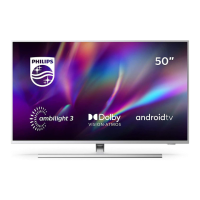
| Display Type | LED |
|---|---|
| Resolution | 4K UHD (3840 x 2160) |
| Smart TV | Android TV |
| Ambilight | 3-sided |
| Connectivity | Wi-Fi, Ethernet, Bluetooth |
| Sound Technology | Dolby Atmos |
| HDMI Ports | 4 |
| USB Ports | 2 |
| Sound Output | 20W |
| Refresh Rate | 60 Hz |
| HDR | HDR10+, Dolby Vision |
| Voice Assistant | Google Assistant |
| Screen Size | 50", 58", 65" |



 To Next Page
